
Vitamin C Capsules: What the Authorised UK Health Claims Actually Say
Contents
1 - Introduction
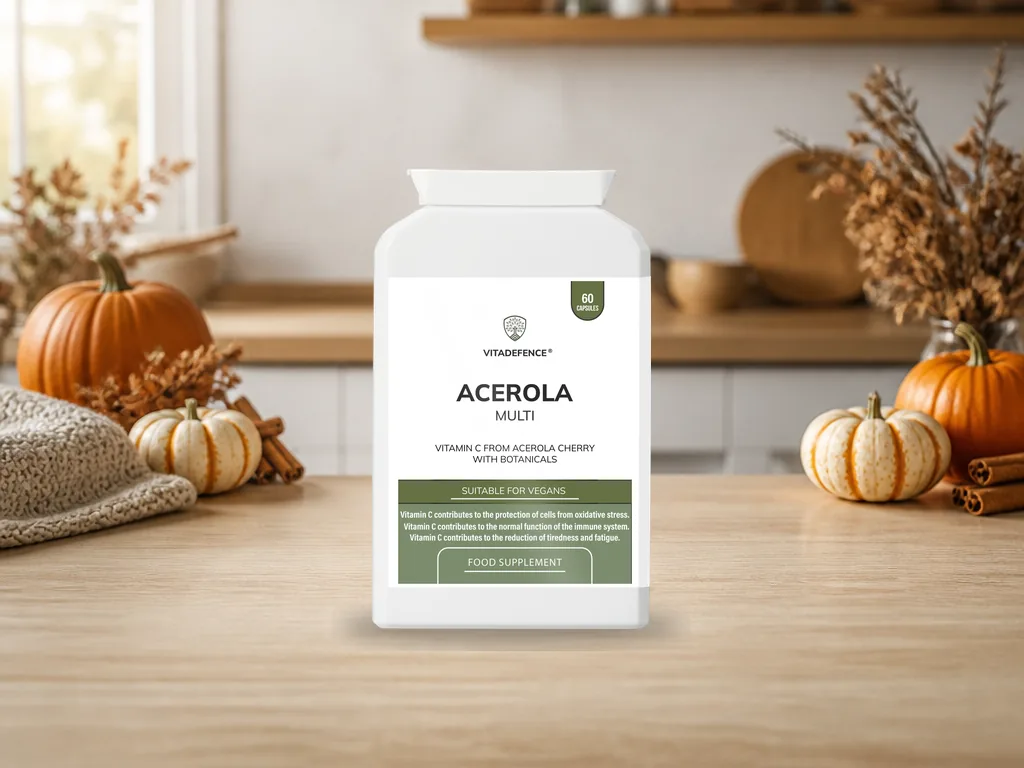
When it comes to getting enough vitamin C, whole-food sources often provide more than just the nutrient alone. Our Vitamin C Capsules provide 125 mg vitamin C (156% NRV) from acerola cherry extract, with blackberry, rosehip, parsley leaf and elderberry. This formula is designed for those who prefer a food-based approach to supplementation, without synthetic ascorbic acid, and with the convenience of a simple capsule.
 Vitamin C CapsulesFood-Based Acerola Vitamin C · 60 Vegan Capsules£16.49View in the shop →
2 - What is vitamin C?
Vitamin C (ascorbic acid) is a water-soluble vitamin essential for the synthesis of collagen, the structural protein that supports skin, blood vessels, bones, and cartilage. It also contributes to normal energy-yielding metabolism, the normal function of the immune system, and the protection of cells from oxidative stress — all authorised health claims under the UK Nutrition and Health Claims Register. Because the human body cannot synthesise vitamin C, dietary intake or supplementation is essential.
The UK reference nutrient intake for adults is 40 mg a day.
3 - Vitamin C Capsules ingredients
Each capsule provides the following, as stated on the bottle:
- Vitamin C – 125 mg (156% NRV)
- Acerola Cherry** – 500 mg
- Blackberry** – 108 mg
- Rosehip** – 108 mg
- Parsley Leaf – 50 mg
- Elderberry** – 42 mg
** = Equivalent weight from extract
Other ingredients: Acerola Cherry Extract (Malphigia glabra) (25% Vitamin C), Capsule Shell: Hydroxypropyl Methylcellulose (HPMC), Stoneground Brown Rice Flour (Oryza Sativa), Parsley Leaf Powder (Petroselinum Crispum), Blackberry Extract (Rubus Fruticosus L.), Elderberry Extract (Sambucus Nigra L.), Rosehip Extract (Rosa Canina).
4 - How the formula was designed
Many vitamin C supplements on the market use synthetic ascorbic acid as the sole source. This product takes a different approach: the primary vitamin C source is acerola cherry extract standardised to 25% vitamin C, providing 125 mg per capsule. Acerola (Malpighia glabra) is a cherry naturally rich in vitamin C.
The formula also includes blackberry, rosehip, elderberry, and parsley leaf — each selected for their traditional use as sources of antioxidants and phytonutrients. While these ingredients contribute negligible amounts of vitamin C compared to the acerola, they add a spectrum of naturally occurring compounds such as anthocyanins (in blackberry and elderberry), quercetin (in rosehip and elderberry), and carotenoids (in parsley). The idea is to provide a more holistic, food-mimicking profile rather than a single, isolated nutrient.
The capsule uses HPMC (hydroxypropyl methylcellulose), a plant-based alternative to gelatin, making it suitable for vegetarians and vegans. Stoneground brown rice flour is used as a carrier, adding a small amount of whole-grain fibre and B vitamins, though the amounts are minimal.
5 - The science — what’s well-supported
The authorised health claims for vitamin C are clear and well-established. According to the UK Nutrition and Health Claims Register, vitamin C contributes to:
- Normal energy-yielding metabolism
- Normal function of the immune system
- Protection of cells from oxidative stress
- Reduction of tiredness and fatigue
- Normal collagen formation for the normal function of skin, blood vessels, bones, cartilage, gums, and teeth
- Increased iron absorption
- Normal psychological function
Vitamin C contributes to the normal function of the immune system.
Regarding the botanical components, the evidence is more limited. Acerola cherry extracts have been studied for their antioxidant capacity in vitro, but human trials are sparse. Blackberry and elderberry are berries; they have no authorised health claim. Parsley leaf is a source of vitamin K and flavonoids, but again, the amount here is modest.
Overall, the strongest evidence supports the vitamin C content. The botanical blend provides a traditional, food-based context, but should not be relied upon for specific therapeutic effects beyond what the vitamin C itself provides.
6 - How to take it
The dosage instructions state: Take 1 capsule, 1 to 3 times per day or as required.
For general maintenance, one capsule per day (125 mg vitamin C) meets and exceeds the UK RNI of 40 mg. Vitamin C contributes to maintain the normal function of the immune system during and after intense physical exercise (200 mg a day on top of the normal intake). Because vitamin C is water-soluble, excess is excreted in urine, but taking more than 1000 mg per day can cause digestive upset in some people. This product’s maximum dose of 375 mg is well below that threshold.
Capsules can be taken with or without food, though taking them with a meal may reduce any mild gastric irritation in sensitive individuals. If you take multiple capsules, space them throughout the day to maintain more consistent blood levels.
7 - Storage
Store in a cool, dry place, out of reach of children. Do not use if the seal is damaged. Best before date printed on the base. Avoid exposure to direct sunlight or heat, as vitamin C is sensitive to light and temperature. The HPMC capsule is less hygroscopic than gelatin, but still best kept away from moisture.
8 - Allergen and dietary information
This product is:
- Suitable for vegetarians and vegans
- Kosher approved
- Halal approved
- Suitable for vegetarians and vegans. Kosher approved. Halal approved.
The capsule shell is HPMC (plant-based) and the carrier is stoneground brown rice flour. No artificial preservatives, colours, or flavours are used.
9 - Who should be cautious
Vitamin C is generally safe at the doses provided. However, certain groups should take care:
- People with oxalate kidney stones: High-dose vitamin C (above 1000 mg daily) can increase oxalate excretion, but the doses here (max 375 mg) are unlikely to be problematic. If you have a history of stones, consult your doctor.
- Iron overload disorders (e.g., haemochromatosis): Vitamin C increases iron absorption. If you have iron overload, limit intake to the RNI (40 mg) or as advised by your doctor.
- G6PD deficiency: Very high doses of vitamin C (several grams) have been linked to haemolysis in susceptible individuals, but standard supplementation is considered safe.
- If you are pregnant or breastfeeding, speak to your midwife or doctor first.
- Medications: Vitamin C may interact with anticoagulants (e.g., warfarin) at high doses, but 125–375 mg is unlikely to have a significant effect.
If you have any medical condition or are taking prescription medication, consult a healthcare professional before starting supplementation.
10 - What pairs well with Vitamin C Capsules
Vitamin C works synergistically with several other nutrients. Consider combining with:
- Vitamin C Multi — 512 mg vitamin C per capsule with zinc and selenium; vitamin C and zinc contribute to the normal function of the immune system. Learn more in our Vitamin C Multi guide.
- Vitamin C increases iron absorption.
- B-complex vitamins — vitamin C and B vitamins both contribute to energy metabolism, making them a logical pairing for fatigue support.
- Zinc — often combined with vitamin C for immune health, though this product is standalone.
11 - Frequently asked questions
1. Is this vitamin C synthetic or natural?
The vitamin C in this product is derived from acerola cherry extract, a natural source. The extract is standardised to 25% vitamin C, so the 125 mg of vitamin C comes from 500 mg of acerola extract. However, during extraction and standardisation, some processing occurs. It is not “whole food” in the sense of consuming the whole cherry, but it is a concentrated natural extract rather than synthetic ascorbic acid.
2. Can I take this if I have a citrus allergy?
Yes. This product contains no citrus fruits. It is based on acerola (a tropical cherry), blackberry, elderberry, rosehip, and parsley — none of which are related to citrus. Always check with your doctor if you have specific allergies.
3. How does the 125 mg dose compare to other supplements?
Many vitamin C supplements provide 500–1000 mg per serving. This product uses a lower dose (125 mg per capsule) because it is food-based and designed for gentle, consistent intake. The maximum dose of 375 mg per day is still above the UK RNI and sufficient for most people’s needs. Higher doses are often excreted unchanged, so this moderate approach may be more efficient for tissue saturation.
4. Is it safe to take three capsules daily long-term?
Yes, 375 mg per day is well within the safe upper level of 1000 mg per day for adults. Long-term use at this dose is not associated with adverse effects in healthy individuals. As with any supplement, periodic breaks may be considered, but there is no evidence that this dose causes harm.
5. Can I open the capsule and mix the powder into food?
Yes, the capsule contents can be emptied into smoothies, yoghurt, or juice. The powder has a slightly tart, fruity taste due to the acerola and berry extracts. However, the capsule is designed to protect the ingredients from moisture and light, so opened powder should be used immediately and not stored.
6. Does this product contain added sugar?
No. The ingredients list shows no added sugars, syrups, or sweeteners. The natural extracts may contain trace amounts of fruit sugars, but these are negligible — less than 0.5 g per capsule. The product is suitable for low-sugar diets.
12 - Why Vitadefence
Vitadefence is a UK-based brand committed to plant-based, high-quality supplements. This product uses a plant-based HPMC capsule and contains no magnesium stearate. Our ingredients are sourced with traceability in mind, and we are registered with the Information Commissioner’s Office (ICO ZC106169) for data protection. You can read independent customer feedback on our reviews page.
We believe in evidence-led formulations, not hype. This product is designed to provide a reliable, food-based vitamin C source without over-dosing or relying on synthetic isolates. For more on our approach, see our shipping and quality information.
13 - Bottom line
The Vitadefence Vitamin C Capsules offer a moderate, food-sourced dose of vitamin C (125 mg per capsule) from acerola cherry, backed by a complementary blend of berry and herb extracts. The formula is vegan, allergen-friendly, and suitable for daily use. While the botanical components add traditional nutritional value, the primary benefit comes from the vitamin C itself, which is well-supported by authorised health claims. If you prefer a natural approach to vitamin C supplementation without synthetic ascorbic acid, this product is a solid choice. For a broader spectrum, consider pairing it with our Vitamin C Multi.
This article is for educational purposes only and does not constitute medical advice. The information provided is based on published scientific literature and authorised health claims as of the date of writing. Always consult a qualified healthcare professional before starting any new supplement, especially if you are pregnant, breastfeeding, have a medical condition, or are taking medication. Vitadefence products are food supplements and should not be used as a substitute for a varied, balanced diet and healthy lifestyle.