Showcase
Acai Berry Multi — a forest fruit, ten quiet partners, and one daily ritual
Deep in the Amazon, a slender palm bends over the river and drops a fruit so dark it looks almost black. The Tupi people called it açaí — the fruit that cries water. We built a capsule around it, and around nine other plants and nutrients that have earned their place in the human story.
If you've been feeling dimmer than you used to
Maybe you noticed it about a year ago. The light behind your eyes used to switch on by 8am. Now there's a lag. Your skin looks tired in the mirror, your hair feels less alive, your nails are softer than they should be. You're not ill. Your bloods are fine. You just feel less luminous than you remember being.
Most people put it down to age, or stress, or screens. But there's a third quiet variable: the modern shopping basket. The bright-coloured plants our grandparents ate by accident — dark berries from the hedge, deep red roots from the garden, bitter greens from the patch behind the kitchen — have largely been engineered out of the supermarket aisle. We eat enough calories. We don't always eat enough colour.
This little bottle is one quiet answer. Ten partners. One capsule. A way to put some of that lost colour back into your week.
The bottle, in your hand
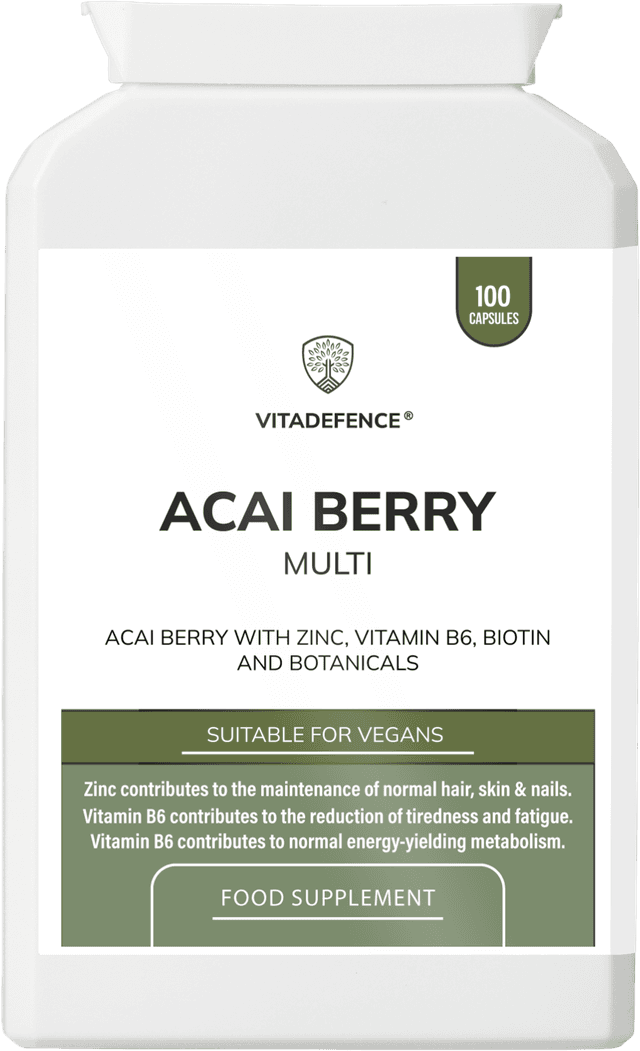
A clean cream pot, the green band of our label running around it like a forest line. One hundred vegan capsules inside. The dose is gentle — one capsule, one to three times a day, with water, with or without food. Nothing dramatic. The kind of thing you forget about for a few weeks and then catch yourself in the mirror and think: something's a little brighter.
That's how plants tend to work. Not with fireworks. With patience.
The story of acai
Açaí (say it ah-sigh-EE) is a fruit, but more than that, a way of life along the rivers of the Brazilian Amazon. The acai palm — Euterpe oleracea — is a slender thing, fifteen to thirty metres tall, growing in floodplain forests where freshwater meets the seasonal tides. The fruit hangs in dense panicles near the crown, almost black-purple when ripe.
The Tupi people, who have lived along these rivers for thousands of years, gave it its name. Ya-saí. The fruit that cries water. The pulp around the seed weeps a deep oily liquid that stains everything it touches.
For the riverine communities of Pará — the ribeirinhos and the indigenous peoples — acai isn't a superfood, it's lunch. Pulped with cassava flour, eaten with grilled fish. A working-class fuel, the colour of every kitchen wall in the river towns.
It travelled out of the Amazon in the 1990s when Rio surfers discovered the bowls. From Rio to California, then everywhere. By the time the world had learned to pronounce it, laboratories had also been quietly looking — and what they kept finding was an unusually high concentration of anthocyanins, the deep purple pigments that give acai (and blueberries, and elderberries, and red cabbage) their colour. Anthocyanins are polyphenols — the plant's own sunscreen against harsh equatorial sun. When we eat them, evidence suggests they may support our own internal balance against a wear-and-tear process called oxidative stress.
Of all the dark berries available to us, acai is one of the most pigment-dense. We use 1,000mg of extract — equivalent weight from concentrated fruit — in every capsule.
Beetroot — the deep red root from the kitchen garden
Long before beetroot was a sports-nutrition ingredient, it was Sunday lunch. The Romans cultivated it first for its leaves, then its root. By medieval Europe it was a monastery-garden staple — easy to grow, stores all winter, dyes everything it touches a colour somewhere between burgundy and oxblood.
What's special about beetroot is its dietary nitrate content. The body converts a portion of that nitrate, in stages, into nitric oxide — a small molecule that helps blood vessels relax and widen. That's why beetroot juice has become popular with cyclists and middle-distance runners.
We're not promising a faster 5K. We're saying the deep red colour is one of nature's signatures for a vegetable worth eating. We've concentrated 500mg of beetroot extract per capsule so you get a meaningful dose without having to roast a beet every day.
Pomegranate seed — the fruit of mythology
Pomegranate is older than memory. It appears in Egyptian tombs from 3000 BC. The Greeks built a goddess around it — Persephone, who ate six pomegranate seeds in the underworld and so was bound there for six months a year, giving us winter. The Hebrew Bible counts it among the seven species of the Promised Land. The Quran names it three times. In Persian gardens it was paradise itself.
The compound that has earned pomegranate its modern reputation is ellagic acid, concentrated in the seeds and the white pith — the bitter parts most people throw away. We use 200mg of pomegranate seed extract standardised to 4mg of ellagic acid per capsule. Ellagic acid belongs to the same wider polyphenol family as the anthocyanins from acai — both working in adjacent rooms of the same broad story: the gentle, daily defence of cells from the wear of being alive.
Moringa — the tree of life
In northern India, moringa is called the drumstick tree. In Senegal and Niger it is nebeday — never die. In the Philippines, malunggay. It grows fast, in poor soil, and almost every part of it is edible: leaves as a vegetable, pods as a bean, seeds crushed for oil, the residue used to clarify drinking water.
Moringa leaf is one of those quietly extraordinary green powders — a wide profile of vitamins and minerals in a single plant. In a culture where most of us eat the same six vegetables on rotation, 100mg of moringa per capsule is a small, steady donation toward dietary variety. A quiet co-pilot in this formula, not a hero.
Grape seed and resveratrol — what the wine drinkers were onto
In the 1990s, researchers tried to explain why French populations who eat plenty of butter and cheese didn't show the cardiovascular outcomes you'd expect. The hypothesis — debated, far from settled — was that something in the daily glass of red wine was doing useful work in the background. Two compounds came under the microscope: the proanthocyanidins in grape seeds, and a stilbene called resveratrol in the skins.
You don't need wine to get them. Grape seed extract delivers the seed compounds without the alcohol. And resveratrol is most efficiently extracted not from grapes at all, but from the root of Polygonum cuspidatum — Japanese knotweed — a plant regarded as a pest in the British countryside but valued for centuries in traditional Chinese and Japanese herbal practice.
Both sit in this formula at modest, supportive doses — 3.6mg of grape seed extract and 2.5mg of resveratrol. No wine-and-longevity promises. They belong to the same broad family of dark-pigment compounds we've built this bottle around, and have earned their place through centuries of human use.
Zinc, Vitamin B6 and Biotin — the three nutrients that the label can speak plainly about
Most of this article has been about plants and history. Three of the ingredients in this bottle can be spoken about with the precision of nutrition science, because they are essential nutrients with European Food Safety Authority authorised wording.
Zinc (1.5mg, 15% NRV) — contributes to the maintenance of normal hair, nails and skin, and to normal immune function. The first places a low zinc level usually shows up are the hair and the nails.
Vitamin B6 (0.21mg, 15% NRV) — contributes to normal red blood cell formation and to the reduction of tiredness and fatigue. Works in concert with the rest of the B-vitamin family.
Biotin (8μg, 16% NRV) — contributes to the maintenance of normal hair, skin and mucous membranes. The nutrient most associated with the hair, skin and nails category, for good reason.
These three are not the headline. They are the spine — a backbone of label-accurate nutrition behind the plant story.
A note on bamboo
One last ingredient worth a sentence — bamboo extract, a plant-derived source of silica, a trace mineral that is part of connective tissue. No claims under EFSA rules. It's here because of a long history of traditional use, and in a formula about looking and feeling a little more alive, it earns a quiet seat at the table.
The formula as a whole
Lay these ten ingredients on a table — acai, beetroot, pomegranate, moringa, grape seed, resveratrol, bamboo, zinc, B6, biotin — and what they share is colour and depth. Most are dark. Most are pigment-rich. Most are the kind of food humans ate when humans foraged.
We didn't pick ten things at random. We picked ten that work in adjacent rooms of the same house. Anthocyanins from acai. Betalains from beetroot. Ellagitannins from pomegranate. Proanthocyanidins from grape seed. Stilbenes from knotweed. The leaf-and-pod profile of moringa. And then the trace minerals and B-vitamins to keep the rest honest.
The thinking isn't more is more. It's variety is the missing piece. Eat one apple, you've eaten one set of compounds. Eat ten different plants in a week, you've fed an entirely different layer of your biology — the layer that doesn't show up in your blood work, but does show up, slowly, in your mirror.
How to use it
One capsule, one to three times a day, with water. Most people take one with breakfast and find that's plenty. The bottle holds a hundred capsules — at one a day it lasts about three months, at three a day a month.
Take it with food if your stomach is sensitive. Don't stack it on top of three other multivitamins or the zinc and B6 will overlap. And don't expect the kind of effect you get from a coffee. Plants of this kind work in the background. Most people who notice a difference notice it between week three and week eight — slightly better hair quality, slightly stronger nails, a little more brightness in the skin, the feeling of having put some colour back into your diet without having to plan it.
If after sixty days nothing has changed, stop. A supplement that isn't doing anything for you isn't worth the money, and we'd rather have your trust for the next thing than your guilt over the wrong thing.
Honest caveats
This is a food supplement — it complements a varied diet, doesn't replace one. If you are pregnant, breastfeeding, taking medication, or living with a medical condition, talk to your GP or pharmacist first. Keep it cool, dry, sealed, out of reach of children. Don't exceed three capsules a day. The acai berry doesn't grow in the UK — we source from established Amazonian harvest chains, and the rest of the formula is blended and encapsulated to UK GMP standards.
If you've read this far, thank you. We tried to write the kind of page we'd want to read before spending money — no neon promises, no overblown language. Just a fruit from a Brazilian river, nine companions, and a small daily ritual that may help you feel a little more like yourself.
— Vitadefence
— Vitadefence