Showcase
Vitamin C Capsules — a Caribbean cherry, four wild fruits, and the colour of immunity
On a sunny ridge in the Lesser Antilles, a small shrub bears a fruit that looks like a cherry and tastes like a sour orange. Locals call it acerola. We built a vitamin C capsule around it — and around four other small wild fruits that have fed European hedgerows and kitchens for centuries.
Key facts
- When the season turns and you start counting tissues again
- The bottle, in your hand
- The story of acerola
- Blackberry — the hedgerow gift
- Rosehip — the bright red fruit of the dog rose
When the season turns and you start counting tissues again
Most of us have a small private ritual around vitamin C. It begins in late October, when the first colleague at work starts coughing. We buy a tube of the orange tablets that fizz in water. By Christmas the tube is half full and we've forgotten about it. By February we've caught two colds anyway.
There's nothing wrong with the orange tablets. They contain vitamin C, the body uses it, and a bit of warm fizzy water on a cold morning is a kind of small comfort. But there's another way to think about vitamin C — not as a fire extinguisher you reach for when symptoms start, but as a daily background nutrient, taken in the form the body has met for hundreds of thousands of years: inside a fruit.
That's what this little bottle is. Five real fruits, milled and concentrated, with the vitamin C exactly where evolution put it.
The bottle, in your hand
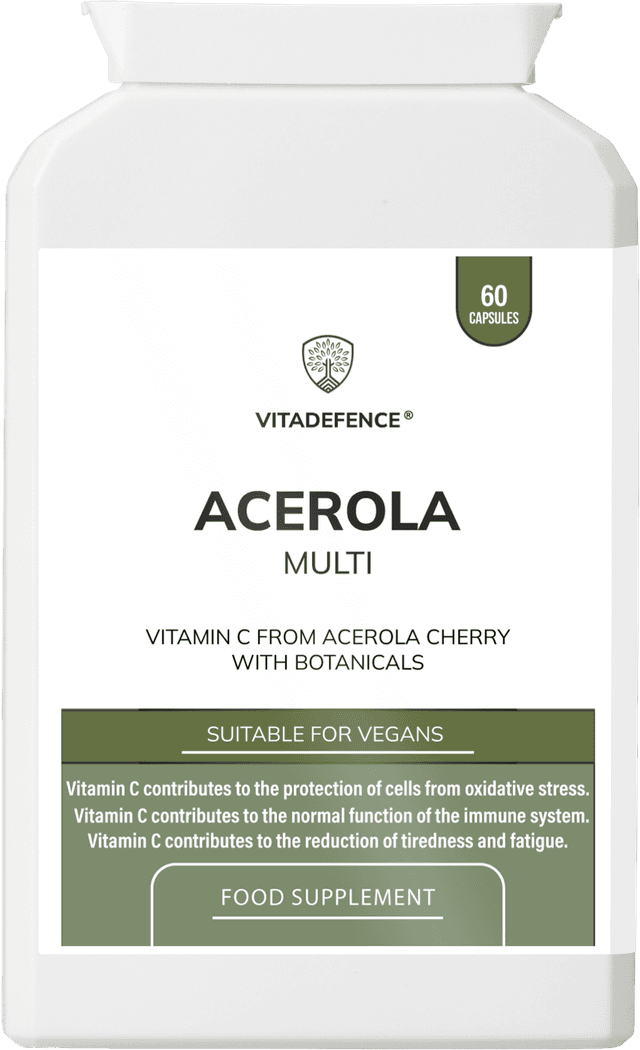
A clean cream pot, sixty vegan capsules, a soft red signature on the label. The dose is gentle — one capsule, one to three times a day, with water, with or without food. Each capsule delivers 125mg of vitamin C, which is 156% of the European reference intake. One a day is enough for most people. Two or three for the days you feel something coming.
A bottle lasts you two months at one a day, three weeks at three. Quiet, daily, the way most useful things are.
The story of acerola
Acerola — Malpighia glabra — is sometimes called the Barbados cherry, sometimes the West Indian cherry, sometimes simply cereza. It grows on a small evergreen shrub native to the Lesser Antilles, the Yucatán, and the dry tropical lowlands of South America. In autumn the branches fill with small bright red fruits, glossy and three-lobed, that look almost identical to the European cherry your grandmother stewed in summer. Bite into one and the resemblance ends. The flesh is sour, watery, faintly tannic, with a flavour somewhere between an underripe orange and a wild crab apple.
Sourness, in the language of plants, often means vitamin C. And acerola is, by the gram, one of the most concentrated natural sources of it on earth. A ripe acerola cherry can carry between 1,500 and 4,000 milligrams of vitamin C per 100 grams of fruit — anywhere from thirty to eighty times more than the orange you put in your child's lunchbox.
The Taino and Carib peoples, the original inhabitants of the islands, ate acerola straight from the tree and used the leaves and bark in their household herb traditions. When the Spanish arrived in the 16th century they noted the fruit but found it too sour to take seriously. It took until the 20th century for laboratories to confirm what the islanders had quietly known for a thousand years: that this small ridge-cherry was vitamin C in a fruit shape.
We use 500mg of acerola cherry extract per capsule, standardised to 25% vitamin C — meaning the bulk of your daily dose comes from a real fruit, not a test tube.
Blackberry — the hedgerow gift
Anyone who grew up in the British countryside knows the rhythm. The brambles flower white in May. By August they are dark purple jewels, and you walk home with stained fingers and a tin full. Blackberries — Rubus fruticosus — grow on every hedgerow, motorway verge, and abandoned allotment in these islands. They are the most democratic fruit we have. Free to anyone with sleeves and patience.
What's special about the blackberry is its density of dark pigments. The same anthocyanin compounds that give it the colour of port wine are useful pieces of plant biochemistry — they belong to the wider polyphenol family. The folk tradition wrapped that knowledge in story: blackberries were said to keep the household healthy through winter, and bramble jelly was made on every farm in the country until the supermarket killed the kitchen garden.
We use 108mg of blackberry extract per capsule. Not a lot in absolute terms — but the point is variety, not volume. Five different fruits feeding five slightly different rooms of your biology, instead of one big dose of the same thing.
Rosehip — the bright red fruit of the dog rose
Walk a hedgerow in October and you'll see them — small oval fruits the colour of fire engines, hanging on bare thorny stems where the wild dog rose flowered in June. These are rosehips. Free, abundant, and largely ignored.
There's a generation of British people who remember rosehip syrup. During the Second World War, when oranges and lemons disappeared from the shops, the Ministry of Health asked schoolchildren to gather rosehips from the hedges. A government scheme — quietly enormous — converted those rosehips into a syrup distributed free to babies and toddlers. It worked, because rosehips are exceptionally rich in vitamin C — more than oranges, by weight — alongside a unique galactolipid pigment that has earned modern scientific attention for its possible role in joint comfort.
We use 108mg of rosehip extract per capsule. It carries on a tradition this country interrupted somewhere between rationing and the supermarket. The wartime rosehip syrup grew up a generation. We thought it was worth bringing back, in capsule form, alongside its companions.
Parsley leaf — the kitchen herb that is secretly a multivitamin
Parsley is the most underestimated plant on the British table. It garnishes the fish and gets pushed to the side. Most people don't eat it. They should.
Fresh parsley is, by weight, one of the most vitamin- and mineral-dense leaves you can put in your mouth. It's a serious source of vitamin C, folate, iron, and vitamin K. It is also, in Mediterranean folk practice, a quiet digestive — a green note at the end of a heavy meal that is meant to settle the stomach.
We use 50mg of parsley leaf powder per capsule. A small contribution, but the principle is the same: variety in the diet, woven into a single morning capsule. Parsley earns its place in this formula in the same way it earned its place on the kitchen windowsill.
Elderberry — the dark fruit of European folk medicine
The elder tree — Sambucus nigra — grows wild from Spain to Scotland. In spring it carries flat creamy umbels of flowers — the classic elderflower from which the cordial is made. By September those flowers have become drooping clusters of small black-purple berries, almost the colour of acai. For at least a thousand years, European households gathered them at the autumn equinox, simmered them with sugar and spice, and bottled the syrup to sip through the cold months.
Hippocrates — writing in the 5th century BC — called the elder tree his "medicine chest." The Anglo-Saxon herbal Lacnunga lists it on the first page. In Romani tradition the tree was sacred and you asked permission before cutting it. In Russian and German village medicine, elderberry syrup was the universal answer to the start of a cough.
What lab science has found in elderberries since the 1990s is a high concentration of anthocyanins — the same dark-purple pigment family that gives acai and blackberries their colour. The folk tradition is older than the chemistry. We use 42mg of elderberry extract per capsule — a quiet seat at the table, alongside the others.
The formula as a whole
Lay these five plants on a table — acerola, blackberry, rosehip, parsley, elderberry — and the family resemblance is obvious. Three of them are small wild fruits with bright pigments. Two are leafy or hedgerow staples. All five are real foods that have been eaten by ordinary households on at least three continents for centuries.
What unites them, on a chemistry level, is vitamin C and a quiet network of polyphenols. What unites them in spirit is that they are old. None of them is a superfood newly invented for a press release. They are the kind of plants the human gut has known forever.
We didn't pick them at random. Acerola gives the headline dose of vitamin C. Rosehip carries a second food-based dose alongside its hedgerow heritage. Blackberry and elderberry add the dark fruit pigments. Parsley adds a quiet leafy multivitamin layer. The result is a capsule that delivers more vitamin C than your daily reference intake — and does so the way evolution arranged it.
How to use it
One capsule, one to three times a day, with water. Most people take one with breakfast and that's plenty. If you feel something coming on, two or three through the day with food is reasonable for a few days.
Don't stack it on top of an effervescent vitamin C tablet — your urine will go bright yellow as your kidneys clear the excess, which is harmless but wasteful. The body uses what it needs and pours the rest away.
Vitamin C contributes to the normal function of the immune system, to normal collagen formation for the normal function of skin and blood vessels, and to the protection of cells from oxidative stress. These are the things the EU food authority has formally agreed it does. We won't promise you it'll stop a cold. We'll say what is true: a daily food-based dose of vitamin C is a sensible, traditional, well-tolerated piece of self-care, especially through the dark months of the year.
Honest caveats
This is a food supplement — it complements a varied diet, doesn't replace one. If you are pregnant, breastfeeding, taking medication, or living with a medical condition, talk to your GP or pharmacist first. Keep it cool, dry, sealed, out of reach of children. Don't exceed three capsules a day.
Acerola doesn't grow in the UK. Neither does the elderberry of every hedge — though we like to think it remembers ours. The fruits are sourced from established harvest chains in their native regions; the formula is blended and encapsulated to UK GMP standards.
If you've read this far, thank you. We tried to write the kind of page we'd want to read before spending money — no neon promises, no overblown language. Just five small fruits, one daily capsule, and a quieter way to put vitamin C back into your week.
— Vitadefence
— Vitadefence