Showcase
African Mango — a forest seed from Cameroon, eaten for a thousand years, milled into a capsule
In the rainforests of West and Central Africa, the dika tree drops a fruit that looks like a small green mango. The flesh is fine. The real prize is the seed inside — bitter, fatty, and treated by the local kitchen as both food and medicine. We milled it into a capsule. This is its story.
Key facts
- When you've tried the loud supplements and want a quiet one
- The bottle, in your hand
- The story of the dika tree
- Why one ingredient
- How to use it
When you've tried the loud supplements and want a quiet one
Most of the weight-management aisle in the supermarket is shouting at you. Burner. Blast. Shred. Bright colours, gym graphics, men with no shirts. The implication is that your body is a problem to be attacked.
We don't think of it that way. We think of food and plants in the older sense — as quiet supports for a body that is mostly working fine, sometimes nudged in the right direction by something an ancestral kitchen has been quietly using for centuries.
This little bottle is one of those quiet things. One ingredient. One seed. From one tree. Milled and put into a vegan capsule, exactly the way you'd put a milled seed into a capsule. Nothing else.
The bottle, in your hand
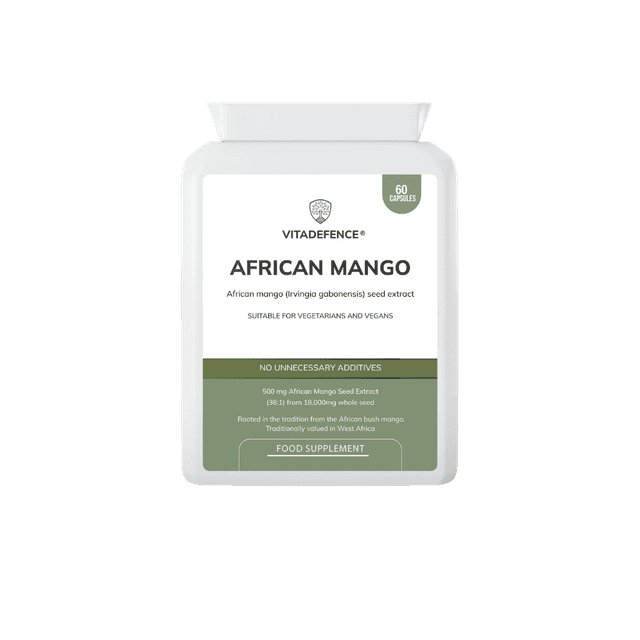
A clean cream pot, the green band of our label, sixty vegan capsules inside. The dose is gentle and old-fashioned — one or two capsules a day, with water, thirty minutes before food. That's it. No proprietary stack. No nine-ingredient blend. Just the seed.
A bottle of sixty lasts a month at two a day, two months at one. The kind of thing you take for a season and see how you feel.
The story of the dika tree
In a stretch of rainforest from Sierra Leone east to the Congo basin grows a tree called Irvingia gabonensis. The English name is the bush mango, or sometimes the wild mango. In Cameroon and Nigeria — where it is most loved — the local names are dika (Bassa, Douala), ogbono (Igbo), odika (Ewondo, Bulu), bobo (Hausa-influenced trade language).
The fruit looks remarkably like a small green mango — fibrous yellow flesh around a single hard kernel. Most travellers eat the flesh and throw away the seed. The local kitchen does the opposite. It is the seed that has carried the tree's reputation for a thousand years.
The kernels are extracted from the fallen fruit, washed, dried in the sun, then either kept whole or pounded into a paste. The paste — ogbono in southern Nigeria, odika in Cameroon — is the foundation of one of West Africa's most famous home stews. A small handful of pounded kernel goes into a pot of water with leaves, onions, peppers, and meat or fish. As it cooks, the dika seed releases a unique mucilaginous quality that thickens the broth into something silky, faintly bitter, deeply savoury. Ogbono soup is to a Nigerian Sunday lunch what gravy is to a British roast — universal, beloved, and grandmother-built.
That is the food story. The medicinal story sits alongside it. Traditional healers across the dika range have used the seed for stomach complaints, for skin, and as a general kitchen tonic for what we'd today loosely call digestive comfort. It is one of those plants whose food role and herbal role are essentially the same role, eaten daily, for as long as anyone can remember.
What modern food chemistry has noticed is that the dika seed is unusually rich in soluble fibre — the same kind of fibre that makes oats feel filling and that slows the absorption of sugar from a meal. It also contains a high proportion of healthy fats, mostly lauric and myristic, the same family found in coconut. None of that is alchemy. It is simply what's inside the seed when you grind it.
We use a concentrated extract of the seed — equivalent to 18,000mg of the original whole seed — in every capsule. One capsule, once or twice a day, before food, in the same spirit a Cameroonian grandmother would add a spoonful of odika paste to her stew.
Why one ingredient
The supplement industry's habit is to stack. Six fat-loss compounds. Twelve botanicals. The label looks impressive. The reality is that with twelve botanicals at trace doses, none of them is doing very much.
We chose to do the opposite here. African mango has a long enough food and folk record on its own. It earns its place in any cupboard that takes traditional plants seriously. So we built a single-plant capsule, at a meaningful dose, instead of burying it inside a nine-ingredient blend where it would be a footnote.
If you want a stack, we have stacks. This isn't one. This is the seed, plainly.
How to use it
Take one or two capsules a day with water, thirty minutes before food. Most people start with one a day for the first two weeks and then move to two if they want to.
The "thirty minutes before food" timing isn't superstition — it gives the soluble fibre a moment to swell with water in the stomach, which is the physical mechanism behind the gentle fullness African mango is known for in folk practice. Take it with a full glass of water, not a sip.
Don't expect the kind of effect you get from a coffee or a chilli. Plants of this kind work in the background, in the same way a tablespoon of psyllium or a bowl of porridge works in the background — by adding fibre and slowing things down a little. Most people who notice anything notice it in the second or third week, and the most common note is "I'm a little less hungry between meals." That's not a clinical claim. That's what the dika seed has been doing in West African kitchens since long before clinical claims were a category.
If after sixty days nothing has shifted in how you feel, stop. A supplement that isn't doing anything for you isn't worth your money. We'd rather have your trust for the next thing than your guilt over the wrong thing.
A word on weight
We owe you honesty about the weight-loss aisle. The real architecture of weight is calories, sleep, stress, movement, and what's on your plate — in roughly that order. No capsule replaces any of those. The most a single-plant supplement like this one can do is sit alongside the work, the way the dika kernel has always sat alongside the West African kitchen — as one ingredient among many in the daily life of someone trying to eat well.
If a website is selling you a single capsule that promises to dissolve fat without lifestyle change, that website is not selling you the truth. We won't say that here.
Honest caveats
This is a food supplement — it complements a varied diet, doesn't replace one. If you are pregnant, breastfeeding, taking medication, or living with a medical condition, talk to your GP or pharmacist first. Keep it cool, dry, sealed, out of reach of children. Don't exceed two capsules a day.
The dika tree doesn't grow in the UK. We source from established harvest chains in West and Central Africa, where the kernels are still gathered from the same forests they have always been gathered from. The seed is then dried, milled, extracted, and encapsulated to UK GMP standards.
If you've read this far, thank you. We tried to write the kind of page we'd want to read before spending money — no neon promises, no overblown language. Just one tree, one seed, and a small daily ritual that has fed and quietly supported a slice of Africa for centuries.
— Vitadefence
— Vitadefence