Showcase
Apple Cider Multi — the kitchen vinegar you grew up smelling, with six warming companions
Cloudy, golden, sour as a Yorkshire morning, apple cider vinegar has lived in British kitchens since orchards covered the south of the country. We dried it into a powder, paired it with chromium and six warming kitchen botanicals, and put the whole thing in a vegan capsule that doesn't taste of vinegar at all.
Key facts
- When you've heard about apple cider vinegar for the tenth time
- The bottle, in your hand
- The story of apple cider vinegar
- Chromium — the trace mineral with a role in everyday metabolism
- Apple cider vinegar's six warming companions
When you've heard about apple cider vinegar for the tenth time
It's the one wellness ingredient that refuses to go away. Your sister-in-law swears by it. Your aunt in Brighton drinks a tablespoon in warm water every morning. There's a podcast you listened to last weekend that mentioned it twice. Half the women you know above the age of forty have tried it. Half the men say they never would, and then secretly try it.
Most of the people who try the liquid version stop within a week. Not because it doesn't do anything for them, but because it tastes like a sour kitchen accident at 7am on a Tuesday. The sting on the throat. The teeth starting to ache. The slightly vinegary breath at the school gate. Apple cider vinegar's biggest enemy isn't its science. It's its taste.
This little bottle is the quiet workaround. The vinegar — dried into a stable powder, the acidity preserved, the sourness sealed inside an HPMC capsule — gets down with a sip of water. The breath stays clean. The teeth are unbothered. And we've added six warming kitchen botanicals around it, in the spirit of the old apothecary tradition that never used a single ingredient when a small chorus of related ones did the job better.
The bottle, in your hand
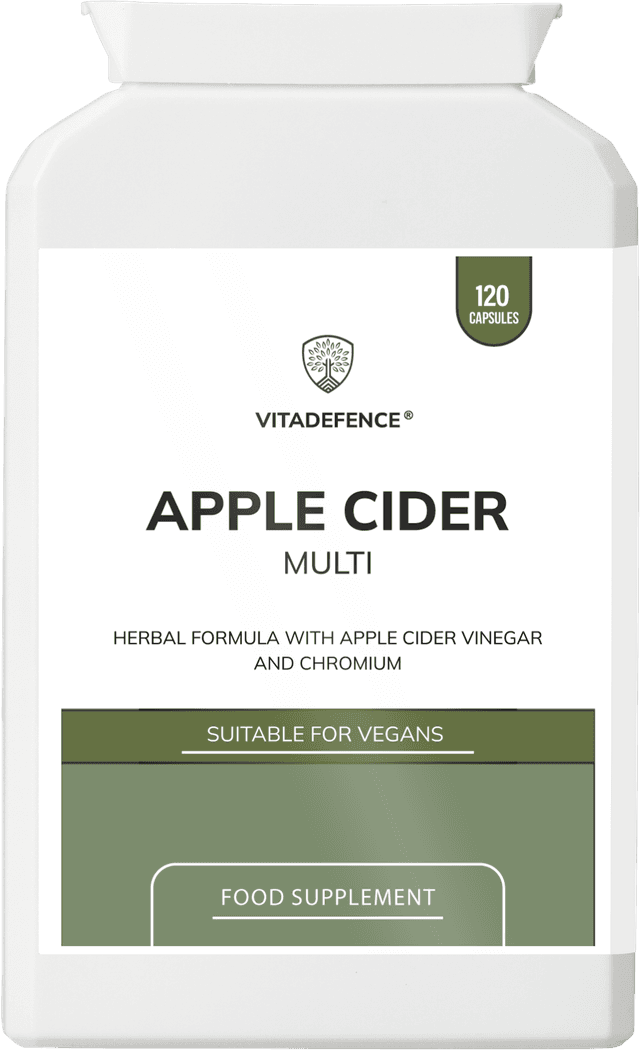
A clean cream pot, the green band of our label, one hundred and twenty vegan capsules inside. The dose is unhurried: one capsule, two or three times a day, with water, ideally before meals. A pot lasts you between forty and one hundred and twenty days depending on how you take it.
The capsules are pale gold-yellow inside, faintly fragrant when you open the seal — turmeric, ginger, a whisper of pepper. They smell like a kitchen, which is what they are.
The story of apple cider vinegar
The orchard belt that runs through Kent, Somerset, Herefordshire and Worcestershire has been making cider for a thousand years. The Normans planted most of the original trees after 1066. By the 18th century, every farm in the south of England had its own press, its own variety of cider apple, and its own slightly idiosyncratic vinegar — because cider, left long enough, becomes vinegar whether you want it to or not. Vinegar comes from the French vin aigre — sour wine. The English, having largely chosen apples over grapes, made the same word work for sour cider.
Apple cider vinegar — the cloudy, unfiltered kind with the sediment at the bottom — has been the most-mentioned wellness folk-food of the 21st century. Hippocrates is supposed to have prescribed honey-and-vinegar drinks. Roman soldiers diluted vinegar in water and called it posca. American farmhouses swore by a daily tablespoon. Every cookbook in the south of England has a chutney that depends on it.
What sits inside the cloudy bottle is a small chemical universe — acetic acid (the sourness), small quantities of malic and lactic acid, polyphenols carried over from the apple, a colony of beneficial yeasts and acetic-acid bacteria called the mother, and trace minerals from the original fruit. We use a stable concentrated apple cider vinegar powder — 400mg per capsule — that preserves the acetic acid content of the original liquid in a form that won't strip your tooth enamel or sting your throat on the way down.
Chromium — the trace mineral with a role in everyday metabolism
The most label-honest ingredient in this bottle is chromium. It is one of the few minerals with a formal European Food Safety Authority statement: chromium contributes to normal macronutrient metabolism, and to the maintenance of normal blood glucose levels. We use 10μg of chromium picolinate per capsule — 25% of the European reference intake.
Chromium is found in trace amounts in broccoli, whole grains, brewer's yeast, and a handful of other foods, but the modern Western diet — heavy in refined flour and sugar — tends not to deliver as much as the old wholegrain diet did. A small daily dose layered into the same capsule as the apple cider vinegar makes a quiet logical pair.
Apple cider vinegar's six warming companions
The remaining six ingredients are all small kitchen botanicals — used in trace, in the apothecary tradition where a little of many often does more than a lot of one.
Green tea leaf has been drunk in China for at least two thousand years. The chemistry — catechins, particularly EGCG — is one of the most-studied of any plant. We use 30mg per capsule. Not a fat-burner dose. A small daily contribution to dietary polyphenols.
Cayenne pepper — Capsicum annuum — is the chilli that domesticated three civilisations: the Aztec, the Indian, and the Hungarian. The bright red powder owes its character to capsaicin, the same molecule that makes a curry warm and signals the digestive tract to wake up. 25mg per capsule, a trace amount that earns its place in the apothecary spirit.
Ginger root has been on the human menu for at least three thousand years. The Romans imported it. Confucius wrote about not eating without it. It is the warming root of half the world's kitchens, from Indonesian rendang to British ginger biscuits. 20mg per capsule.
Turmeric root — the bright orange rhizome of Curcuma longa — has been used in Ayurvedic kitchens and apothecaries for at least four thousand years. The active fraction is curcumin. We use 20mg of turmeric extract per capsule, alongside a tiny dose of black pepper because the apothecary lore — and modern food chemistry — both find that piperine improves the body's uptake of curcumin.
Black pepper — organic, 1.5mg per capsule. Trace, but not pointless. Pepper has been in the apothecary cabinet of every civilisation that has ever traded for it, and its job here is to lift the turmeric.
Why a chorus instead of a single ingredient
A lot of apple cider vinegar capsules sold in Britain contain only ACV powder. We could have made one of those. We didn't, because the apothecary instinct — the same instinct that put rosemary, garlic, ginger and pepper into the same daily teaspoon for two thousand years — has consistently been that real plants work better in small companies than alone.
The seven plants in this bottle are not a stack of fat-burners. They are a kitchen-cabinet pairing. Apple cider vinegar leads. Chromium adds the label-honest mineral note. Green tea, cayenne, ginger, turmeric and black pepper add the warming-aromatic line that runs through nearly every world cuisine. The whole thing is meant to feel like a single capsule version of a small daily teaspoon of something good.
How to use it
Take one capsule, two or three times a day, with water. Most people take one before breakfast, one before lunch, one before dinner — and find that's plenty. Don't take it on an empty stomach if your stomach is acid-sensitive; take it just before food instead.
The "before meals" timing isn't superstition. The apple cider vinegar tradition has always been a just-before-eating one — partly to prepare the digestive tract, partly because the acid does its quiet work alongside the meal rather than later. Take the capsule with a full glass of water, never a sip.
Don't expect dramatic effects. Plants of this kind work in the background, the way a daily teaspoon of vinegar in water has worked in farmhouse Britain for centuries — by small accumulation, not by spectacle. If after sixty days nothing has shifted in how you feel, stop. A supplement that isn't doing anything for you isn't worth your money.
Honest caveats
This is a food supplement — it complements a varied diet, doesn't replace one. If you are pregnant, breastfeeding, taking medication (particularly any blood-sugar medication, due to the chromium), or living with a medical condition, talk to your GP or pharmacist first. Keep it cool, dry, sealed, out of reach of children. Don't exceed three capsules a day.
The apple cider vinegar in this bottle does not originate from the UK. We source from established cider-vinegar producers in regions with a longer harvest season, then dry, mill, and encapsulate the blend to UK GMP standards.
If you've read this far, thank you. We tried to write the kind of page we'd want to read before spending money — no neon promises, no overblown language. Just one ancient kitchen vinegar, one trace mineral with an honest job, six warming companions, and a small daily ritual that doesn't taste of vinegar at all.
— Vitadefence
— Vitadefence