Showcase
Artichoke Multi — the great green flower-bud and the bitter principle
On the limestone hillsides of Sicily, a thistle the height of a man flowers in deep purple. The Romans cut its tight green buds and ate them with garum and pepper, and noticed something the modern label can no longer say plainly. We built a capsule around the artichoke, and around twelve other plants and nutrients that have earned their place in the slow story of looking after a working liver.
Key facts
- When you start to notice that meals sit a little heavier
- The bottle, in your hand
- The story of the artichoke
- Black aged garlic — the slow black bulb of southern Spain
- Beetroot — the deep red root from the kitchen garden
When you start to notice that meals sit a little heavier
Maybe it began some time around your forties. The big Sunday lunch you used to bounce out of now sends you to the sofa. The glass of wine on a Tuesday is more expensive than it used to be. Rich food makes you a little sluggish. Your skin feels less clear after a weekend of takeaways. You're not unwell — you just notice the body is keeping a quieter accounting these days.
Most cultures with a long food history have a quiet answer to this. Italians end a heavy meal with a small bitter glass — Cynar, made from artichoke leaves; Fernet, made from twenty-seven herbs; an espresso. The French have digestifs. The Indians chew fennel seed. The Chinese drink bitter tea. The bitter principle, in plant form, has been the after-dinner ritual of every culinary civilisation that learned to cook with fat — because the bitter taste, for reasons our great-grandmothers understood and our supermarkets forgot, helps the body get on with the work of digestion.
This little bottle is one quiet way to bring that bitter principle back into a modern kitchen. Thirteen plants and nutrients. One capsule. A small daily nod to the way ordinary households used to live alongside their food.
The bottle, in your hand
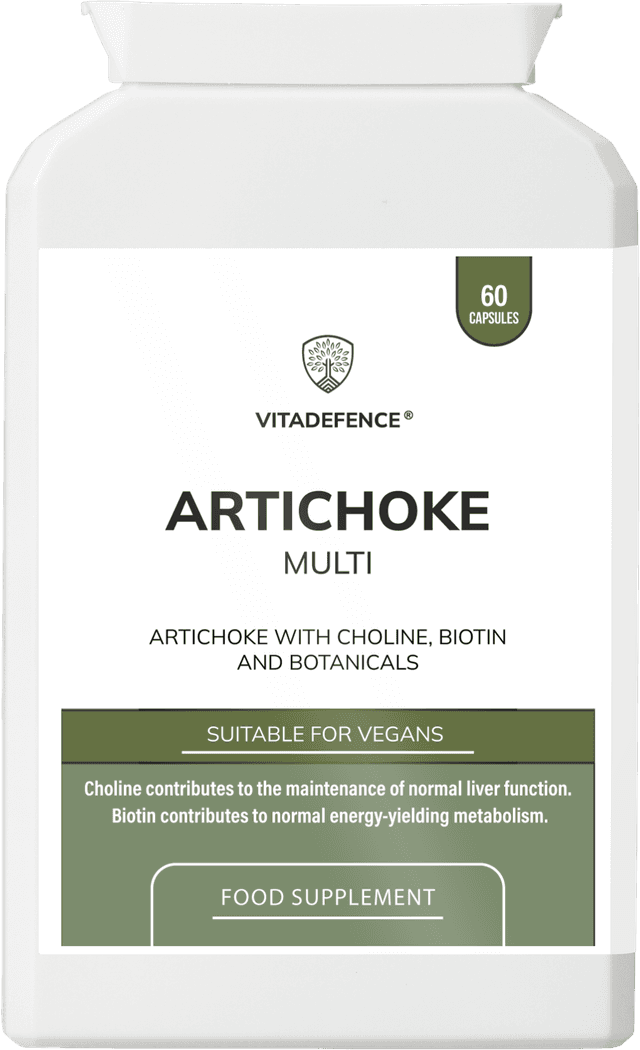
A clean cream pot, the green band of our label running around it like a hedge line. Sixty vegan capsules inside. The dose is gentle — one capsule, one to three times a day, with water, with or without food. Nothing dramatic. Most people take one with the heaviest meal of the day and forget about it the rest of the week.
That's how plants in this category tend to work. Not with fireworks. With patience, and with the working bitter taste your tongue will recognise from the very first capsule.
The story of the artichoke
The globe artichoke — Cynara scolymus — is a domesticated thistle. Wild in the western Mediterranean basin, cultivated for at least two and a half thousand years, the artichoke we eat today was selected, slowly, from the cardoon — a magnificent silver thistle that still grows wild on Sicilian hillsides and Spanish ravines. The Greeks knew it. The Romans loved it. Pliny the Elder devoted three paragraphs of his Natural History to its preparation, recommending it pickled in vinegar with cumin. Catherine de' Medici brought artichokes from Florence to the French court in 1533, and the great kitchen gardens of the Loire have grown them every season since.
What we eat at the table is the unopened flower bud — the tight scaled green head, picked before it bursts into a deep mauve-purple flower the colour of cathedral stained glass. Strip away the leaves, scoop out the choke, and the heart at the centre is soft and sweet and faintly nutty. But the bitter principle that earned the artichoke its place in herbal tradition isn't really in the heart. It's in the leaves — the fleshy outer bracts, and especially the long ribbed leaves of the plant itself, which Italian contadini dried, ground, and tucked into a corner of the pantry beside the salt.
The compound that gives artichoke leaf its character is called cynarin — a polyphenol with a sharp green-bitter taste. Cynarin and its sister compounds are concentrated in the leaf, not the bud. We use 4,800mg of fresh artichoke equivalent per capsule, drawn from a leaf extract — meaning the bitter principle is delivered where the plant actually keeps it, not the part the supermarket sells.
Black aged garlic — the slow black bulb of southern Spain
Ordinary garlic, fermented in its own skin at low heat for several weeks, undergoes a Maillard reaction — the same browning that turns toast brown — and emerges black, sticky, soft, and sweet. This is aged garlic, and the process turns the harsh sulphur compounds of fresh garlic into a different family — chiefly S-allyl cysteine — that the gut tolerates more gently. Aged garlic has been a cottage tradition in Korea, Japan, and southern Spain for at least a century, and a serious laboratory subject for the last thirty years. We use 500mg per capsule.
Beetroot — the deep red root from the kitchen garden
Beetroot is here for two reasons. First, its dietary nitrate content, which the body converts into nitric oxide, the small molecule that helps blood vessels relax. Second, its colour. Beetroot is one of the few foods in the European garden that carries the betalain family of pigments — a class of plant compounds entirely separate from the anthocyanins and the carotenes, with their own quiet heritage. We use 420mg of beetroot extract per capsule.
Burdock root — the bitter taproot of the hedgerow
Burdock — Arctium lappa — is the great long taproot you sometimes see in Asian grocers labelled gobo. In Japan it is roasted, simmered, and woven into the everyday vegetable repertoire. In British folk medicine it was a spring tonic — the long root dug, peeled, and stewed at the end of winter to clear the blood, in the language of country herbalists. The taste is earthy, bitter, slightly resinous. We use 160mg per capsule.
Turmeric — the golden rhizome
Turmeric — Curcuma longa — is too well-known to need an introduction. It has been the colour of every kitchen in the Indian subcontinent for at least four thousand years, and the centrepiece of Ayurvedic herbal practice for almost as long. The active fraction, curcumin, is a deep yellow polyphenol with a long folk reputation. We use 500mg of turmeric extract per capsule, which sits alongside the artichoke and the burdock as part of the bitter-and-pigmented backbone of the formula.
Liquorice root — the sweet bitter
Liquorice — Glycyrrhiza glabra — has been chewed in the eastern Mediterranean since at least 2,500 BC. The root tastes intensely sweet, almost too sweet, and yet the herbal tradition counts it among the gentle bitters. In the formula we use the deglycyrrhized extract — the variant with the glycyrrhizin removed — at 200mg per capsule, a respectful dose intended to support, not dominate.
Cayenne pepper, fennel seed, ginger — the warm trio
Three culinary plants, one paragraph, because they belong together. Cayenne (30mg) is the dried red chilli first cultivated by the Aztecs and now grown from Mexico to Hungary. Its bite comes from capsaicin. Fennel seed (30mg) — Foeniculum vulgare — is the after-meal seed of every Indian restaurant, and was already in Roman cookbooks. Ginger root (5mg) — Zingiber officinale — has been a kitchen staple from Canton to Cornwall for two thousand years. Three small contributions to a formula that quietly mirrors a real kitchen spice rack.
Choline and biotin — the two nutrients the label can speak plainly about
Most of this article has been about plants and history. Two of the ingredients here can be spoken about with the precision of nutrition science, because they are recognised under European Food Safety Authority authorised wording.
Choline (85.8mg) — contributes to normal lipid metabolism and to the maintenance of normal liver function. The body makes a little choline by itself but most of us rely on dietary sources — eggs, liver, fish, soy. In a country where breakfast is increasingly a piece of toast on the way to the train, a small daily contribution from a capsule is one quiet form of insurance.
Biotin (8.8μg, 18% NRV) — contributes to normal macronutrient metabolism, to the maintenance of normal mucous membranes, and to normal hair and skin. It belongs to the wider B-vitamin family, and works best in concert with the rest of it.
These two are not the headline. They are the spine — a backbone of label-accurate nutrition behind the plant story.
Parsley, silica, NAC, alpha-lipoic acid, dandelion — the supporting cast
The remaining five ingredients each deserve a sentence. Parsley leaf (100mg) — the kitchen herb that is secretly a multivitamin, a dense source of folate and vitamin K and chlorophyll. Silica (22mg, from bamboo) — a trace mineral with a long traditional reputation for connective tissue. N-acetyl L-cysteine (20mg) — the acetylated form of the amino acid cysteine, important to the body's own internal repair chemistry; familiar to anyone who has ever opened a hospital pharmacopoeia. Alpha-lipoic acid (10mg) — a fatty acid that the body makes in small amounts and can also receive from food, working in adjacent rooms of the same broad metabolic story. Dandelion root (10mg) — Taraxacum officinale, the bitter taproot of the British lawn, used since medieval monastery gardens as a digestive tonic.
The formula as a whole
Lay these thirteen ingredients on a table — artichoke, black aged garlic, beetroot, burdock, parsley, turmeric, liquorice, cayenne, fennel, silica, NAC, alpha-lipoic, dandelion, ginger, plus choline and biotin — and what they share is a quiet thematic coherence: the bitter principle, the earthy roots, the warm kitchen spices, and the two essential nutrients that hold the structure together.
We didn't pick them at random. We picked plants that have appeared together, in different combinations, in real kitchens and real herbal traditions for centuries. Italian after-dinner bitters lean on artichoke and dandelion. Ayurvedic kitchari leans on turmeric, ginger, and fennel. Korean banchan leans on garlic and burdock. The formula is a kind of edited highlights reel from the world's bitter-and-aromatic kitchen — fitted into a small vegan capsule.
The thinking isn't more is more. It's the body knows what to do with food, when food is what we give it.
How to use it
One capsule, one to three times a day, with water. Most people take one with the heaviest meal of the day — typically dinner — and find that's plenty. The bottle holds sixty capsules: at one a day it lasts two months, at three a day three weeks.
Take it with food if your stomach is sensitive — the bitter principle is meant to meet the meal, not arrive on its own. Don't stack it on top of a heavy stack of multivitamins where the choline and biotin will overlap. And don't expect the kind of effect you get from a coffee. Plants of this kind work in the background. Most people who notice a difference notice it between week three and week eight — meals sitting a little easier, mornings feeling a little less heavy after a rich evening, the sort of slow recalibration that supplements like this are honestly capable of.
If after sixty days nothing has changed, stop. A supplement that isn't doing anything for you isn't worth the money, and we'd rather have your trust for the next thing than your loyalty to the wrong thing.
Honest caveats
This is a food supplement — it complements a varied diet, doesn't replace one. If you are pregnant, breastfeeding, taking medication (especially for blood pressure, diabetes, or blood thinners — liquorice and turmeric in particular can interact), or living with a medical condition, talk to your GP or pharmacist first. Keep it cool, dry, sealed, out of reach of children. Don't exceed three capsules a day. The artichoke leaves don't grow in the British climate at scale — we source from Mediterranean harvest chains, and the formula is blended and encapsulated to UK GMP standards.
If you've read this far, thank you. We tried to write the kind of page we'd want to read before spending money — no neon promises, no overblown language. Just a Sicilian thistle, twelve quiet companions, and a small daily ritual that may help meals sit a little better.
— Vitadefence
— Vitadefence