Showcase
Ashwagandha Capsules — the smell of the horse, the calm of the still pool
On the dry plains of Rajasthan, a small woody nightshade with hairy leaves and red berries grows where almost nothing else will. The Sanskrit physicians called it ashwagandha — the smell of the horse — and they meant strength. We built a capsule around it, and around twelve other roots, mushrooms, and B-vitamins that have earned their place in the long story of staying steady under pressure.
Key facts
- When the day starts to feel like a phone with too many tabs open
- The bottle, in your hand
- The story of ashwagandha
- Cordyceps mushroom — the fungus that climbs to the sky
- Panax ginseng — the man-shaped root of Korea
When the day starts to feel like a phone with too many tabs open
You used to be able to switch from work to dinner to bed without thinking about it. Now there's a moment around 4pm when you can feel the shoulders rising. The deadline that wasn't a problem on Monday is a quiet pressure on your chest by Thursday. You sleep, but not quite all the way down. You wake up at the same hour every morning — three minutes before the alarm — already a little wired, already a little behind.
Most modern jobs do this. So does parenting young children, looking after older parents, running anything that has your name on the door. The body is excellent at handling short bursts of stress. It's the long, low, never-ending hum that wears the system down — the hum that didn't exist for most of human history, and that the human nervous system is still learning to file properly.
The Sanskrit physicians of two thousand years ago had a word for the plants that helped a person stay steady through this kind of pressure. They called them rasayana — the rejuvenators. And at the head of the rasayana list, on every Ayurvedic textbook from the Charaka Samhita onward, sits a small unimpressive shrub with hairy leaves and bright red berries: ashwagandha.
This little bottle is one quiet way to bring the rasayana idea into a modern week. Thirteen plants and nutrients. One capsule. A small daily nod to a tradition that has helped working people stay upright under load for at least eighty generations.
The bottle, in your hand
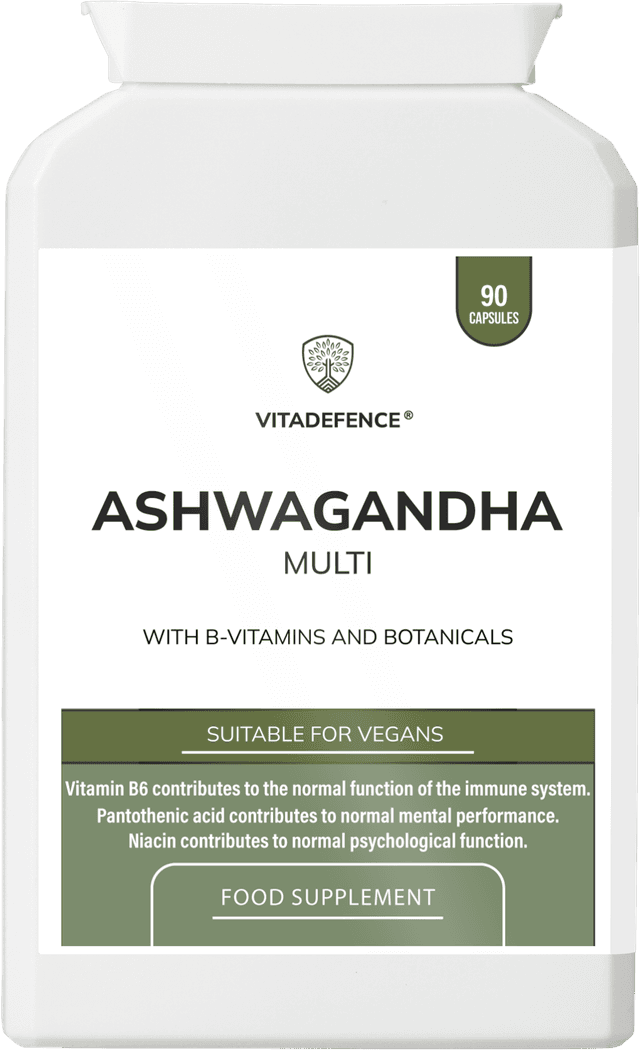
A clean cream pot, the green band of our label running around it like a forest line. Ninety vegan capsules inside. The dose is gentle — one capsule, one to three times a day, with water, with or without food. Most people take one in the morning and find that's plenty. The kind of thing you forget about for a few weeks and then catch yourself in the mirror at the end of a tough Friday and think: I'm still here. Still steady.
That's how plants in this category tend to work. Not with fireworks. With patience.
The story of ashwagandha
Ashwagandha — Withania somnifera — is a small bushy nightshade, about a metre tall, growing in dry sandy soil from Yemen to the Punjab. The leaves are oval and softly hairy. The flowers are tiny and greenish. The fruit is a small red-orange berry held inside a papery lantern, like a miniature version of its cousin the Cape gooseberry. None of it would catch your eye on a country walk. The interesting part is buried.
The root — pale, woody, the thickness of a man's thumb — is what the rasayana tradition harvests. Crushed, the fresh root smells faintly of horse. The Sanskrit name says it directly: ashwa = horse, gandha = smell. The classical Ayurvedic textbooks teach that whoever drinks the milky decoction of this root takes on the strength and stamina of a horse — and the calm of one.
For at least twenty-three centuries, ashwagandha has been the herbal answer to the kind of complaint we'd now call burnout. Charaka, the foundational physician of Ayurveda, lists it as the first-rank tonic for low stamina, broken sleep, and the wearing-down of the working body. The Indian village pharmacist still hands it out, dried and ground into a coarse warm-coloured powder that you stir into milk at bedtime with a pinch of honey.
Modern laboratories have put ashwagandha through a hundred trials over the last forty years. The compounds responsible for the activity are called withanolides — a family of steroidal lactones unique to the Withania genus. The richest, best-characterised commercial extract is called KSM-66 — a full-spectrum root extract standardised to a known withanolide content, made by a slow milk-and-water process that preserves the natural ratio of the plant's chemistry. We use 400mg of KSM-66 ashwagandha per capsule, which is a meaningful daily dose.
Cordyceps mushroom — the fungus that climbs to the sky
In the high pastures of Tibet and Bhutan — between four and five thousand metres — there grows a strange fungus that begins its life inside a moth caterpillar overwintering in the soil. As spring comes, the fungus consumes the caterpillar from within and sends a slim brown fruiting body up through the snow. Tibetan herders gather them by hand and dry them in the sun. They have been a centrepiece of the Tibetan and Chinese medicinal mushroom tradition for at least four hundred documented years, and almost certainly far longer in oral tradition.
What modern cultivation has done — and this is one of the genuinely good developments in the last thirty years of botanical sourcing — is replicate the Cordyceps sinensis fruiting body on plant substrate, without the caterpillar, in clean controlled conditions. We use 200mg of cordyceps fruiting-body extract per capsule. The Tibetan herders called it the plant that helps a man climb a mountain without losing his breath. We won't promise that. We will say it has earned its place in this formula through five hundred years of Himalayan use.
Panax ginseng — the man-shaped root of Korea
The taproot of Panax ginseng — five to seven years old, dug from the cool forest floor of the Korean peninsula or the Heilongjiang river basin — is among the most intensively studied herbal medicines in the world. The Chinese name rén shēn means man root — a reference to the way mature roots branch into something resembling arms and legs. Korean insam tea, made by simmering a whole root with red dates, is a traditional winter morning ritual.
We use 200mg of Panax ginseng extract per capsule, alongside the ashwagandha — because the two adaptogens have very different temperaments. Ashwagandha is calming. Ginseng is brightening. The combination is a long-standing herbal pairing in modern Asian formulation.
Peruvian maca root — the high-altitude radish of the Andes
Above 4,000 metres in the Junín plateau of Peru — a place so cold and windswept that almost nothing else grows — Quechua farmers have cultivated a small radish-like tuber for at least two thousand years. It is maca — Lepidium meyenii — and it has been the staple energy food of the Andean highland population since long before the Inca empire. Maca is here at 200mg per capsule, alongside ginseng and ashwagandha, completing what herbalists sometimes call the three-continent adaptogen triangle.
Liquorice and reishi — the sweet bitter and the mushroom of immortality
Liquorice root (100mg) — Glycyrrhiza glabra — is the deglycyrrhized variant, used in Chinese herbal formulae for two thousand years as the harmoniser — the herb that smooths the rough edges of stronger plants. Reishi (25mg) — Ganoderma lucidum — is the dark glossy bracket fungus that grows on hardwood logs in the forests of east Asia. Chinese imperial pharmacy called it líng zhī — the mushroom of immortality — and it has appeared in the Shennong Ben Cao Jing since the Han dynasty. Two ancient companions to the headline plants.
Schisandra and gotu kola — the five-flavour berry and the brain leaf
Schisandra (25mg) — Schisandra chinensis — is the small red berry of north-east China, called wǔ wèi zǐ — the five-flavour berry — because in one taste it carries sweet, sour, bitter, salt, and pungent. It is one of the classical adaptogens of Chinese practice. Gotu kola (5mg) — Centella asiatica — is the small fan-shaped marsh herb that grows in Sri Lanka, southern India and parts of Southeast Asia. The Sinhalese name translates as the herb of the philosopher-king; it has been the brain-tonic of the Ayurvedic tradition for at least two millennia.
Black pepper and turmeric — the kitchen spices that earned a seat
Black pepper (52mg) — Piper nigrum — is here for two reasons. It is one of the world's oldest traded spices and has been a centrepiece of Indian cooking for at least three thousand years. It also contains piperine, a compound that has been studied as an enhancer of how well the body absorbs other plant compounds taken alongside it — which is why you'll often see black pepper appear in a turmeric capsule. Turmeric (5mg) — added in respectful organic form — needs no introduction.
The B-vitamin spine — Niacin, Pantothenic Acid, B6, B12
Most of this article has been about plants. Four of the ingredients in this bottle can be spoken about with the precision of nutrition science, because they are essential nutrients with European Food Safety Authority authorised wording.
Vitamin B3 (Niacin) (20mg, 125% NRV) — contributes to normal energy-yielding metabolism and to the reduction of tiredness and fatigue.
Vitamin B5 (Pantothenic Acid) (10mg, 168% NRV) — contributes to normal mental performance and to the reduction of tiredness and fatigue. The B-vitamin most associated, in plain nutrition language, with sustained mental work.
Vitamin B6 (Pyridoxine) (2mg, 143% NRV) — contributes to normal psychological function, to the regulation of hormonal activity, and to normal red blood cell formation.
Vitamin B12 (Cyanocobalamin) (25μg, 1000% NRV) — contributes to normal energy-yielding metabolism and to the reduction of tiredness and fatigue. Vegans, vegetarians, and people over 50 are the populations most likely to run low.
These four are not the headline. They are the spine — a backbone of label-accurate nutrition behind the plant story.
The formula as a whole
Lay these thirteen ingredients on a table — ashwagandha, cordyceps, ginseng, maca, liquorice, reishi, schisandra, gotu kola, black pepper, turmeric, B3, B5, B6, B12 — and what they share is a single quiet theme: the help that real working people, in three different ancient cultures, asked for when life was hard.
We didn't pick them at random. We picked the rasayana tradition of Ayurveda, the adaptogen tradition of Chinese herbalism, the highland tonic tradition of the Andes, and the working B-vitamin family of modern nutrition science — and laid them in the same capsule. The thinking isn't more is more. It's the wisdom of three continents, edited into one daily ritual, behind a transparent label.
How to use it
One capsule, one to three times a day, with water. Most people take one with breakfast and find that's plenty. The bottle holds ninety capsules — at one a day it lasts three months, at three a day a month.
Take it with food if your stomach is sensitive. Don't stack it on top of three other multivitamins or the B-vitamins will overlap. And don't expect the kind of effect you get from a coffee. Adaptogens of this kind work in the background. Most people who notice a difference notice it between week three and week eight — slightly easier sleep, a slightly steadier afternoon, the sense of having a small extra inch of tolerance for the day's noise.
If after sixty days nothing has changed, stop. A supplement that isn't doing anything for you isn't worth the money, and we'd rather have your trust for the next thing than your loyalty to the wrong thing.
Honest caveats
This is a food supplement — it complements a varied diet, doesn't replace one. If you are pregnant, breastfeeding, taking medication (in particular thyroid medication, sedatives, or immunosuppressants — ashwagandha and reishi can interact), or living with a medical condition, talk to your GP or pharmacist first. Keep it cool, dry, sealed, out of reach of children. Don't exceed three capsules a day. Ashwagandha and most of these botanicals don't grow in the British climate at scale — we source from established harvest chains in their native regions, and the formula is blended and encapsulated to UK GMP standards.
If you've read this far, thank you. We tried to write the kind of page we'd want to read before spending money — no neon promises, no overblown language. Just a Rajasthani root, twelve quiet companions, and a small daily ritual that may help you stay a little steadier under pressure.
— Vitadefence
— Vitadefence