Showcase
Bilberry Multi — the small dark berry of the northern moor and the colour of seeing
On the Yorkshire moors and the Highland heath, a low-growing relative of the blueberry hides a fruit so dark it stains your fingers black. RAF pilots in the Second World War swore by bilberry jam. We built a capsule around it, and around eleven other plants and nutrients that have earned their place in the long story of looking after eyes that spend too long in front of a screen.
Key facts
- When you start to notice your eyes by the end of the day
- The bottle, in your hand
- The story of bilberry
- Pine bark — the bark of the Atlantic Ocean coast
- Lutein and zeaxanthin — the two yellow pigments inside the eye itself
When you start to notice your eyes by the end of the day
Maybe you noticed it about a year ago. By 9pm your eyes feel a little dry, a little tired, a little reluctant to focus on the small text on your phone. The drive home in the dark feels harder than it used to. Your reading glasses have crept up the bridge of your nose. You're not having a serious problem. You're just having a modern eye day — eight hours of screen, two hours of phone, an hour of TV, and almost nothing for the eye to look at that is more than two metres away.
Most generations didn't put their eyes through this. Our grandparents looked at the horizon a hundred times a day. They saw shadows in candlelight, depth in fields, distance in walked roads. The modern eye lives in a flat box at thirty centimetres for most of its waking life. The retina is a metabolically intensive piece of tissue — it uses more oxygen, gram for gram, than almost any other organ in the body — and the nutrients it would have got from a foraged hedgerow diet are not always coming from a supermarket trolley.
This little bottle is one quiet answer. Twelve plants and nutrients. One capsule. A way to put some of that lost colour back into a part of the body that depends, more than most, on colour and pigment.
The bottle, in your hand
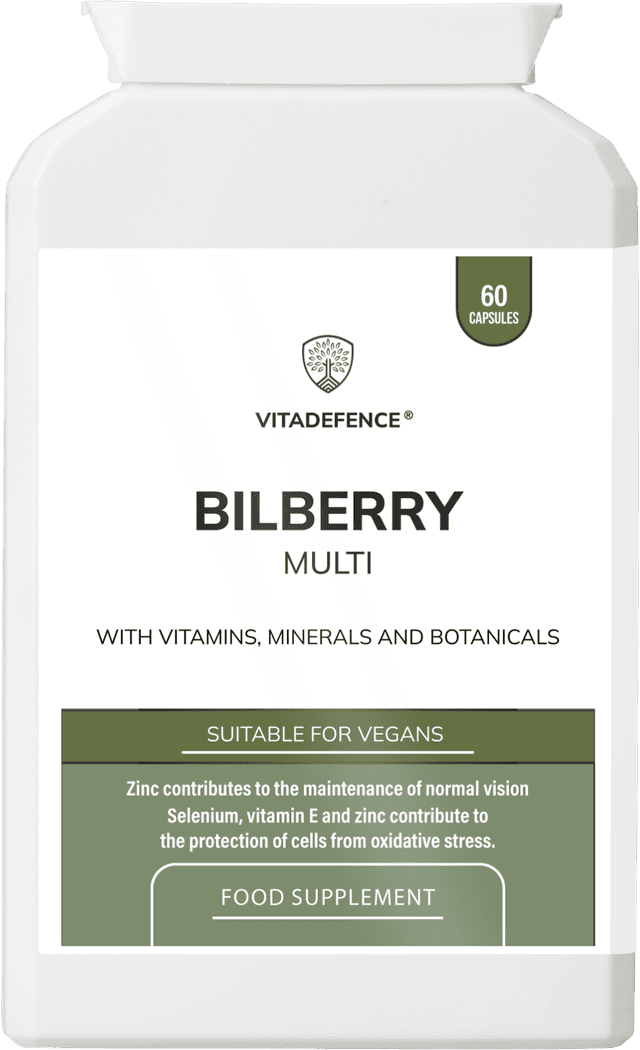
A clean cream pot, the green band of our label running around it like a forest line. Sixty vegan capsules inside. The dose is gentle — one capsule, one to three times a day, with food. Most people take one with breakfast or lunch and find that's plenty.
That's how plants in this category tend to work. Not with fireworks. With patience.
The story of bilberry
Bilberry — Vaccinium myrtillus — is the small dark cousin of the cultivated blueberry. It grows wild from Iceland to the Caucasus, in acid heathland and mountain woodland, on knee-high shrubs that you have to crouch to pick. In the British Isles it is the whortleberry of the West Country, the blaeberry of Scotland, the bilberry of Yorkshire. In Sweden it is blåbär, in Finland mustikka. The fruit is smaller than a cultivated blueberry, deeper purple-black, juicier, and tastes more wild — sweet on first bite, with a faint resinous edge that no greenhouse fruit ever quite achieves.
What sets the bilberry apart from its supermarket cousin is the colour goes all the way through. Cut a cultivated blueberry in half and the flesh is pale green. Cut a bilberry and the inside is the same deep ink as the skin. That difference is the sign of one of the highest natural concentrations of anthocyanins in any fruit — the deep purple pigments that give the bilberry, the elderberry, and the acai berry their character.
The legend that everyone in this country has heard once goes like this. During the Second World War, RAF pilots flying night raids over occupied Europe ate bilberry jam before takeoff and reported sharper night vision in the cockpit. The story may or may not be literally true — it has been told for so long that the historians have lost sight of the original source — but it is true to a quiet older tradition: in northern Europe, the bilberry has always been considered the eye fruit. The Provençal herbalist of the seventeenth century knew it. The Scottish cailleach knew it. The Latvian grandmother knew it. We use 550mg of bilberry fruit extract per capsule, drawn from concentrated wild-harvest fruit, alongside the rest of the formula.
Pine bark — the bark of the Atlantic Ocean coast
In the landes — the great pine forests of south-west France, planted in the nineteenth century to stabilise the dunes — and in the long-needled stands of Pinus massoniana in southern China, the inner bark of the tree carries a quiet treasure. Proanthocyanidins — a family of polyphenol compounds, deep red-brown, related to the tannins in tea and red wine. The Atlantic French have been grinding the bark of the maritime pine and brewing it as a tea since at least the sixteenth century — a French Canadian explorer's diary from 1535 records the indigenous Iroquois teaching his men to drink pine-bark tea against scurvy on the Saint Lawrence river.
Modern extraction concentrates the proanthocyanidins from the bark into a fine reddish-brown powder. We use 1,250mg of pine bark equivalent per capsule, providing 79mg of standardised proanthocyanidins. They sit in the formula in the same way the bilberry sits — both belonging to the wider polyphenol family, both with a long folk reputation for the small blood vessels of the body, including the ones that feed the back of the eye.
Lutein and zeaxanthin — the two yellow pigments inside the eye itself
If you cut a healthy human retina open at the back, you will find a small bright yellow spot called the macula lutea — Latin for yellow spot. It is the part of the eye responsible for sharp central vision. The yellow comes from two pigments — lutein and zeaxanthin — both of which the body cannot make from scratch and must take in through food. They are abundant in dark green leaves: kale, spinach, watercress, parsley. They are also abundant in marigold flowers (Tagetes erecta), the orange flower from which the supplement industry now harvests them.
A diet that includes generous amounts of dark leafy greens delivers them in real food form. A British supermarket trolley often does not. We use 15mg of lutein esters per capsule (equivalent to 7.5mg free lutein) plus 2mg of zeaxanthin — a meaningful daily contribution, alongside whatever salad you put on the plate.
Citrus bioflavonoids — the white pith the supermarket throws away
When you peel an orange, the bitter white layer between the skin and the segments is the pith. Most of us scrape it off and bin it. The pith is where the bioflavonoids of the citrus fruit are concentrated — a family of compounds, including hesperidin, that have been used in southern Italian and southern French folk medicine for centuries as a tonic for the small blood vessels. It is from this folk reputation that the eye-and-blood-vessel category of supplements was first built. We use 5mg of citrus bioflavonoid complex per capsule, providing 3mg of standardised hesperidin.
Vitamin C — the orange tablet, but better understood
Vitamin C (40mg, 50% NRV) — the most familiar nutrient in the bottle. The European Food Safety Authority allows the wording: vitamin C contributes to normal collagen formation for the normal function of blood vessels — and the small blood vessels of the eye are part of that story. Vitamin C also contributes to the protection of cells from oxidative stress — the wear-and-tear process of being alive that the polyphenols in this formula are also part of.
The four trace minerals — Zinc, Manganese, Copper, Selenium
Most of this article has been about plants. Four of the ingredients here are trace minerals, all with European Food Safety Authority authorised wording.
Zinc (5mg, 50% NRV) — contributes to the maintenance of normal vision. The retina contains the highest concentration of zinc of any soft tissue in the human body. Zinc deficiency is the single most consistent dietary finding in the eye-health literature.
Manganese (2mg, 100% NRV) — contributes to the protection of cells from oxidative stress. A trace mineral the modern diet is often short of.
Copper (0.5mg, 50% NRV) — contributes to the maintenance of normal connective tissues and to the protection of cells from oxidative stress. Works in concert with zinc — the two minerals are usually paired in good formulation, because too much of one without the other can disturb the balance.
Selenium (55μg, 100% NRV) — contributes to the protection of cells from oxidative stress and to the normal function of the immune system. UK soils are notoriously low in selenium; British diets are often deficient as a result.
Vitamin E — the fat-soluble antioxidant
Vitamin E (6mg α-TE, 9 IU, 50% NRV) — contributes to the protection of cells from oxidative stress. A fat-soluble vitamin that works in adjacent rooms of the same broad story as vitamin C. Found in cold-pressed plant oils, nuts, seeds, leafy greens.
The formula as a whole
Lay these twelve ingredients on a table — bilberry, pine bark, lutein, zeaxanthin, citrus bioflavonoids, vitamin C, zinc, manganese, copper, selenium, vitamin E — and what they share is a single quiet theme: the colour and protection of a part of the body that depends, more than most, on tiny blood vessels and exquisitely sensitive light-sensing cells.
We didn't pick them at random. We picked the bilberry tradition of northern Europe, the maritime pine bark tradition of Atlantic France, the marigold-derived eye pigments that the body can't make for itself, the four trace minerals that the soil isn't always supplying, and the two antioxidant vitamins that EFSA has formally agreed support cells against oxidative stress. And we laid them in the same capsule. The thinking isn't more is more. It's colour goes where the eye needs it most.
How to use it
One capsule, one to three times a day, with food — most of these compounds are fat-soluble, and a meal helps absorption. Most people take one with breakfast or lunch and find that's plenty. The bottle holds sixty capsules — at one a day it lasts two months, at three a day three weeks.
Don't stack it on top of three other multivitamins or the zinc, copper, and selenium will overlap. Plants of this kind work in the background. Most people who notice a difference notice it between week three and week eight — slightly less eye fatigue at the end of a long screen day, the sense of slightly easier focus when the light starts to fade.
If after sixty days nothing has changed, stop. A supplement that isn't doing anything for you isn't worth the money, and we'd rather have your trust for the next thing than your loyalty to the wrong thing.
Honest caveats
This is a food supplement — it complements a varied diet, doesn't replace one. This product is for adults only and should be avoided during pregnancy, breastfeeding and if you take medication, unless advised by a medical practitioner. Keep it cool, dry, sealed, out of reach of children. Don't exceed three capsules a day. The bilberry, pine bark, and marigold don't grow in the British climate at scale — we source from established harvest chains in their native regions, and the formula is blended and encapsulated to UK GMP standards.
If you've read this far, thank you. We tried to write the kind of page we'd want to read before spending money — no neon promises, no overblown language. Just a small dark moorland berry, eleven quiet companions, and a small daily ritual that may help your eyes feel a little less tired at the end of a long screen day.
— Vitadefence
— Vitadefence