Showcase
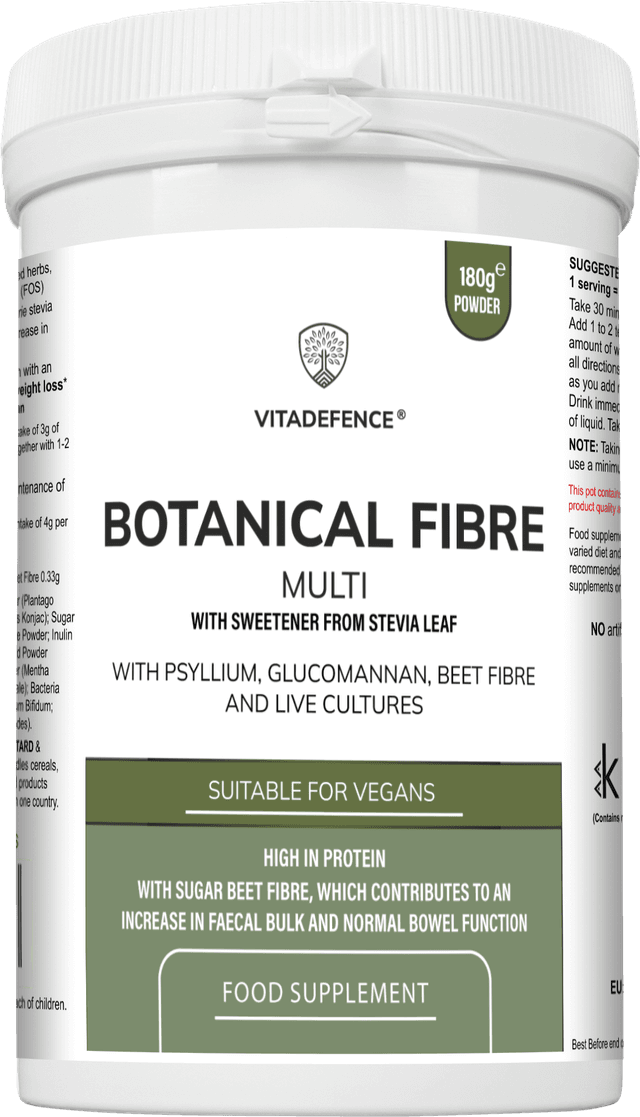
Botanical Fibre Multi — the powder you stir into water and the gut that thanks you for it
On the dry plains of Gujarat, a small pinkish flower drops a tiny seed wrapped in a translucent husk that swells in water to the size of a tadpole. The Hindi name is *isabgol* — the horse's ear — for the shape of the husk. We built a powder around it, and around eight other plants and live cultures that have earned their place in the long story of looking after a working gut.
Key facts
- When you start to feel the modern diet in the gut
- The bag, in your hand
- The story of psyllium husk
- Glucomannan — the konjac root of Japan
- Sugar beet fibre — the by-product the food industry should have taken more seriously
When you start to feel the modern diet in the gut
Maybe you noticed it in your thirties. The bloated feeling after lunch that didn't used to happen. The gut that doesn't quite settle into a rhythm during a busy week. The afternoon energy slump that has more to do with what you ate than what you slept. You're not unwell — you're just running on a diet that the gut wasn't really designed for.
Most ancestral diets carried somewhere between forty and a hundred grams of fibre a day. The British average sits around eighteen. The Mediterranean grandmother's plate was, on close inspection, mostly fibre — bitter greens, beans, whole grains, fruit, herbs, the rough end of every loaf. The supermarket trolley, by contrast, has been engineered for shelf life and softness. Fibre is the part the food industry took out first because it spoils, costs money, and slows the till.
The cost of taking the fibre out is a cost paid privately, by the gut. The slow daily work of the colon — moving food through, holding water, feeding the bacteria that live there — is the part of digestion that asks for fibre and asks for not very much else. When fibre is missing, that work doesn't stop; it just gets harder.
This bag is one quiet way to put some of that lost roughness back into a modern week. Nine plants and live cultures. One scoop. A small daily ritual that the colon will recognise within a fortnight.
The bag, in your hand
A 300g bag — about sixty servings at one heaped teaspoon a day. The texture is fine pale powder, gently aromatic from the fennel and peppermint. Stirred into water it thickens and swells; drunk quickly with another full glass of water on top, it slips down with no fuss.
That's how this kind of supplement works. Not with fireworks. With patience, and with a glass of water.
The story of psyllium husk
Psyllium — Plantago ovata — is a small annual plant of the dry plains of north-western India and Pakistan. It throws up slender stems with little spikes of pale pink flowers, and the flowers turn into seed pods full of tiny brown seeds, each one wrapped in a translucent fibrous husk. The husk is what we use. The Hindi name for the seed is isabgol — the horse's ear — for the curved shape of the husk under the field worker's lens.
Psyllium has been the traditional gentle bowel regulator of Ayurvedic and Unani-Tibb medicine for at least a thousand years. The husk works because it is almost pure soluble fibre — it absorbs water and forms a soft gelatinous bulk that the colon can move through easily. It feeds nothing in particular; it does no clever metabolic work; it simply holds water, and that water, on the inside of the bowel, is what most modern guts are quietly short of.
We use psyllium whole husks powder as the largest single ingredient in this blend. It is the workhorse of the formula — the plant the formula is built around.
Glucomannan — the konjac root of Japan
In the volcanic soil of central Japan, on the slopes of Gunma and Ibaraki prefectures, farmers have for at least fifteen hundred years cultivated a strange-looking plant called konnyaku — Amorphophallus konjac — the corm of which is grated into a grey gelatinous block that is sliced into noodles and simmered in dashi. The fibre that gives konjac its texture is called glucomannan — a soluble fibre with extraordinary water-holding capacity. Gram for gram, glucomannan absorbs more water than almost any other plant fibre on earth.
Under EU regulation 432/2012, glucomannan contributes to the maintenance of normal blood cholesterol levels (at a daily intake of 4g) and contributes to weight loss in the context of an energy-restricted diet (at 3g daily, in three doses, with a glass of water before meals). We include glucomannan as part of the blend — not as a stand-alone weight-loss product, but as a supporting fibre for the daily ritual.
Sugar beet fibre — the by-product the food industry should have taken more seriously
When the British and French sugar industries process sugar beet — Beta vulgaris — they extract the sucrose and are left with a fibrous pulp that has historically been used as cattle fodder. The pulp, dried and milled, is one of the most concentrated dietary-fibre powders in European agriculture. It is bland, almost flavourless, and adds the kind of insoluble bulk that a modern white-bread diet doesn't deliver. Quietly excellent, and quietly under-used.
L-glutamine — the amino acid the gut wall lives on
The cells lining the small intestine — the enterocytes — have an unusual metabolic preference. Most cells in the body burn glucose for fuel. The enterocytes prefer the amino acid glutamine. Under stress — illness, heavy training, an inflammatory diet — the gut wall asks for more glutamine than the rest of the body is happy to spare. Adding a measured amount of free L-glutamine to the daily glass of fibre is one quiet way to support that internal economy. Note: L-glutamine is an amino acid; we don't make EU-authorised health claims for it. We include it because of the long body of physiological literature describing its relationship with the gut wall.
Inulin — the prebiotic of the chicory root
Inulin is a soluble fibre belonging to a family called fructo-oligosaccharides (FOS) — long chains of fructose units that the human stomach cannot break down, but which the bacteria of the colon can. The bacteria ferment inulin into short-chain fatty acids — chiefly butyrate, propionate, and acetate — that the colon cells use as fuel. Chicory root is the commercial source. Inulin is sometimes called a prebiotic — food for the bacteria — and pairs naturally with the live cultures further down the ingredient list.
Fennel seed, peppermint leaf, ginger root — the after-dinner trio
Three plants that every old culinary culture had on the windowsill. Fennel seed (Foeniculum vulgare) — the after-meal seed of every Indian restaurant, in Roman cookbooks since Pliny, traditional carminative for the post-meal stomach. Peppermint leaf (Mentha piperita) — Greek folk medicine, English kitchen garden, the cooling green note in any digestive tea. Ginger root (Zingiber officinale) — the pickled accompaniment to sushi, the steaming infusion of the Indian household, the warming spice of every Christmas cake. Three quiet companions whose role in the formula is as much taste as function — they make the powder pleasant to drink, and they earn their place in the long after-dinner tradition of every culinary civilisation.
The two live cultures — the bacteria that already live inside you
The last two ingredients on the label are not plants but living organisms. Lactobacillus acidophilus and Bifidobacterium bifidum are two strains of bacteria native to the healthy human gut. They are the most extensively studied of the probiotic cultures, with a body of literature stretching back to Élie Metchnikoff in early-twentieth-century Paris. Note: under current EU rules, the word probiotic is not allowed on a food supplement label — but the cultures themselves are permitted as ingredients. Their inclusion in this powder is a quiet acknowledgement that the gut is a community, not a tube — and a daily fibre with a small live-culture component is closer to what real fermented food traditions (Bulgarian yogurt, Korean kimchi, German sauerkraut) have always offered.
The sweetener — Stevia, in trace
We sweeten the powder with a small amount of Stevia rebaudiana leaf extract — the South American leaf that has been chewed for sweetness by the Guaraní people of Paraguay for hundreds of years, and is now an EU-authorised sweetener. Stevia is a sweetener — a plant-derived one, the only sweetener in the powder, used in trace. No added cane sugar; no maltodextrin; no synthetic colours. Just a leaf doing the job a leaf has done for the Guaraní for centuries.
The formula as a whole
Lay these nine ingredients on a table — psyllium, glucomannan, sugar beet fibre, L-glutamine, inulin, fennel, peppermint, ginger, the two live cultures — and what they share is a single quiet theme: the return of fibre, in real plant form, to a modern diet that has quietly lost it.
We didn't pick them at random. We picked the great soluble-fibre traditions of three continents — the Indian isabgol, the Japanese konjac, the European sugar beet — added the after-dinner kitchen herbs, the prebiotic chicory root, the gut-wall amino acid, and the two well-studied live cultures, and laid them in a single bag. The thinking isn't more is more. It's the gut wants what real food used to give it, in roughly the order real food used to give it.
How to use it
Add 1 to 2 heaped teaspoons (5–10g) of powder to a small amount of water or juice (about a quarter of a glass), stir slowly into a paste, then top up with more liquid until the glass is full. Stir well and drink immediately. Follow with another full glass of water. Take 1 to 3 times a day, ideally about thirty minutes before a meal.
⚠️ Important. Taking this powder without enough water can cause choking. Always use a minimum of 250ml of liquid per heaped teaspoon. If swallowing is difficult, do not use this product. The fibres swell rapidly on contact with water — they are designed to. That swelling is the point of the formula, and it is also the reason for the water rule.
Most people start with a single daily teaspoon for a fortnight, then build to twice or three times a day if comfortable. The gut takes about ten days to settle into a new fibre rhythm; expect a little wind in the first week, less by the third. If after sixty days nothing has changed, stop. A supplement that isn't doing anything for you isn't worth the money.
Honest caveats
This is a food supplement — it complements a varied diet, doesn't replace one. If you are pregnant, breastfeeding, taking medication (especially thyroid medication, oral diabetes medication, or anticoagulants — fibre changes the absorption of many medicines, and a window of one to two hours between this powder and any pill is sensible), or living with a medical condition, talk to your GP or pharmacist first. Best consumed within three months of opening; replace the lid after each use.
⚠️ May contain traces of mustard and sesame. Manufactured in a facility that handles cereals, egg, fish, milk, nuts, soya, mustard and seeds, and products derived from crustaceans. Produce of more than one country. Blended and packed in the United Kingdom.
If you've read this far, thank you. We tried to write the kind of page we'd want to read before spending money — no neon promises, no overblown language. Just a small Indian seed husk, eight quiet companions, and a single daily glass of cloudy water that may help the gut do the work it was always doing.
— Vitadefence
— Vitadefence