Showcase
Cranberry Multi — the small red berry of the New England bog
Long before cranberry became a Thanksgiving sauce, the Wampanoag people of coastal Massachusetts called it sasumuneash and packed it into pemmican for winter journeys. We built this capsule around 2,160mg of cranberry extract, 900mg of D-mannose, and a small chorus of botanicals that have shared a kitchen drawer with cranberry for three centuries.
Key facts
- When you've been buying cranberry juice by the carton
- The bottle, in your hand
- The story of cranberry
- D-mannose — the sugar that doesn't act like one
- Lactobacillus acidophilus — the friendly bacterium that lives in the same neighbourhood
When you've been buying cranberry juice by the carton
You know the routine. The little tug in the lower belly that arrives without warning, usually on a busy day, usually before a long drive. The pharmacy aisle, the carton of unsweetened cranberry juice, the wince when you actually drink it. The hope that this time the sour red liquid does what your grandmother said it would.
Cranberry juice is a tradition that won't go away because something in it actually seems to help. The trouble is the dose: a glass of unsweetened juice — bracingly tart — gives you a small fraction of what the published trials used. To match those amounts you'd need a litre a day, and a litre a day of cranberry juice tastes like a punishment.
This little bottle is the same plant, concentrated into a capsule, and stacked with the other small things people have reached for in the same drawer for centuries — D-mannose, oregano, cinnamon, a friendly bacterium and a gentle dose of zinc.
The bottle, in your hand
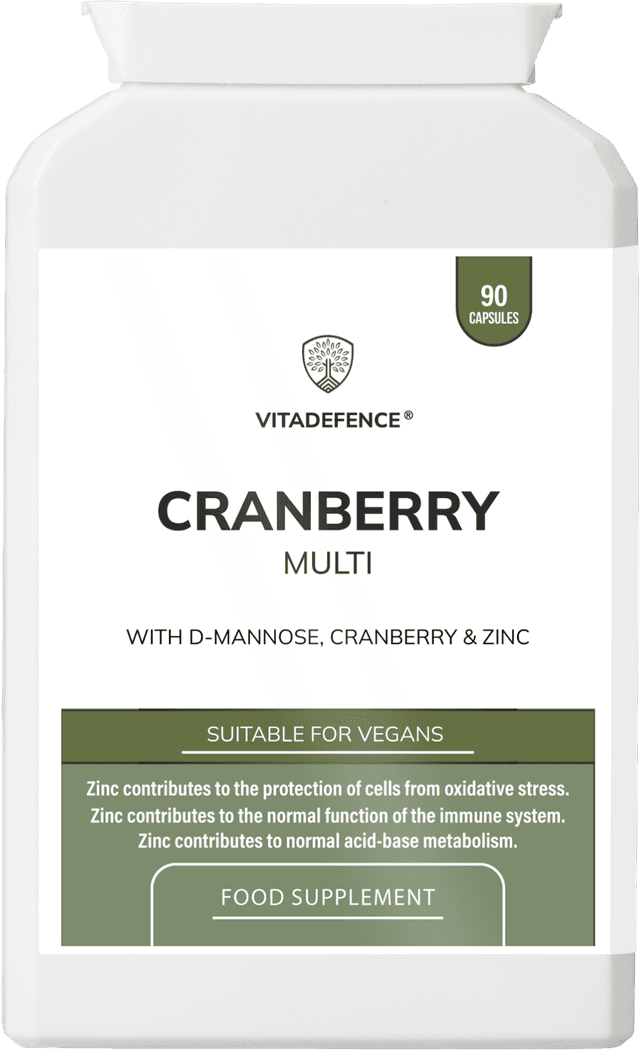
A clean cream pot, the green band of our label running around it. Ninety vegan capsules inside. The dose is two capsules, two to three times a day — a higher daily count than most things on this site, because cranberry is one of those plants that earns its keep at meaningful doses or not at all. The bottle holds about a fortnight at the high end, three weeks at the lower.
You can take them with water or, if you want to lean into the tradition, with a small glass of unsweetened cranberry juice. The two stack happily.
The story of cranberry
Vaccinium macrocarpon — the American cranberry — is a small evergreen vine that grows along the floor of acidic bogs in the cold north-east of America and the Atlantic coast of Canada. The berry is hard, dark red, and famously tart. It floats — which is why modern harvest looks the way it does on television, with farmers walking thigh-deep through flooded fields, sweeping rafts of red fruit toward the truck.
The Wampanoag and Algonquin peoples knew the plant long before the colonists. They mashed it with deer meat and rendered fat to make pemmican — a high-energy, long-shelf-life travel food that kept on a snow-covered march for months. They also used cranberry poultices on wounds, and the berry travelled in their medicine bags as a quiet kind of utility.
The European settlers learned both uses. The first written record of cranberry as a urinary remedy in English is from the 1840s; by 1923 it was being formally studied; by the 1990s its modern reputation was set. The active fraction, scientists eventually decided, was a class of compounds called proanthocyanidins — specifically the A-type structure, found in cranberry but rare elsewhere. The hypothesis is that A-type proanthocyanidins make the inside of the urinary tract slipperier — less hospitable to certain bacteria that would otherwise stick. Mechanism not finally settled. Tradition very long.
We use 2,160mg equivalent weight from concentrated cranberry extract per daily serving — a dose that aligns with the upper end of the published trials.
D-mannose — the sugar that doesn't act like one
D-mannose is a simple sugar. It's structurally similar to glucose, found naturally in cranberries, peaches, apples and a handful of other fruits, but the body uses it almost not at all for fuel. Most of what you swallow passes through the bloodstream and ends up in the urine almost unchanged.
That's the curious thing about it. Once in the urinary tract, D-mannose appears to bind to the same receptors that certain bacteria use to grip the bladder wall — occupying the parking spaces, in effect, so the bacteria can't park there. The compound is then washed out the next time the bladder empties.
D-mannose is one of the cleanest things in modern supplement science: a sugar so plain it doesn't really act like a sugar, doing one job by what looks like simple physical occupation. We use 900mg per daily serving — meaningful, in line with the dose used in the dedicated trials.
Lactobacillus acidophilus — the friendly bacterium that lives in the same neighbourhood
If you've ever bought a yoghurt drink with a Latin name on the bottle, you've met Lactobacillus acidophilus. It's one of the well-studied resident bacteria of the human gut and urogenital tract — naturally present, generally helpful, and one of the original "friendly" microbes of the probiotic age.
In a formula about urinary support, a small dose of acidophilus is a quiet vote for the idea that a healthy local microbial community is part of the picture. We use a dose providing two billion live cultures per serving — modest, supportive, and chosen specifically to coexist with the other ingredients on the same daily schedule.
Oregano leaf and Ceylon cinnamon — the kitchen drawer working a second job
Oregano and cinnamon are spices most people know from the kitchen — pizza and porridge, respectively. Both have older lives as traditional remedies. Oregano essential oil, packed with carvacrol and thymol, has been used in Mediterranean folk medicine for centuries; concentrated oregano leaf is a traditional support for digestion and general microbial balance. Ceylon cinnamon — the soft-rolled "true" cinnamon from Sri Lanka, distinct from the harder cassia — has a long history in both Ayurveda and Greek medicine.
Both sit at supportive doses in this formula. Not the headline. The grace notes. They earn their place because they have shared a drawer with cranberry for three centuries of practical home medicine.
Bamboo silica and zinc — the small backbone
A small amount of bamboo extract delivers around 15mg of plant-derived silica per serving — silica being a structural trace mineral. And 1.5mg of zinc — 16% of the European nutrient reference value — comes in via zinc glycinate, a gentle absorbed form. Under EFSA-authorised wording, zinc contributes to normal immune system function and to the maintenance of normal mucous membranes. In a formula about the lining of a hard-working tract, a meaningful daily zinc dose is a quiet, label-honest spine.
The formula as a whole
Six plants and one nutrient, working in adjacent rooms of the same small house.
Cranberry brings the headline and the proanthocyanidin chemistry. D-mannose brings the simple physical mechanism. Acidophilus brings the microbial company. Oregano and cinnamon bring centuries of culinary-medicinal cross-use. Bamboo brings a structural trace mineral. Zinc brings the only EFSA-authorised wording in the bottle, and a steady backbone.
We didn't pick seven things at random. We picked seven that have actually been used together — in juices, in tinctures, in folk recipes — for long enough that the combination feels like an old friendship rather than a marketing decision.
How to use it
Two capsules, two to three times a day, with water — or with unsweetened cranberry juice if you want to honour the tradition. Most people start at three doses a day for the first week or two if there's a reason to, then drop to two a day as a maintenance rhythm. Don't skip days during the first month — cranberry seems to need consistent daily presence to do its quiet work.
Plenty of water alongside is the simplest, oldest piece of advice in this category, and it stands. Cranberry asks for hydration as a partner.
If after sixty days nothing about the part of you that prompted the bottle has changed, stop. We'd rather have your trust for the next thing than your guilt over the wrong thing.
Honest caveats
This is a food supplement — it complements a varied diet, doesn't replace one. If you have a recurring or persistent urinary tract issue, see your GP — cranberry is a support, not a substitute for a proper diagnosis or, when needed, antibiotics. If you are pregnant, breastfeeding, on warfarin or any blood-thinning medication, taking lithium, or living with a medical condition, talk to your GP or pharmacist first. Keep the bottle cool, dry, sealed, out of reach of children. Don't exceed six capsules a day. We blend and encapsulate to UK GMP standards.
If you've read this far, thank you. We tried to write the kind of page we'd want to read before spending money on a bottle of red-berry capsules — no neon promises, no overblown language. Just a small bog fruit, a curious sugar, a friendly microbe, and three centuries of kitchen-drawer wisdom in one daily ritual.
— Vitadefence
— Vitadefence