Showcase
Dandelion Multi — the weed in your lawn that the apothecaries used to charge for
Long before dandelion was the yellow thing your dad pulled out of the lawn, it was a kitchen vegetable, a coffee substitute, and one of the most respected liver and kidney plants in European herbal medicine. We built this capsule around 320mg of dandelion root and a quiet chorus of other green-and-bitter botanicals that any French grandmother would have recognised on the windowsill.
Key facts
- When you've been feeling a bit puffy and a bit slow
- The bottle, in your hand
- The story of dandelion
- Alfalfa — the deep-rooted green from the field edge
- Juniper berry — the hedgerow gin botanical
When you've been feeling a bit puffy and a bit slow
It's a quiet kind of feeling. Your fingers feel slightly fatter on the keyboard than they did last week. Your rings sit a half-size tighter. The trousers that fitted properly on Monday feel less so by Friday afternoon. Your face in the morning mirror has a softness around the eyes that wasn't there last month.
You're not unwell. The bloods are fine. You probably ate a few more salty meals than usual, drank a little less water, slept a little worse, sat at the desk a bit longer. The body is just holding onto a touch more fluid than it really needs to, the way bodies sometimes do when life gets quietly inconsistent.
This little bottle is the green-and-bitter answer to that feeling. Nine plants and a couple of nutrients — the kind of thing a French grandmother in a country kitchen would have made you a tea from, and walked off into the garden to gather most of the ingredients herself.
The bottle, in your hand
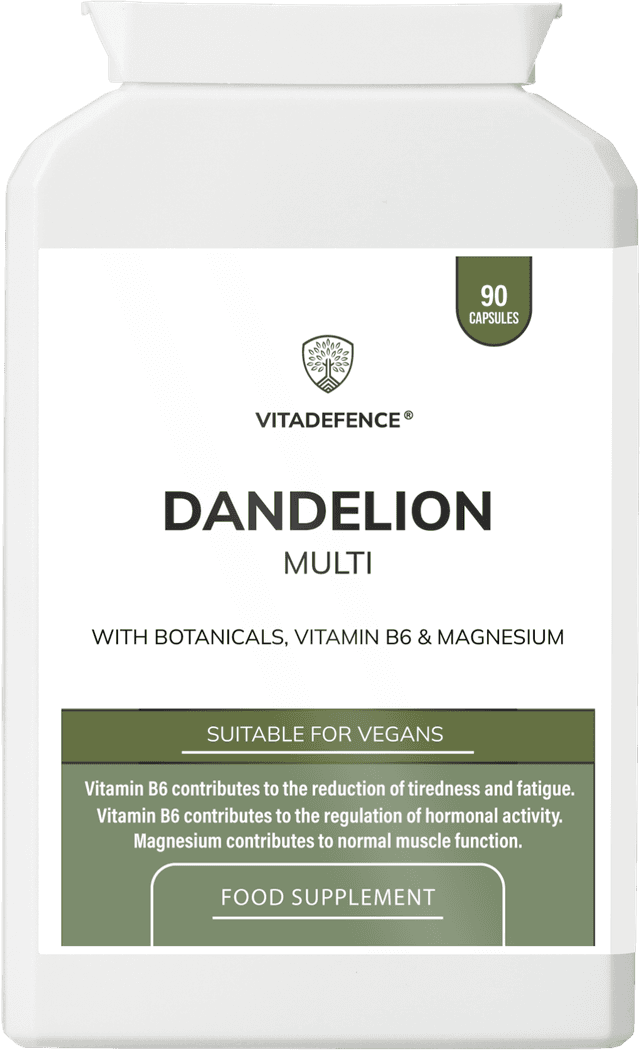
A clean cream pot, the green band of our label running around it. Ninety vegan capsules inside. The dose is two capsules, one to three times a day, before meals. Bitterness on the tongue is the traditional cue for digestive plants, and the encapsulated form misses that — but if you tip a capsule into hot water, you'll smell some of the green-and-bitter character through the lid.
A capsule with breakfast, a capsule with lunch, a capsule with dinner — that's the high end of the dose. One a day is the gentle end.
The story of dandelion
Taraxacum officinale — the common dandelion. The English name comes from the medieval French dent-de-lion, the lion's tooth, after the jagged edge of the leaf. The plant grows everywhere humans have ever walked. It is one of the most successful flowering plants on earth precisely because it is so undemanding.
Long before it was a weed, it was lunch. Roman cooks used the leaves in salads. Anglo-Saxon herbalists prescribed it. Across rural France, the leaves were sold as pissenlit — literally piss-the-bed, an unsubtle reference to its long-known diuretic effect. The roots were dug up in autumn, dried, roasted and ground as a coffee substitute, particularly during wartime shortages. Even now, in any French jardin ouvrier in March, you can watch retired men picking the first young leaves before the flower comes — bitter, tender, the start of spring on the plate.
The two parts of the plant — leaf and root — have slightly different traditional uses. The leaf is a gentle diuretic; rich in potassium, which is a useful counterweight to fluid loss. The root is a bitter, traditionally associated with bile flow and digestion, classified for centuries in European herbal practice as a liver-supporting plant. Both have travelled into the modern dandelion supplement, often together.
We use 320mg equivalent weight of dandelion root extract per daily serving — a meaningful dose, enough to give the formula its name and its character.
Alfalfa — the deep-rooted green from the field edge
Alfalfa (Medicago sativa) is a legume, a relative of clover, used as a hay crop for cattle for thousands of years. The Persians grew it for war horses; the Greeks called it Medikai after the Medes who first traded it westward. Its roots reach extraordinary depths — sometimes fifteen metres — pulling minerals from soil layers most plants never touch.
That depth is why alfalfa earned its place in herbal cabinets long before it was a salad sprout. The leaf carries a useful spread of plant minerals and a wide chlorophyll content. We use 170mg per daily serving — a quiet, mineral-leaning grace note in this formula.
Juniper berry — the hedgerow gin botanical
The juniper berry isn't really a berry; it's a fleshy seed-cone from a small evergreen shrub that grows on chalk downs and Scottish moors. Its smell is the smell of gin — sharp, resinous, piney. That same essential oil profile is what European herbalists prized it for: a traditional diuretic and digestive bitter, used in folk medicine across northern Europe for centuries.
We use 100mg per daily serving — a small, supportive dose. The juniper isn't the headline. It's the friend who came with the dandelion.
Celery seed — the ancient medicine that became a salt
Celery seed, from Apium graveolens, was used as a medicine in Egypt and Greece centuries before it was used as a vegetable. The Greeks crowned victors at the Nemean Games with celery garlands. Hippocrates wrote about it. By the medieval period, the seed had become a respected component of European phytotherapy, traditionally used for joint comfort and water balance.
The seed is also what celery salt is made of — ground seed mixed with sodium. In this formula it appears as a powder at 80mg per daily serving. Worth a note for anyone with a celery allergy — it shows up in the allergen warning on the label.
Nettle leaf, parsley, kelp, watercress, radish — the kitchen-garden chorus
Five more green-and-bitter plants sit at small supportive doses, each carrying a long history of European or coastal-traditional use:
Nettle leaf — the sting plant your grandmother said was good for you, dried and lost the sting; rich in plant minerals, traditional diuretic.
Parsley leaf — the garnish nobody eats; in fact, one of the densest plant sources of vitamin K, traditionally used for fluid balance and as a freshener.
Kelp — Fucus vesiculosus, the bladderwrack of the Atlantic shoreline; a marine source of iodine and trace minerals, used in coastal European folk medicine for thyroid and metabolism.
Watercress — Britain's quietly excellent native salad green; a brassica with a bright, peppery profile, traditionally a "spring tonic" food.
Radish — the small bitter root, traditionally classified as a digestive bitter.
Each appears at around 80mg in this formula. None is the headline; together they form a chorus around the dandelion.
Magnesium and Vitamin B6 — the label-honest spine
Two essential nutrients carry the EFSA-authorised wording in this bottle. Magnesium at 66mg per serving (18% NRV) — contributes to electrolyte balance, normal muscle function, and a reduction of tiredness and fatigue. Vitamin B6 at 24mg per serving (1714% NRV — a high but safe upper level for short courses) — contributes to the regulation of hormonal activity and to normal protein and glycogen metabolism.
These two are the spine of the bottle. The plants are the headline. The nutrients are the backbone.
The formula as a whole
Lay it on a table — dandelion, alfalfa, juniper, celery seed, nettle, parsley, kelp, watercress, radish, magnesium, B6 — and what you've got is essentially a French country herb garden in a capsule, plus two minerals to keep the label honest.
The connecting thread is bitter and green and traditionally diuretic. None of these plants is a single-active blockbuster. They're the kind of ingredients people in herb-eating cultures consumed in small amounts almost daily — in salads, in soups, in teas — as a quiet, ongoing piece of seasonal housekeeping.
We didn't pick eleven things at random. We picked eleven that have shared a tradition for centuries — the green-and-bitter palette of European herbal medicine, plus the two minerals that earn the EFSA wording about fluid and energy.
How to use it
Two capsules, one to three times a day, before meals. Most people start with two before lunch, see how that sits, and add a second dose if helpful.
Drink water alongside. Plants in this category work with hydration, not against it; they encourage the body to move fluid through more efficiently, not to dehydrate it. A glass of water with each dose is the simplest, oldest piece of advice in the category and it stands.
If after sixty days nothing has changed in the way you feel about that puffy-and-slow sense that brought you here, stop. We'd rather have your trust for the next thing than your money for the wrong thing.
Honest caveats
This is a food supplement — it complements a varied diet, doesn't replace one. Contains celery, other umbelliferae, and members of the parsley family — read the allergens panel if you have any history of celery or carrot-family sensitivity. If you are pregnant, breastfeeding, taking diuretic medication, on lithium, on warfarin or any blood-thinner, taking thyroid medication (kelp content), or living with kidney or gallbladder issues, talk to your GP or pharmacist before starting. Don't exceed six capsules a day. Keep the bottle cool, dry and sealed. We blend and encapsulate to UK GMP standards.
If you've read this far, thank you. We tried to write the kind of page we'd want to read before spending money on a bottle of green-and-bitter capsules — no neon promises, no overblown language. Just a French country garden in a capsule, plus two minerals, and a small daily ritual for the puffy-and-slow weeks of life.
— Vitadefence
— Vitadefence