Showcase
Electrolyte Multi
A clean berry-flavoured electrolyte powder — sodium, potassium, chloride. The three minerals your body loses through sweat, all in one scoop, in the proportions that matter.
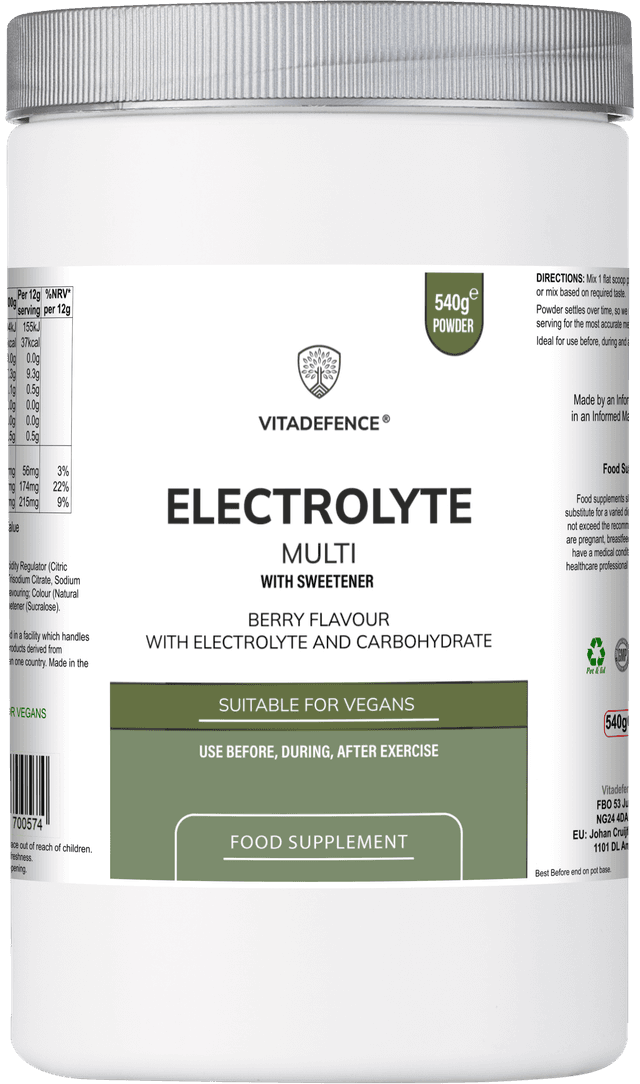
A scoop of berry-coloured powder, half a litre of water, and the three minerals you've been quietly running short of.
There's a particular kind of tired you can't put your finger on. You drank water. You slept. You ate a reasonable lunch. And yet, halfway through the afternoon — or halfway up the second hill on a long walk, or three hours into a hot drive — something starts to shut down. Your legs feel heavier than they should. Your head feels a fraction muddier than it did at breakfast. You're not dehydrated in any dramatic way. You just feel less than yourself.
For most people the missing variable isn't water. It's salt.
Modern Western diets have done many things, but one of the quieter ones is to make us cautious about salt. The packet of crisps got smaller. The ham got leaner. The crackers got rebranded low-sodium. None of that is bad — for some people with high blood pressure it's genuinely helpful. But for everyone else, particularly people who sweat through exercise, work outside, fly often, or live in heat, the result is a daily mineral deficit that water alone cannot fix.
This is why endurance athletes have used electrolyte drinks for fifty years. It's why marathon runners, footballers and cyclists carry them in pouches. It's why aid workers in tropical countries hand out oral rehydration salts in clinics. The principle is older than sports science: when you sweat, you lose sodium, potassium and chloride. Replacing the water without replacing the minerals fixes only half the problem.
This little tub is the simplest expression of that principle. A clean, berry-flavoured powder. Three minerals in the right proportions. One scoop, one bottle of water, one fewer reason to feel half-yourself by 4pm.
The tub, in your hand
A 540 gram pouch — forty-five servings if you're using it daily, far more if you only reach for it on the days you've earned it. The flavour is berry, soft and fruit-led rather than candy-bright. The colour comes from grape skin extract — the same pigment that gives red wine its colour. The base is maltodextrin, a slow-release carbohydrate that helps the minerals absorb cleanly and gives the drink the same gentle body as a proper sports drink rather than the watery feel of a salt-only mix.
The scoop is twelve grams. The water it goes into is five hundred millilitres — half a sports bottle. Stir it. Drink it. That's the whole ritual.
Sodium — the mineral your sweat is loaded with
Look at any sweat analysis and the dominant mineral is sodium. A litre of sweat carries between 500 and 2,000 milligrams of it depending on who you are, what you're doing, and how heat-acclimatised you are. That's a lot.
Sodium is the mineral that controls how much water sits inside your blood vessels and how much sits between cells. It's the partner to potassium in every nerve impulse you fire. Without enough of it, the muscle that twitched in your calf at 3am has nothing to push against. The headache that crept in during the long drive has no chemistry to clear.
Each 100g of this powder delivers 1,788mg of sodium. In a single 12g scoop in 500ml of water, that's roughly 215mg per glass — a sensible dose, comfortable to drink, enough to matter without overdoing it.
Salt has a longer history with humans than almost any other ingredient. Roman soldiers were paid in it (the word salary comes from the Latin salarium). African caravans crossed the Sahara to trade it. Mediaeval European cities grew rich on its tax. It is, simply, the original supplement.
Potassium — the partner mineral
If sodium is the outside-the-cell mineral, potassium is the inside-the-cell one. The two work in pairs — every electrical signal in your body, from a heartbeat to the bend of a finger, depends on the gradient between sodium outside and potassium inside being held at exactly the right ratio.
Most of us get plenty of sodium from cooking salt and don't think about potassium at all. Bananas are famous for it; so are potatoes, beans, leafy greens, dried apricots. But people who train hard, sweat heavily, or eat a fairly modern processed diet often run a small daily potassium deficit. The result is, again, that vague sense of being a fraction less crisp than usual.
We use 467mg of potassium per 100g of powder — approximately 56mg in a 12g serving. Not a megadose; a sensible top-up.
Chloride — the silent third
The mineral nobody mentions on the front of the pack is chloride. We pair it with sodium so often (sodium chloride is just table salt) that we tend to lump them together as one ingredient. They aren't. Chloride is a mineral in its own right — central to stomach acid production, central to the body's pH balance, central to the way water moves across cell membranes.
You lose chloride in sweat at almost the same rate you lose sodium. A proper electrolyte mix replaces both. We deliver 1,454mg of chloride per 100g of powder — natural pairing with the sodium and potassium, included by design rather than as an afterthought.
The supporting cast
Two more ingredients earn a sentence each.
Citric acid — the sharp acid in lemons, limes and oranges. It does two jobs in this formula: it gives the drink its slight tartness (which is the cue your tongue takes to actually want to drink the next sip), and it acts as a gentle pH buffer that helps the minerals absorb cleanly.
Maltodextrin — a slow-release carbohydrate base derived from corn or potato. Some people see it on a label and assume sugar. It isn't, technically — it's a chain of glucose molecules that breaks down a little slower than sucrose and provides the small amount of fuel an electrolyte drink should carry to deliver the minerals to where they need to go. Without it, electrolytes alone go in and come out without doing very much. With it, they're carried into the bloodstream alongside the small carbohydrate hit your working muscles can use immediately.
Grape skin extract — the natural colour. The same anthocyanin pigments you'd find in a glass of red wine, in a bowl of blackberries, in a deep-purple plum. We use it because we'd rather a powder coloured by fruit than by a number from a chemistry catalogue.
Sucralose — a small amount of sweetener, used because the sodium-potassium-chloride combination, on its own, tastes like a salt lick. The sweetener allows you to actually drink the half litre. Used in extremely small amounts.
When to reach for it
Three honest use cases:
1. Training and exercise. Anything over forty-five minutes of sustained effort, particularly in heat. Anything where you finish with a salt-rim of sweat dried on your t-shirt. Anything where your body weight on the scales has dropped a kilogram between starting and finishing — that's water you've lost, and the minerals went with it.
2. Hot days and travel. Long-haul flights are notoriously dehydrating. Hot summer commutes. Days at the beach. Hill walks in August. Any situation where you're sweating without quite noticing.
3. The morning after. Alcohol, illness, food poisoning, a poor night's sleep — all of these leave you mildly mineral-depleted. A scoop of this at breakfast is the simplest possible reset. Not a hangover cure, just a sensible re-balancing of the chemistry.
How to use it
Mix one flat scoop (12g) into 500ml of water and drink. Stir well — the powder settles over time, so for the most accurate measure, weigh the serving rather than relying on the scoop alone.
Ideal before, during or after exercise. For long sessions — bike rides over two hours, walks over four, sport in heat — sip throughout rather than finishing the bottle in one go. Your body absorbs minerals more efficiently in steady small doses than in a single hit.
Don't stack it on top of three other electrolyte products in the same day. Don't double up on top of a high-salt meal — your kidneys will quietly handle the surplus, but there's no benefit to overloading.
Honest caveats
This is a food supplement, not a medicine. Forty-five servings per pouch — at one a day, that's a month and a half of supply. If you have high blood pressure, kidney concerns, or any condition where your doctor has asked you to limit sodium intake, talk to your GP before adding this — same goes for any prescription medication that affects fluid balance. If you are pregnant or breastfeeding, ask a healthcare professional. Keep it cool, dry, sealed, out of reach of children.
Made by an Informed Manufacturer in an Informed Manufacturer Facility — the certification standard for sports supplements that ensures every batch is screened against the WADA banned-substance list. That matters if you compete; it doesn't hurt if you don't.
If you've read this far, thank you. Most people don't think about electrolytes until the day they really need them. The point of a tub like this is that it's quietly there in the cupboard for the day you do — the long walk, the hot afternoon, the morning your body is asking for something more than another glass of plain water.
— Vitadefence
— Vitadefence