Showcase
Garcinia Cambogia Multi
Before garcinia became a wellness headline it was a souring spice in a South Indian fish curry — kokum, Malabar tamarind, the bright-tart rind that anchors a coastal kitchen. This is its honest story.
Before it became a wellness headline, it was a souring spice in a South Indian fish curry. The honest story of a coastal-kitchen fruit and the seven companions we put alongside it.
If you've heard of garcinia cambogia, you've probably heard of it for the wrong reason. The plant has spent the last decade and a half being repackaged in increasingly loud bottles with increasingly loud promises about weight loss — most of them disappointing, several of them frankly silly, and none of them honest about what the fruit actually is.
So let's start with what it actually is.
Garcinia cambogia is a small, pumpkin-shaped tropical fruit that grows in the wet hills of southern India, Sri Lanka and parts of Southeast Asia. In the kitchens of Kerala and coastal Karnataka it has another, older name: kokum in some regions, Malabar tamarind in others, goraka in Sri Lanka. It is a souring spice — the way lemon, vinegar or tamarind is a souring spice. You dry the rind, you split it open, you toss a piece into a fish curry along with curry leaves and mustard seeds, and the curry comes out with a particular bright-tart-fruity flavour that no other ingredient quite replicates.
That is what garcinia is. Not a miracle fruit. Not a fat-burner. A culinary acid, used in coastal Indian and Sri Lankan cooking for as long as anyone can remember, the same way lemons get used in a Mediterranean kitchen.
This bottle puts the rind into a capsule, alongside seven companions that have their own kitchen-and-tradition stories. We're not going to dress it up as anything it isn't. We're going to walk through what's in it and why we put it in.
The bottle, in your hand
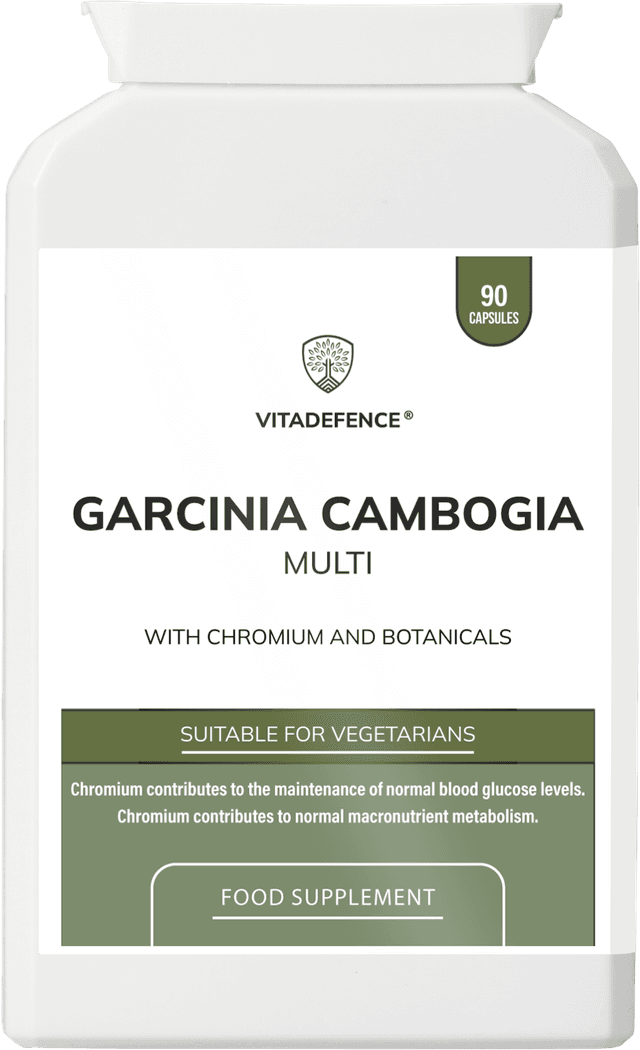
A clean cream pot with the green band of our label. Ninety vegan capsules — about a month and a half at the recommended one-to-four-a-day. The dose is taken thirty minutes before meals, which is the traditional time for a souring agent in any cuisine that uses one — before the meal, not during, because the function is appetite-orienting rather than mid-meal flavouring.
A note up front: this product contains caffeine (about 1.5mg per capsule, which is small but real, from the green coffee extract). It is not recommended for children or pregnant women. If you're sensitive to coffee, take it earlier in the day rather than late.
Garcinia cambogia — the kokum tree
The garcinia tree (Garcinia gummi-gutta in modern Latin) is a small evergreen with dark glossy leaves, growing up to twelve metres tall, native to the Western Ghats of India and parts of Southeast Asia. The fruit is the size of a small orange and looks, when ripe, like a yellow-green pumpkin in miniature — five or six longitudinal lobes running from stem to base.
In Konkani-speaking coastal Karnataka the dried rind is called aamsul. In Marathi, kokum. Down the Malabar coast in Kerala, it's kudampuli or fish tamarind. In Sri Lanka, goraka. The ingredient changes name every two hundred kilometres of coastline, but the function stays the same: a souring agent for fish, for prawns, for lentil curries, for the smoked-fish dish meen vevichathu that defines a Keralan home kitchen.
You dry the rind in the sun, sometimes smoked, until it darkens and stiffens. To use it, you tear off a piece and drop it whole into the simmering pot. After half an hour the curry has acquired the soft, fruity sourness that is unmistakably garcinia — different from lemon (sharper), different from tamarind (more puckery), different from vinegar (more aromatic).
The compound that gives the rind its sour bite is hydroxycitric acid — an organic acid related to the citric acid in citrus fruit. We use 260mg of garcinia whole-fruit powder per capsule. We are not making any specific claims about what this does. We are saying it is a long-traditioned culinary plant and we have included it in this formula at a meaningful dose, exactly as you would find it in the right curry.
Green coffee — the bean before it was roasted
Coffee, before it is roasted, is green. The green bean carries a much higher concentration of a compound called chlorogenic acid than the roasted bean does — heat breaks chlorogenic acid down. So green coffee extract isn't a different plant; it's the same plant, taken at a different point in the process.
We use a substantial dose: 1,500mg equivalent weight of green coffee bean from concentrated extract per capsule. Coffee, of course, has its own long history — from the Ethiopian highlands where the legend of the goat-herd Kaldi places its discovery, through Yemeni Sufi monasteries where it became a religious aid against drowsiness, through Ottoman coffeehouses, through the European Enlightenment, into the morning kitchen of nearly every household on earth.
The chlorogenic acid in green coffee belongs to the polyphenol family — the same broad family of plant compounds you'd find in dark berries, in red wine grape skins, in green tea leaves. The caffeine content of a single capsule is about 1.5mg — for context, an espresso has roughly a hundred milligrams. Not enough to keep you awake. Enough that we mention it on the label.
Cinnamon — the spice that earned an empire
Cinnamon (Cinnamomum cassia, in this formula) is the inner bark of a small evergreen tree, peeled and dried into the curls you'd recognise from any spice rack. We use 399mg of cinnamon per capsule, equivalent weight from extract.
The history of cinnamon is the history of the spice trade itself. Ancient Egyptians used it in embalming and as a perfume. Mediaeval Arab merchants, who controlled the supply, told European buyers elaborate stories about giant birds carrying it from the nests of distant cliffs — anything to keep the source secret. When Portuguese ships reached Sri Lanka in the 1500s, they discovered the truth: cinnamon was the bark of a small tree, and the people who had been growing it for two thousand years had simply chosen not to share where.
In supplement form cinnamon has earned its place because of the polyphenol profile in the bark — the same broad family of compounds we keep returning to in this formula.
White kidney bean — the lectin and the legume
White kidney bean (Phaseolus vulgaris) at 200mg per capsule. The white kidney bean is the bean of a thousand European peasant kitchens — the cannellini of Tuscany, the haricot blanc of France, the bean in a slow-cooked Boston baked dish.
The reason it appears in supplement form rather than as a soup is that the bean contains a specific protein, phaseolamin, which has been studied for decades as a digestive interactor with starches. We don't make claims about what it does. We do say: the bean is a long-traditioned food, the protein is well-known, and a 200mg extract dose is a sensible inclusion in a formula like this one.
Bamboo — the silica plant
200mg of bamboo extract (Bambusa vulgaris) per capsule. Bamboo earns its place for one specific reason: it is one of the highest natural sources of plant silica on the planet. Silica is the trace mineral that contributes to connective tissue — the framework that holds skin, hair, nails and the linings of joints together.
We don't make EFSA claims about silica. We include the bamboo because it is the cleanest plant-derived silica source and because, in a formula about plants and balance, a quiet trace mineral background earns a seat at the table.
Glucomannan — the konjac root
100mg of glucomannan per capsule, from the konjac plant (Amorphophallus konjac) — a soft, fibrous root that has been a Japanese kitchen ingredient for fifteen hundred years. In Japan it becomes konnyaku, a slightly translucent jelly that is one of the basic ingredients of oden hot-pot. The shirataki noodles in your last bowl of ramen — the slightly bouncy near-translucent ones — are made from konjac.
Glucomannan is a soluble fibre. In the gut it absorbs many times its own weight in water. The texture of konnyaku is exactly that absorption working in the bowl. As a fibre, it has a long traditional association with the digestive sense of fullness that comes from a bowl of well-cooked vegetables.
(One small safety note — anyone using glucomannan-containing capsules should drink plenty of water with them. The fibre absorbs water; without enough water, that's not a happy combination. The label warns about choking risk for people with swallowing difficulties.)
CLA — conjugated linoleic acid, the dairy fat
12mg of conjugated linoleic acid per capsule. CLA is a particular kind of fatty acid found mostly in the milk and meat of grass-fed cattle and sheep — which is why traditional dairy-eating cultures (Alpine, Scottish Highland, Anatolian, Indian) get more of it than modern grain-fed-beef-and-margarine ones do.
Note for vegans: this product contains milk-derived CLA. The label flags this in its allergy advice. Suitable for vegetarians, not for strict vegans.
Chromium — the trace mineral
100µg of chromium per capsule (250% of the EU Nutrient Reference Value) — the only ingredient in this formula on which we can speak with the precision of an authorised nutrition statement. Chromium is a trace mineral that contributes to the maintenance of normal blood glucose levels and contributes to normal macronutrient metabolism. Those are EFSA-authorised wordings — the careful, label-accurate way of saying that chromium plays a role in how the body processes the carbohydrates and fats in a meal.
How to use it
One capsule, two to four times per day, taken thirty minutes before meals. Drink water alongside.
If you're new to caffeine sensitivity, start with one capsule before breakfast and skip the late-evening dose — the small amount of caffeine adds up across four capsules.
Don't take it pregnant or breastfeeding. Not for children. If you're on prescription medication — particularly anything affecting blood sugar — speak to your GP first, especially given the chromium content. Anyone with swallowing difficulties should not take glucomannan-containing capsules.
Honest caveats
This is a food supplement — it complements a varied diet, it doesn't replace one, and it certainly doesn't replace home cooking, time on your feet, or sleep. Contains caffeine (1.5mg per capsule). Contains milk (CLA). Halal-approved, Kosher-approved, vegetarian-friendly, not strict-vegan-friendly because of the dairy CLA.
If you've read this far, thank you. We've tried to write the kind of page we'd want to read about a fruit that has been heavily oversold to us by other people for years. The truth is simpler and, we think, more interesting: kokum is a real coastal-Indian souring spice, green coffee is a beautiful unroasted bean, cinnamon was once worth more than gold, and chromium plays a quiet role in how a meal becomes you. Eight ingredients, one capsule, taken before meals, the way a proper bitter or sour was always taken before meals — to wake the system up, gently, before you eat.
— Vitadefence
— Vitadefence