Showcase
Glucomannan Multi
A fibre-led capsule built around konjac glucomannan and green tea, with raspberry, Siberian ginseng and African mango. The Japanese root that has anchored noodle bowls for fifteen hundred years.
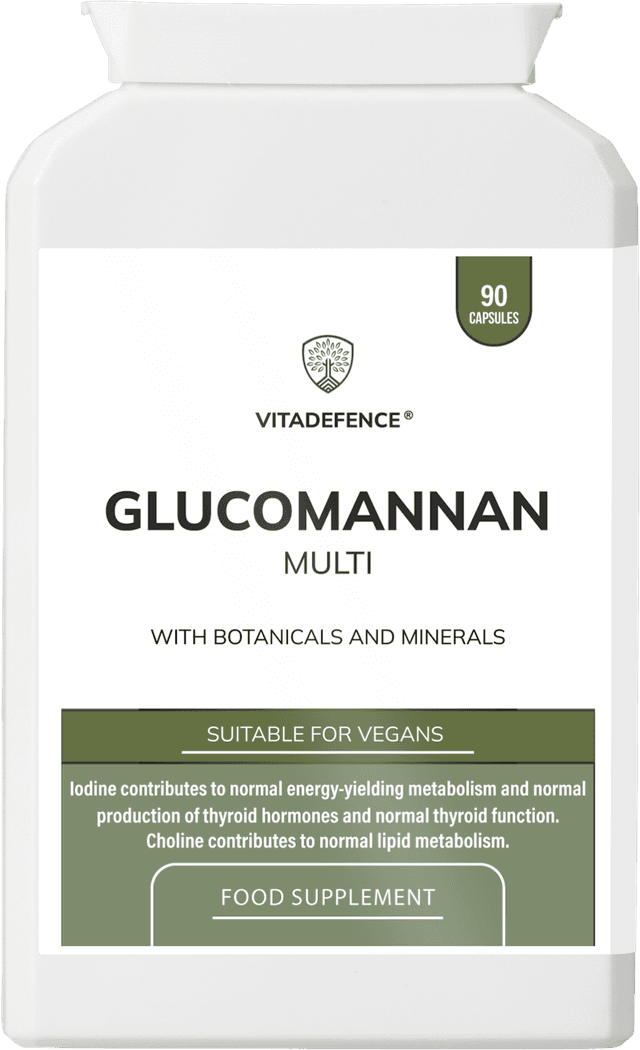
The Japanese root that became noodles, the green leaf that became tea, and the small handful of plants we've put around them.
There is a particular kind of restlessness that shows up around mid-afternoon. You ate lunch a few hours ago. It was, on paper, fine — a sandwich, a bowl, whatever. And yet by 4pm something in your stomach is asking for the next thing already, and the asking is louder than it should be. You're not actually hungry. You just feel a little hollow.
For most of human history this was solved by a bowl of well-cooked vegetables. The bowl of vegetables had three things going for it that the modern sandwich often doesn't: it had bulk (real fibre, real volume), it had time (cooked slowly, eaten slowly), and it had plant variety (one bowl with five or six different plants in it). The combination is what makes a meal settle in the body — the sense of being properly fed rather than just calorically refilled.
This bottle is one quiet attempt to replicate, in capsule form, two of those three properties: bulk, from a Japanese root that absorbs many times its own weight in water; and plant variety, from a small but deliberate assembly of partners around it.
The bottle, in your hand
A clean cream pot. Ninety vegan capsules. The dose is two capsules, two or three times a day, taken with water before meals. At three doses a day the pot lasts fifteen days; at two, it lasts about three weeks.
A few notes up front, because they matter:
- This product contains caffeine (50mg per serving — roughly half a small cup of coffee, mostly from green tea and a touch of guarana). Not for children. Not for pregnant or breastfeeding women.
- The label carries a choking warning — glucomannan is a powerful fibre that absorbs water in the gut. Always take with plenty of water. Anyone with swallowing difficulties should not take this product.
These warnings are real and we'd rather flag them at the top than bury them at the end.
Glucomannan — the konjac root, and why Japan has used it for 1,500 years
Glucomannan is a soluble fibre extracted from the root of Amorphophallus konjac — a soft, fibrous tuber native to East Asia. Konjac arrived in Japan from China in the sixth century alongside Buddhism. Mediaeval Japanese monks ate it during fasting periods because it filled the bowl without filling the body in the conventional sense.
Walk into any Japanese supermarket and you will find konjac in three forms. Konnyaku — a slightly translucent grey jelly, sliced and added to oden hot-pot. Shirataki — long, near-transparent noodles that bounce against the teeth and make up the soft thread of certain ramen and sukiyaki bowls. Konjac powder — the form we're using here, the dried and milled root.
The thing that gives all three of these their character is the same thing that gives the powder its function: glucomannan is a fibre that absorbs roughly fifty times its weight in water. Drop a teaspoon into a glass and watch — within minutes the powder has formed a thick gel.
Inside the gut this property does what fibre always does: it adds bulk. The European Food Safety Authority has authorised a specific wording for glucomannan: glucomannan, in the context of an energy-restricted diet, contributes to the maintenance of normal blood cholesterol levels and to weight loss. The authorised dose for those effects is 3g of glucomannan per day, in three doses of 1g each, with one to two glasses of water, before meals.
This formula provides 1,000mg (1g) of glucomannan in a two-capsule serving — at three servings a day, exactly the EFSA-authorised dose. The caveats remain: an energy-restricted diet, plenty of water, before meals.
We are not going to dress it up beyond what the law and the science actually permit. The fibre is real. The mechanism is real. The dose matters.
Green tea — the leaf that anchors most of Asia's afternoons
1,000mg equivalent weight of green tea (Camellia sinensis) per serving, from concentrated extract.
Tea entered Chinese cultural life around the eighth century — the Tang Dynasty poet Lu Yu wrote The Classic of Tea in 760 AD, the first systematic treatise on its cultivation, preparation and ritual. From China the leaf travelled to Japan with the Buddhist monk Eisai in the twelfth century, where it became inseparable from Zen practice. From Japan it eventually travelled west — slowly, a luxury at first, then a daily fact in millions of British and Indian and Russian kitchens.
The compounds in green tea that have earned the most modern attention are the catechins — particularly EGCG (epigallocatechin gallate). Catechins belong to the polyphenol family — the same broad family of plant compounds that gives dark berries, red wine grape skins, cinnamon bark and turmeric root their character. They are, in plain words, plant compounds that the plant uses to defend itself against environmental stress, and which seem to do useful work in our own internal balancing systems when we eat them.
A small amount of caffeine comes along for the ride — roughly 25-40mg per gram of green tea extract, depending on the standardisation. We've kept the dose modest.
Raspberry, Siberian ginseng, African mango — the three quieter plants
Three plants that earn their seat at the table for very different reasons.
Raspberry fruit — 600mg equivalent weight per serving. Raspberry (Rubus idaeus) is a hedgerow plant of northern Europe, the small red drupe of every British country lane and northern French farmhouse garden. The fruit is rich in anthocyanins (the red pigment) and in a particular polyphenol called raspberry ketone — the compound that gives ripe raspberries their unmistakable smell. We use it for its polyphenol profile, not for any specific claim.
Siberian ginseng — 350mg equivalent weight. Eleutherococcus senticosus is the eleuthero of Russian and northern Chinese herbal medicine — a different plant from the Korean Panax ginseng, with its own long traditional history of use in cold-climate, hard-working populations. In traditional Chinese medicine it sits in the category of adaptogens — plants used to help the body's own balancing systems through stress.
African mango — 200mg equivalent weight. Irvingia gabonensis is a tree of the West African rainforest. Its fruit is mango-shaped but not the same plant as the Indian mango most of us know; the seed inside has been a traditional Cameroonian and Nigerian kitchen ingredient for centuries, ground and used to thicken stews. Modern interest centres on its high soluble-fibre content — a different fibre profile from glucomannan, included here for plant-variety reasons.
Cayenne, guarana, citrus aurantium — the small bright trio
Three traditional warming plants, in modest doses.
Cayenne pepper (Capsicum annuum) — 80mg equivalent weight. The capsicum that defines a thousand cuisines from Mexico to Sichuan to West Africa. The compound that gives cayenne its heat — capsaicin — has been a culinary and traditional medicinal ingredient since the Aztecs cultivated it, and probably long before.
Guarana (Paullinia cupana) — 40mg equivalent weight, providing a small amount of natural caffeine. Guarana is a climbing vine native to the Amazon basin, used by the Sateré-Mawé people of Brazil for centuries before European contact. The dried roasted seed has roughly twice the caffeine concentration of a coffee bean. It is included here at a very modest dose to round out the plant-variety side of the formula.
Citrus aurantium (bitter orange) — 40mg whole-fruit powder. The fruit of the bitter orange tree, the original sour orange of Mediterranean cooking — used in marmalade, in Cointreau, in the dressing on a Sicilian fennel salad.
The supporting ingredients
A handful of supporting ingredients earn label-accurate mentions.
Vitamin B6 (10mg per serving — 714% NRV) — contributes to normal energy-yielding metabolism and to the reduction of tiredness and fatigue. Authorised EFSA wording.
Choline (8mg) — a B-vitamin-adjacent nutrient we get mostly from eggs. Included here as a small dietary contribution.
Zinc (4mg, 40% NRV) — contributes to the maintenance of normal hair, skin and nails and to normal immune function. Authorised EFSA wording.
Chromium (50µg, 125% NRV) — contributes to the maintenance of normal blood glucose levels and to normal macronutrient metabolism. Authorised EFSA wording.
Iodine (40µg, 26% NRV) — sourced from kelp extract (Laminaria japonica). Iodine contributes to normal thyroid function and to normal energy-yielding metabolism. Authorised EFSA wording.
L-tyrosine (40mg) — an amino acid the body uses as a building block for thyroid hormone (in concert with iodine) and certain neurotransmitters. Included here as a small dietary contribution; no specific claims.
Piperine (3mg, equivalent weight from black pepper extract) — the compound that gives black pepper its bite. Used as a small absorption helper for the polyphenols in the formula.
How to use it
Two capsules, two or three times per day, taken with plenty of water, before meals. The water matters — glucomannan absorbs many times its weight, and you want it absorbing in your stomach with adequate fluid, not in your throat without any.
For the EFSA-authorised effect of the glucomannan, take three doses a day (3g total), with at least one to two glasses of water per dose, and as part of an energy-restricted diet — the law is specific on this. Without the energy-restricted diet, you're getting the fibre but not making the authorised claim.
If caffeine sensitivity is a concern, take both daily doses earlier — breakfast and lunch — and skip the third. The 50mg per serving (mostly green tea, a touch of guarana) is roughly half a small cup of coffee.
Honest caveats
This is a food supplement — complements a varied diet, doesn't replace one. Contains caffeine (50mg per serving — not for children, not for pregnant or breastfeeding women). Choking risk for people with swallowing difficulties — take with plenty of water. If you are on prescription medication — particularly anything that interacts with fibre absorption (some heart medications and certain diabetes medications need to be timed apart from soluble-fibre supplements), or anything affecting thyroid function (we have iodine here), or any blood-thinner — talk to your GP before starting.
Suitable for vegetarians and vegans. Kosher-approved. Halal-approved.
Keep cool, dry, sealed, out of reach of children. Best before date on the base.
If you've read this far, thank you. We've tried to write the kind of page we'd want to read before spending money on a fibre supplement — no neon claims, no overblown promises. The Japanese root has been earning its place in noodle bowls for fifteen hundred years; the green tea leaf has been earning its place in tea cups for thirteen hundred. The dose matters. The water matters. The diet around it matters. None of those are revolutionary points, but they are the honest ones.
— Vitadefence
— Vitadefence