Showcase
Green Coffee Multi
The coffee bean before it was roasted — high in chlorogenic acid, with cinnamon, kelp and cayenne alongside. The plant story behind a substantial 8000mg green coffee equivalent dose.
The coffee bean before it was roasted, the cinnamon bark before it became a teaspoon of crumb topping, and three trace minerals to round out the morning.
If you have ever picked up a fresh coffee cherry at origin — in Ethiopia, Colombia, Vietnam, Brazil — you will have noticed something. The cherry is bright red. Inside, when you split it open with your thumbnail, there are two pale green seeds. Those seeds are coffee beans. They are not brown. They are the colour of an unripe pistachio.
Roasting is what turns them brown. The high temperature transforms the bean — caramelising sugars, developing aromatic compounds, creating the dark colour and the complex flavour that the rest of the world calls coffee. Roasting also breaks down a particular compound the bean started out with: chlorogenic acid. The longer and darker the roast, the less chlorogenic acid survives.
So green coffee extract isn't a different plant. It isn't a marketing rebrand. It is exactly the same plant — the same coffee bean, from the same coffee farm, often from the same harvest — taken at a different point in the process. Before the roaster. Before the chemistry changes.
This bottle puts the unroasted bean into a capsule, at a substantial 8,000 milligrams equivalent weight from concentrated extract per capsule. That sits at the upper end of green coffee dosing in the supplement world, deliberately. Around it sit four supporting ingredients with their own stories — cinnamon, kelp, cayenne and chromium.
The bottle, in your hand
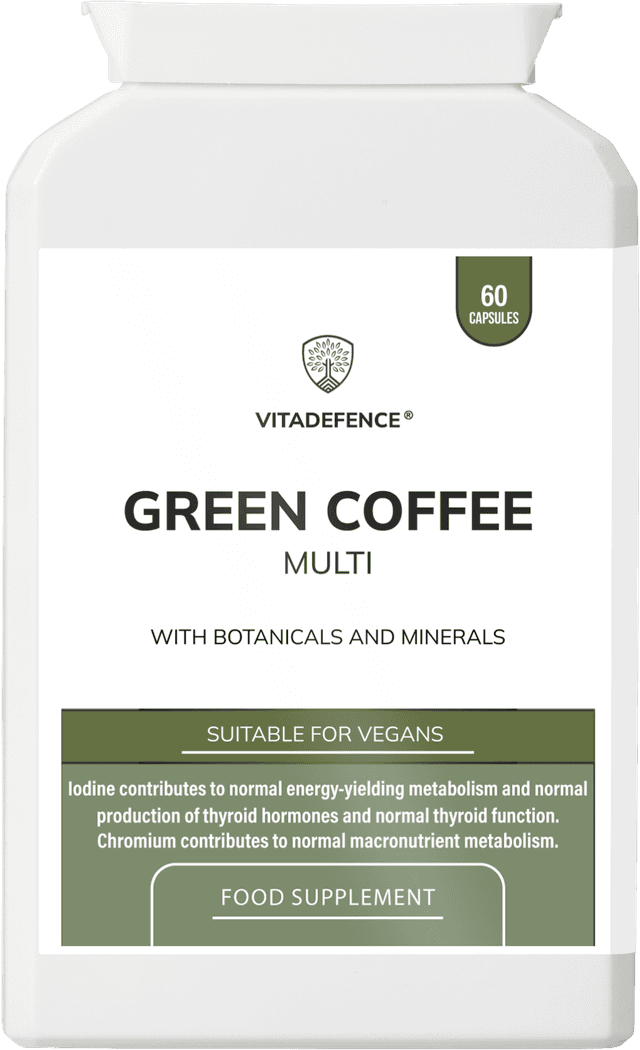
A clean cream pot with the green band of our label running around it like a forest line. Sixty vegan capsules — a two-month supply at the lower dose, three weeks at the higher one. The dose is one capsule, one to three times per day, taken with water.
A note up front: this product contains caffeine — about 8mg per capsule from the green coffee, which is small but real. (For context, a standard espresso has roughly 100mg.) Not recommended for children. Not recommended for pregnant or breastfeeding women. If you're caffeine-sensitive, take it earlier in the day and stick to one or two capsules rather than three.
The label also notes — honestly — that the green coffee bean does not originate from the UK. We source from established global coffee origins; the encapsulation and final-product blending happens in the UK to GMP standards.
Green coffee — the bean before the roaster
8,000mg equivalent weight of green coffee bean (Coffea robusta) per capsule, from concentrated extract standardised to 50% chlorogenic acid.
Coffee's history is long. The plant is native to Ethiopia — the highlands where the legend places its discovery, by a young goat-herd named Kaldi who noticed his goats becoming unusually energetic after grazing on a particular shrub. The goats led him to the cherries. Kaldi tried them himself, and that is, depending on which version of the legend you read, how the world found out.
From Ethiopia coffee crossed the Red Sea to Yemen, where Sufi monasteries adopted it as a religious aid against drowsiness during long evening prayers. By the 1500s coffee houses had spread to Cairo, Damascus, Istanbul. By the 1600s they had reached Venice, then Vienna, then London — Lloyd's of London, the famous insurance market, was originally a coffee house. By the 1700s coffee was being grown in Java, in the Caribbean, and eventually across Latin America.
The compound that the supplement world has paid most attention to in recent decades is chlorogenic acid. It is a polyphenol — the same broad family of plant compounds we keep returning to in our other formulas: the pigments and bitter principles plants make to defend themselves against environmental stress. In green coffee, chlorogenic acid is the dominant polyphenol; in the roasted bean, much of it has broken down into other compounds.
We have used a 50%-standardised extract because consistency matters. A green coffee bean grown at 1,800 metres in Ethiopia and a green coffee bean grown at 600 metres in Vietnam will have meaningfully different chlorogenic acid content. Standardising to a fixed percentage means each capsule does the same job regardless of which farm grew it.
Cinnamon — the bark that earned an empire
300mg equivalent weight of Ceylon cinnamon (Cinnamomum zeylanicum) per capsule.
There are several different plants in the world that get called cinnamon. The most common one in the UK supermarket is Chinese cinnamon — Cinnamomum cassia — which is fine for crumb toppings but has a slightly higher coumarin content. The cinnamon in this formula is Ceylon cinnamon — the original cinnamon, the one Sri Lankan growers cultivated for two thousand years before the rest of the world had words for it.
The history of cinnamon is the history of the spice trade. Ancient Egyptians used it in embalming and as a perfume; mediaeval Arab merchants, who controlled the supply, told European buyers fantastic stories about giant birds carrying cinnamon from inaccessible cliff-side nests — anything to keep the source secret. When Portuguese ships finally reached Sri Lanka in the 1500s, they discovered the truth: cinnamon was the inner bark of a small evergreen tree, and the people who had been growing it for two millennia had simply chosen not to share where.
Ceylon cinnamon's bark is paper-thin, rolled into the multi-layered curls you would recognise from a good spice merchant. Its flavour is softer, sweeter, more complex than the cassia most kitchens use. We've used it deliberately — the better cinnamon, in a meaningful dose.
In supplement form cinnamon earns its place because of the polyphenol profile in the bark — including a particular compound called methylhydroxychalcone polymer, which has been studied for decades for the way it interacts with how the body processes dietary sugars. We don't make specific claims; we do say the spice is well-traditioned and the polyphenol family is the same one we've been threading through this whole formula.
Kelp — the seaweed that gave us iodine
80mg equivalent weight of kelp (Laminaria japonica) per capsule, providing 200µg of iodine — 133% of the EU Nutrient Reference Value.
Kelp is one of the giant brown seaweeds — konbu in Japan, dashima in Korea — the long, leathery, sea-green ribbons that anchor a thousand kilometres of coastline along the Pacific Rim. Laminaria japonica in particular has been a Japanese kitchen ingredient for at least 1,500 years. Dried strips of konbu sit at the bottom of the dashi-stock pot; the savoury depth of miso soup, of oden hot-pot, of nearly every Japanese broth begins with a piece of kelp.
The reason kelp matters in a supplement is iodine. Kelp absorbs and concentrates iodine from seawater more efficiently than almost any other plant on earth. A teaspoon of dried kelp contains more iodine than most people get in a week of inland eating.
Iodine contributes to normal thyroid function, to the maintenance of normal skin, and to normal energy-yielding metabolism. Those are EFSA-authorised wordings — the careful, label-accurate way of stating what iodine actually does in the body. Modern Western diets, particularly diets that have moved away from sea fish, are often slightly low in iodine. Most table salts in the UK are not iodised by default. A daily 200µg dose from kelp is a sensible top-up for the inland eater.
Cayenne — the small bright pepper
40mg equivalent weight of cayenne pepper (Capsicum annuum) per capsule.
Cayenne is the small, bright, hot capsicum that defines a thousand cuisines from Mexico to West Africa to Sichuan. The Aztecs were cultivating chillies long before the Spanish arrived; chillies travelled out of the Americas with Columbus and within a hundred years had been adopted by Indian, Ethiopian, Hungarian, Korean and Sichuan kitchens as if they had always been there. They are one of the great culinary success stories of the post-Columbian world.
The compound that gives cayenne its heat is capsaicin — the same compound that puts the burn into chilli oil and the sting into a Sichuan dan dan noodle. In the kitchen capsaicin is a culinary brightness; in supplement form, at the modest doses used here, it earns its place as part of the warming-spice tradition that runs through this formula.
Bamboo — the silica plant
A small inclusion of bamboo silica extract (Bambusa vulgaris) — used as a natural anti-caking agent in the capsule and providing a trace contribution of plant silica. Silica is the trace mineral that helps form the framework of skin, hair, nails and connective tissue. We don't make EFSA claims about silica; the bamboo earns its place as a clean plant-derived inclusion.
Chromium — the trace mineral that closes the formula
50µg of chromium per capsule — 125% of the EU Nutrient Reference Value.
Chromium is a trace mineral the body uses in tiny amounts. It contributes to the maintenance of normal blood glucose levels and to normal macronutrient metabolism. Those are EFSA-authorised wordings — the careful, label-accurate way of saying that chromium plays a quiet role in how the body processes the carbohydrates and fats in a meal.
The chromium pairs intentionally with the cinnamon and the green coffee — both of which interact with the same dietary-sugar handling story from different angles. A capsule that contains all three, taken before or with a meal, is the practical expression of that thinking.
How to use it
One capsule, one to three times per day, taken with water. Most people start with one capsule before breakfast and find that's plenty.
If you decide to use the higher dose, take it as one before breakfast and one before lunch — keep the caffeine to the morning half of the day. The 8mg per capsule is small (roughly a tenth of an espresso) but it adds up across three doses.
If you're already drinking coffee — and most of us are — bear that caffeine load in mind. Six espressos plus three of these capsules is more than the body needs in a day. One coffee plus one capsule is fine.
Honest caveats
This is a food supplement — it complements a varied diet, doesn't replace one. Contains caffeine (8mg per capsule) — not for children, not for pregnant or breastfeeding women. The green coffee bean does not originate from the UK; the formula is encapsulated and blended in the UK to GMP standards. If you are on prescription medication — particularly anything affecting blood sugar (we have chromium and cinnamon here), thyroid function (we have iodine), or caffeine sensitivity — speak to your GP first.
Suitable for vegetarians and vegans. Kosher-approved. Halal-approved. Keep cool, dry, sealed, out of reach of children. Best before date on the base.
If you've read this far, thank you. We've tried to write the kind of page we'd want to read before spending money on a green coffee supplement — no neon promises, no fat-burning fantasies. The truth, as it usually is, is more modest and more interesting: the bean before it was roasted is a different chemistry from the bean after; cinnamon was once worth more than gold; kelp gave half the world its iodine; and chromium plays a quiet role in how a meal becomes you. Six ingredients, one capsule, the kind of small honest formula we'd be proud to leave on the kitchen shelf.
— Vitadefence
— Vitadefence