Showcase
Herbal Multi
Ten plants in a small capsule, in the tradition of British and Chinese apothecary medicine. Fibre, bitter roots, warming pepper. The kind of formula your grandmother would have recognised.
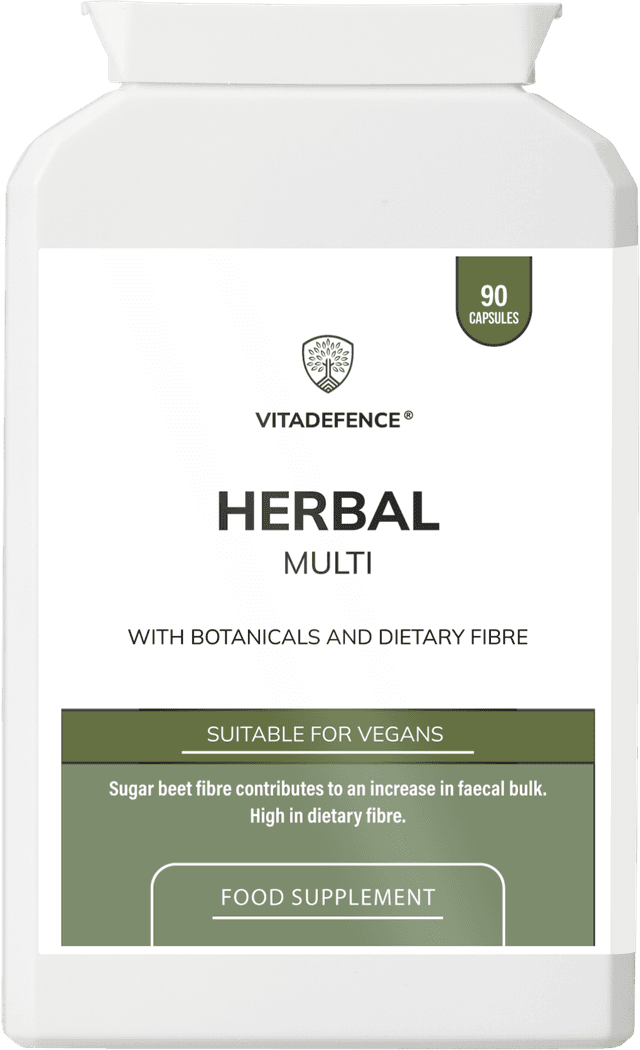
A ten-plant fibre and bitters blend, in the British apothecary tradition.
When the modern diet has gone too clean
There's an irony at the heart of the modern food shop. We've cleaned up our food — pre-washed, peeled, packaged, palatable, low in roughage, low in bitterness, low in surprises. And in doing that, we've quietly removed two whole categories of plant from the daily plate: dietary fibre, and bitter roots. The two things every traditional cuisine, from Yorkshire to Sichuan, used to take for granted.
Walk back two centuries. A British kitchen would have had rhubarb stewing in spring, dandelion leaves from the lawn, ginger root grated into puddings, nettles in soup, garlic plaited from the rafters. A Chinese kitchen of the period had different plants, same logic — bitter, warming, fibrous, alive.
This little bottle is one quiet way back. Ten plants from the old apothecary cabinet — rhubarb root, glucomannan, cayenne, sugar beet fibre, dandelion, aloe vera, ginger, nettle, barberry bark and black garlic — packed into a vegan capsule. One or two capsules, one to three times a day. Not a meal replacement, not a detox kit. A small, daily nudge back toward the variety modern shopping baskets have edited out.
The bottle, in your hand
A clean cream pot, the green band of our label running around it, ninety vegan capsules inside. Each capsule is a small dose of ten plants, no fillers, brown rice flour as the carrier. Take one or two with water, with or without food, up to three times a day.
Don't expect a coffee-strong effect. These are bitters and fibres — quiet plants, the kind that work in the background, the kind your body responds to over weeks rather than minutes.
The story of rhubarb
Rhubarb is older than most people realise. The root — Rheum palmatum, the medicinal Chinese rhubarb — appears in the Shen Nong Ben Cao Jing, a Han-dynasty herbal text dated around 200 BC. By the Tang dynasty (618–907 AD) it was a major export crop along the Silk Road, prized so highly in Europe that during the eighteenth century it cost more than cinnamon. The British learned to grow the culinary stalks (Rheum rhabarbarum) but the root tradition stayed in China.
Two compounds give rhubarb root its character — anthraquinones, which give the root its deep yellow colour and its place in traditional Chinese digestive practice, and tannins, which give it the slightly astringent, slightly bitter edge of the cup. Used carefully, in the small culinary doses this formula carries, rhubarb root is one of the great quiet bitters of the herbal tradition.
We carry both rhubarb root powder and a concentrated rhubarb root extract here — the powder for whole-plant character, the extract for a measured contribution.
Glucomannan — the soluble fibre from konjac
Glucomannan is a soluble fibre extracted from the corm of Amorphophallus konjac, a tuber that has been cultivated in China and Japan for over a thousand years. In Japan it is the source of konnyaku, a translucent jelly cake; in shirataki noodles it gives the slippery, low-calorie texture noodle-bowls have built whole cuisines around.
In a capsule, the dose is small — around 7mg — and is part of the wider fibre profile of this formula rather than the headline. Note that glucomannan, taken as a deliberate fibre supplement at the EFSA-authorised dose of 3g per day, requires a full glass of water with each dose; the tiny culinary amount in this capsule does not, but it is sensible to take any fibre-bearing capsule with water all the same.
Cayenne — the warming red pepper
The cayenne pepper (Capsicum annuum) is a New World plant, brought to Europe via Spanish trade in the sixteenth century, then carried east into Indian, Sichuanese, and Korean cooking with such enthusiasm that today most people forget it isn't native. Its compound, capsaicin, is the molecule responsible for both the heat on the tongue and the warming sensation in the stomach. In old British herbal practice, a pinch of cayenne in a tonic was the standard "warming" addition. We use a small dose — enough to feel the kitchen heritage of the formula, not enough to upset a sensitive gut.
Sugar beet fibre — the British beetroot's quiet cousin
Sugar beet (Beta vulgaris) is a paler cultivar of the same species as the deep red beetroot. The pulp left after sugar extraction is a clean, neutral-tasting source of insoluble fibre — the kind that bulks the diet, the kind the modern shopping basket runs short of. Forty-five milligrams per capsule isn't dramatic on its own; over ninety capsules of daily use it is one of the small, steady ways this formula nudges fibre intake gently upward.
Dandelion root — the bitter spring tonic
The dandelion, Taraxacum officinale, is one of those plants the Victorian gardener cursed and the Victorian herbalist quietly harvested. Both right. The root, dried and ground, has been part of European spring tonics for a thousand years — bitter, mineral, the kind of taste the modern palate has been protected from but the liver appears to recognise.
Dandelion root is a bitter — and bitterness, in classical European and Chinese herbal traditions, is the flavour associated with appetite, digestion, and the upper end of the stomach's natural rhythm. A small extract dose here is an old herbal handshake.
Aloe vera leaf — the desert succulent
The aloe vera plant (Aloe barbadensis) has been a folk-medicine plant from Egypt to Mesoamerica for over five thousand years. The clear inner leaf gel is the cosmetic part most people know. The dried whole-leaf powder, used at low concentration in herbal blends like this, is a different proposition — slightly bitter, slightly cooling, used in traditional Indian Ayurvedic practice for centuries. We use a 200x concentration powder, which means a tiny weight gives a meaningful plant signature.
Ginger root — the warming kitchen staple
Ginger (Zingiber officinale) needs little introduction. Native to maritime Southeast Asia, traded into Roman Europe by the first century AD, used in every major cuisine on Earth, ginger is one of the rare plants that crosses every kitchen and every herbal tradition. Its compounds — gingerols and shogaols — give it both the warmth on the tongue and the gentle settling effect on the stomach that has made it the grandmother's-cure-for-travel-sickness for as long as anyone can remember. A small extract dose sits comfortably alongside the rhubarb and the cayenne in this formula.
Nettle leaf — the hedgerow mineral plant
The stinging nettle (Urtica dioica) is one of the most mineral-dense leafy greens in the British countryside. Cooked or dried, the sting disappears and what's left is a nutritious, slightly grassy leaf rich in iron, calcium, and trace minerals. In English herbal practice nettle has been the spring tonic for joints and skin for a thousand years. Here it sits as one more layer of dark green plant character in the capsule.
Barberry bark — the yellow-rooted European herb
Barberry (Berberis vulgaris) is a thorny European shrub, native to England and across the continent. Its inner bark is bright yellow and contains berberine — a compound shared with goldenseal, Oregon grape, and the Chinese herb huang lian. Berberine has been the subject of considerable modern interest, but it has been a quiet pillar of European folk-bitters for far longer than the modern lab has been studying it.
Black garlic — the fermented kitchen staple
Black garlic is regular garlic (Allium sativum) slowly aged at warm humidity for several weeks, until the cloves turn jet black and develop a sweet, prune-like flavour. The technique is Korean in origin. In a capsule it brings the sulphur compounds of garlic without the breath. Small dose, quiet contribution.
How to use it
One or two capsules, one to three times a day, with water, with or without food. Most people take one or two with breakfast and find that's enough; some take a second small dose in the evening. The bottle holds ninety capsules — at two a day it lasts about six weeks, at six a day a fortnight.
Take it with food if your stomach is sensitive. If you are new to bitter herbs, start with one capsule and see how the day feels. Don't stack three other fibre supplements on top of this one — fibre is a thing the body adjusts to over a week or two, not a thing to suddenly triple. And as always with fibre, drink water.
Honest caveats
This is a food supplement — it complements a varied diet, it doesn't replace one. It is not a laxative kit, not a detox kit, not a weight-loss product. Rhubarb root and aloe vera leaf both contain compounds that, in much higher doses than this formula carries, are used as stimulant laxatives — at the small culinary doses here, they are part of a wider bitter profile rather than that effect.
Do not take if you are pregnant or breastfeeding. Do not take if you have inflammatory bowel disease, intestinal obstruction, or are taking blood-thinning medication, without speaking to your GP. Don't exceed six capsules a day. Keep the bottle cool, dry, sealed, out of reach of children.
If after eight weeks nothing has shifted, stop. A capsule that isn't doing anything for you isn't worth the money — we would rather have your trust for the next thing than your guilt over the wrong one.
— Vitadefence
— Vitadefence