Showcase
Krill Oil Antarctic
A small red softgel from the cleanest sea on Earth. The story isn't the EPA. The story is the source — a fishery managed under treaty, a species at the bottom of a clean food chain, and a phospholipid carrier the body recognises.
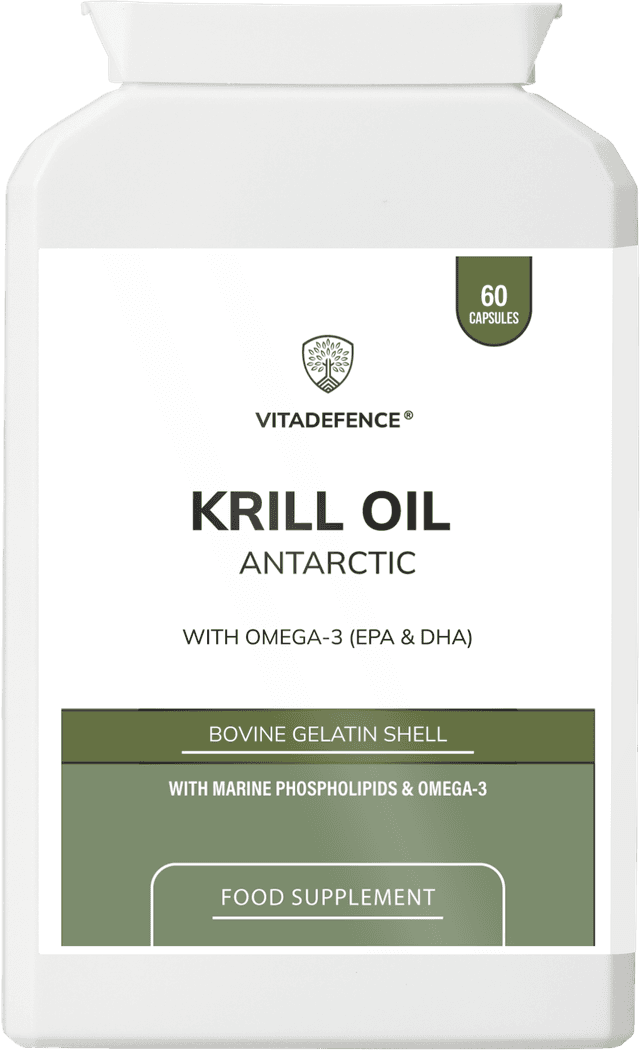
A small red softgel from the cleanest sea on Earth.
Why this is a different conversation than fish oil
Most omega-3 supplements answer the same question: how do I get EPA and DHA into my diet without eating salmon four times a week? The usual answer is fish oil — typically anchovy or sardine, refined and concentrated, sometimes with a vitamin E preservative, sometimes a flavour. It works. It is cheap. And it has a well-documented problem: the further up the food chain the fish lives, the more it has accumulated whatever the rivers and the open ocean carried into its prey before it ate them.
Krill is a different conversation, for three reasons.
First, the source. Antarctic krill (Euphausia superba) lives in the Southern Ocean, in waters that ring the coast of Antarctica. There are no rivers carrying agricultural runoff into the Southern Ocean. There are no industrial cities upstream. There are no upstream fish for these tiny creatures to eat. Krill feed on phytoplankton — the single-celled algae that bloom across the polar summer when the ice retreats. They sit at the very bottom of the marine food chain, two trophic levels below the salmon, four below the tuna.
Second, the fishery. Since 1982 the Southern Ocean krill fishery has been managed under the Convention on the Conservation of Antarctic Marine Living Resources — CCAMLR — a 27-nation treaty body that sets a precautionary catch limit at roughly one percent of the standing biomass. The fishery is also certified by the Marine Stewardship Council. The standing biomass of Antarctic krill is estimated at around 379 million tonnes, making it one of the largest single-species biomasses on Earth, and the harvest each year is measured in tens of thousands of tonnes — a tiny percentage. There are good arguments to be cautious about any wild-capture fishery; the krill fishery is one of the better-managed ones we have.
Third, the chemistry. The omega-3s in krill are bound to phospholipid molecules — the same kind of molecule that makes up our own cell membranes — rather than to triglycerides as in fish oil. The astaxanthin, the deep red pigment from their algae diet, is naturally present and acts as a built-in preservative.
This little bottle is one quiet way to take that conversation seriously. Sixty softgels. One a day, with breakfast. Five hundred milligrams of Antarctic krill oil per softgel, providing 60mg EPA, 40mg DHA, and a hundred micrograms of astaxanthin.
The bottle, in your hand
A small cream pot, the green band of our label running around it, sixty softgels inside. Each softgel is a deep coral-red, almost luminous in the light — the natural colour of astaxanthin from the krill's own diet, no added dyes. The shell is made from bovine gelatin (we will be honest about that — krill oil softgels are very rarely vegan; the technology to encapsulate marine oil at this dose without gelatin is still maturing).
One softgel a day, with water, with breakfast. The pot lasts two months. No fishy aftertaste — phospholipid omega-3s tend to cause noticeably less of the burp that traditional fish oil does, because the carrier molecule mixes more readily with the watery contents of the upper stomach.
The story of Antarctic krill
Krill are not fish. They are crustaceans — small shrimp-like animals, typically about six centimetres long when adult, with two large black eyes and bodies that are partly translucent, partly tinged red from the astaxanthin they accumulate from their algal food.
They live in vast swarms. A single super-swarm can stretch for several kilometres and be dense enough to make the water itself appear pink from the surface. They are the foundation of the entire Southern Ocean food web — the food of penguins, of seals, of whales, of squid, of seabirds. The blue whale, the largest animal ever to have lived on this planet, eats almost nothing else. A single adult blue whale will consume around four tonnes of krill on a feeding day.
This is one of the reasons the krill fishery is held to a tighter precautionary standard than most. CCAMLR's catch limit is set with the food needs of the wider Antarctic ecosystem in mind, not just the standing biomass of krill itself. The annual harvest, even at its largest, sits at less than one percent of the estimated stock — a margin most North Atlantic fisheries can only dream of.
The harvesting itself is done with what is called continuous pumping — a fine net continuously pumps krill into a sealed pipe and onto the deck of a single specialised vessel. The catch is processed within hours, sealed cold, and shipped frozen. The freshness is what allows the soft phospholipid oil to be extracted without the oxidative damage that bedevils slower-handled fish oil.
EPA and DHA — the long-chain omegas, plain words
EPA — eicosapentaenoic acid — and DHA — docosahexaenoic acid — are the two long-chain omega-3 fatty acids the human body uses for cell-membrane structure, brain tissue, and the resolution of normal inflammation. We can technically make small amounts ourselves from the short-chain ALA in flax and walnuts, but the conversion rate is poor — typically below five percent — and most of the modern Western diet does not supply nearly enough of either form.
EPA contributes to the normal function of the heart at a daily intake of 250mg combined EPA and DHA, under European Food Safety Authority authorised wording. Our daily softgel does not reach that 250mg threshold on its own — at 60mg EPA and 40mg DHA — and we are honest about that. This is a foundational dose, paired with the unique phospholipid carrier and the natural astaxanthin. People who specifically want to hit the 250mg-per-day threshold with a single supplement should look at a higher-dose fish oil, or take two krill softgels a day with food.
What krill brings that fish oil does not is the phospholipid form — the omega-3 fatty acids are tied to phosphatidylcholine, the same molecule the body uses to build cell-membrane scaffolding. There is a body of work, still being added to, suggesting this form is more efficiently absorbed than the triglyceride form in fish oil, gram for gram.
Astaxanthin — the deep-red carotenoid
Astaxanthin is the pigment that turns the krill red, the salmon flesh pink, and the flamingo's feathers their characteristic colour. It is produced by Haematococcus pluvialis, a microalgae, accumulates in the krill that feed on the algae, and accumulates further in the salmon and flamingo that eat the krill.
It is a deep-orange-red carotenoid, lipid-soluble, and a natural antioxidant in the technical sense — it occupies cell membranes and quenches free radicals there. In a krill softgel, its presence does double work: it gives the oil its colour, and it acts as the natural preservative that allows the oil to be encapsulated without added vitamin E or rosemary extract. A hundred micrograms per softgel is a small dose by sport-supplement standards, but it is the dose nature gave the krill.
Why "the source is the story"
Most supplement marketing is about the molecule. Krill oil, done honestly, is about the place. The Southern Ocean is one of the last large bodies of water on Earth to have escaped industrial-scale agricultural runoff, urban pollution, and major fish farming. A bottle of Antarctic krill oil is a strange and quiet thing — a softgel sourced four kilometres of ship and eight thousand miles of sea away from anything resembling a city.
We don't say "purest" or "cleanest" with a marketing finger pointed at the certification certificate. We say it because the maps of agricultural runoff, of microplastic concentration, of mercury bioaccumulation, all darken northward from the polar circle and lighten southward toward the ice. It is — for now, while the treaty holds and the catch limits hold — about as clean a marine source as exists.
How to use it
One softgel a day, with water, with breakfast or another meal that contains some fat (the phospholipid form is fat-soluble). Two a day if you specifically want to push toward the 250mg combined EPA+DHA daily threshold associated with EFSA's heart-function wording. Don't take it on a completely empty stomach — like all oils, it absorbs better with food.
The pot holds sixty softgels. At one a day it lasts two months. At two a day, one month.
Honest caveats
Not suitable if you have a fish or shellfish allergy — krill is a crustacean and the oil contains traces of crustacean protein. Not suitable if you are pregnant or breastfeeding without speaking to your GP first. If you take blood-thinning medication or have a coagulation disorder, speak to your GP or pharmacist before use, as omega-3 oils may have additive effects. Don't exceed two softgels a day. Keep the bottle cool, dry, sealed, out of reach of children.
The softgel shell is bovine gelatin. The product is halal-approved but not suitable for vegetarians or vegans. If you eat plant-only, our algae-based and flax-based omega-3 options are a better fit.
If after eight weeks you don't feel any difference in the things omega-3 oils tend to quietly support — skin smoothness, the steadiness of mood through a long winter, the suppleness of joints — stop. We would rather have your trust for the next thing than your guilt over the wrong thing.
— Vitadefence
— Vitadefence