Showcase
L-Glutamine
Pure glutamine in a capsule — the discreet, exact-dose, travel-friendly version. Same amino acid as the powder, but in a small white tablet you can carry in your wash bag.
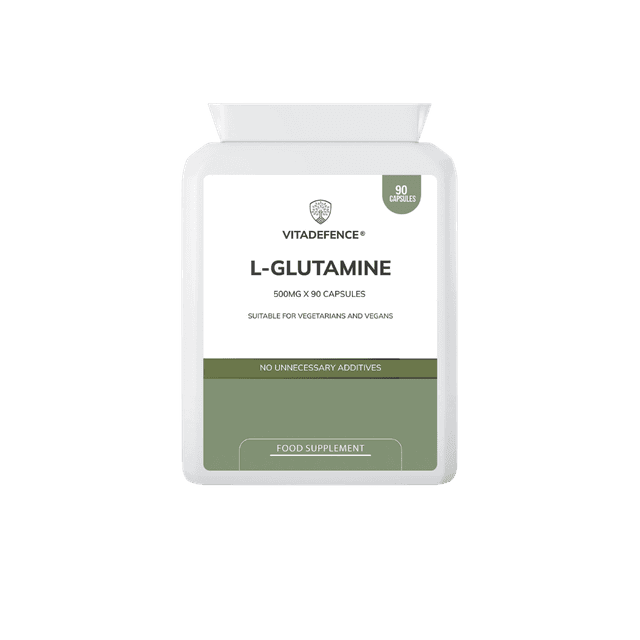
Pure glutamine in a capsule — the discreet, exact-dose, travel-friendly version.
When you don't want a shaker bottle in your hand
There are two kinds of supplement-takers in the world. There are people who love the morning ritual of the kitchen — the protein scoop, the shaker bottle, the cold press, the jug — and there are people for whom the supplement should disappear into the day with as little drama as possible. A small capsule with a glass of water, on the way out the door, no scene.
This little bottle is for the second group. Pure L-glutamine, the most abundant amino acid in the human body, in 500mg vegan capsules. Ninety capsules in the pot. Three to thirty capsules a day depending on what you are using it for and what your day looks like — but for most people, two or three with breakfast and another two or three after exercise is the rhythm.
Same molecule that sits behind the powder version of this product. Same standardised crystalline amino acid. The difference is the form factor. A capsule fits in a jacket pocket, in an airline carry-on, in a desk drawer at the office. A scoop of powder doesn't.
The bottle, in your hand
A clean cream pot, the green band of our label running around it, ninety capsules inside. Each capsule is a vegan cellulose shell holding 500 milligrams of crystalline pure L-glutamine — no fillers, no flavour, no sweetener. Take with water. With or without food.
The taste, on the rare occasions a capsule splits, is faintly sweet and faintly chalky — pure glutamine has a soft, almost neutral character on the tongue. That is one of the reasons the powder version of this product mixes cleanly into anything. In the capsule, the taste isn't a question. You swallow it the way you swallow a multivitamin.
What L-glutamine actually is
Glutamine is one of the twenty proteinogenic amino acids — the building blocks of every protein your body makes. It is what biochemists call a "conditionally essential" amino acid. The body normally makes its own glutamine from glutamate, in the muscle and the liver, in quantities sufficient for normal life. But under significant stress — heavy training, surgical recovery, prolonged illness, severe injury — demand can rise faster than synthesis, and the body can pull glutamine out of muscle tissue to meet demand elsewhere, particularly in the gut lining and the immune system.
Glutamine is the most abundant free amino acid in human plasma. It is the most abundant amino acid in skeletal muscle. The cells of the small intestine — the enterocytes that line the inside of your gut — use glutamine as their primary fuel source, ahead of glucose. The cells of the immune system, particularly lymphocytes and macrophages, also rely on glutamine for energy at a high rate during periods of activity. This is the basis on which sports nutrition, surgical recovery clinics, and gastroenterology have all paid attention to glutamine for the better part of fifty years.
Note the careful wording. We are describing a real, well-characterised biochemistry. We are not promising a cure for any condition. The body's demand for glutamine rises under stress; supplementation puts a measured amount of the amino acid into the diet without having to source it from twenty grams of cottage cheese.
A short history
Glutamine was first isolated from beetroot juice in 1883 by the German chemist Ernst Schulze. It became commercially available as a pure crystalline amino acid in the second half of the twentieth century — the production process is now a clean fermentation, typically using a strain of Corynebacterium glutamicum, the same family of bacteria used to produce monosodium glutamate. The output is a fine white crystalline powder of food-grade purity. The capsule version of this product is the same crystalline material, encapsulated.
Within sports nutrition, glutamine had its moment in the 1990s, when bodybuilding magazines treated it as the must-have post-workout supplement. The hype eventually settled. What remains, after several decades of more careful research, is a modest, sensible position: glutamine is not a magic muscle-building supplement on its own, but it is one of the cleanest, simplest amino acids you can put into a body that is being trained hard or healing.
Why a capsule, and not the powder
Three reasons people choose the capsule over the powder.
Travel. A small bottle in a wash bag clears airline security without questions. A 100g pot of white powder, in the wrong jurisdiction, occasionally does not. People who travel frequently for work, who train in different cities every few days, or who simply prefer not to explain a scoop of powder to a hotel housekeeper, default to the capsule.
Exactness. Each capsule is precisely 500mg. There is no scooping, no levelling off, no "is that 5g or 8g?" question. For people who want to track amino-acid intake to the milligram — competitive athletes on a coach's plan, people in physiotherapy, people coming back from surgery on a clinician's recommendation — the capsule is the form-factor of choice.
Discretion. Some people, frankly, just don't want a tub of white powder in the kitchen. The bodybuilder optic isn't for everyone. A small bottle of capsules in the bathroom cabinet, alongside the multivitamin, fits more naturally into a quiet supplement habit.
This is the same molecule as the powder. The choice is purely about the day-shape it fits into.
A quiet word about ritual
Supplements work best when the ritual around them is quiet enough that you forget to skip them. The capsule, as a delivery form, is designed for invisibility — bottle on the bathroom shelf, two with the morning brushed teeth, one with the kit bag at the gym door, no scoops to wash up, no shaker to remember. People who do best with supplements are usually the ones who have made the ritual small enough that life doesn't have to bend around it.
That is the case being made here. Not that the capsule is a better dose than the powder — they are the same molecule, gram for gram. The case is that for people whose day is already tightly stitched together with appointments, travel, and someone else's calendar, the form factor that disappears into existing rituals tends to be the one they actually take consistently for nine months instead of two weeks.
How to use it
For everyday foundational use — two or three capsules with breakfast, two or three after exercise. That gives between 1.5g and 3g of glutamine across the day, which is in the range many studies have used for general well-trained-adult support.
For more intentional sports use — five to ten capsules around training, often split into two doses, one before and one after the session. That puts the dose into the 2.5g to 5g range, closer to what is commonly used in sports protocols. Don't exceed thirty capsules in a day.
Take with water. With or without food. Glutamine is heat-sensitive in liquid, so if you do empty capsules into a drink, drink it cold — but in the capsule form this isn't a question, the shell protects the crystalline glutamine until it dissolves in the gut.
The bottle of ninety lasts roughly fifteen days at six capsules a day, or thirty days at three a day.
Honest caveats
This is a food supplement — it complements a varied diet, it doesn't replace one. Glutamine is one of the most-studied amino acids in sports and clinical literature, but the research base on its benefit in healthy, well-fed adults is modest. People with chronic kidney disease, chronic liver disease, or any condition involving impaired ammonia metabolism should not take supplemental glutamine without medical supervision, as glutamine metabolism produces ammonia which the impaired kidney or liver may not clear well. Pregnant or breastfeeding women, or anyone on medication, should speak to their GP before taking.
Don't exceed thirty capsules in twenty-four hours. Keep the bottle cool, dry, sealed, out of reach of children. The shell is vegan cellulose. The product is suitable for vegetarians, vegans, kosher and halal.
If after eight weeks of consistent use you feel no difference in the things glutamine tends to support — recovery between training sessions, the steadiness of the gut on a stressful schedule, the quickness with which the day starts to feel normal again after a heavy week — stop. We would rather have your trust for the next thing than your guilt over the wrong thing.
— Vitadefence
— Vitadefence