Showcase
Liposomal Vitamin D3 & K2
A small bottle and a glass dropper. Apple-vanilla flavoured liposomal drops carrying vitamin D3 from algae and vitamin K2 as MK-7, in sunflower phospholipid spheres designed to slip past the gut wall the way nature intended.
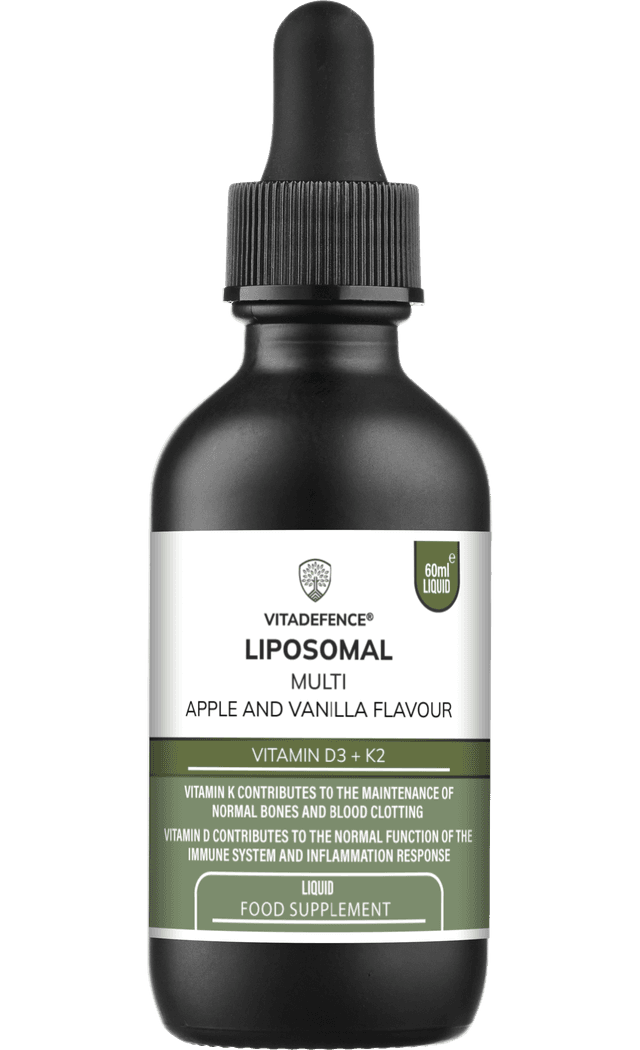
Sunshine in a dropper, calcium with somewhere to go.
If you live in Britain, you are probably running low
There is no gentle way to say this. Between October and March, the sun in the United Kingdom sits too low in the sky for human skin to make any meaningful amount of vitamin D. The wavelength of ultraviolet light required — UVB, around 290 to 315 nanometres — is filtered out by the angle of the atmosphere. You can stand outside at January noon for an hour, sleeves rolled up, and your skin will produce essentially nothing.
Public Health England has acknowledged this for years. The official advice for everyone in the UK is to consider a daily vitamin D supplement during the autumn and winter months. For people with darker skin, people who cover their skin, people who don't get outdoors much, and older adults, the advice extends to the entire year. And yet the National Diet and Nutrition Survey shows around one in five British adults has a vitamin D level low enough to count as deficient — closer to one in three among teenagers and older adults in winter. The shortfall isn't loud. It just whispers, in the form of muscles that ache more than they should and bones that lose density quietly while the rest of life carries on.
This little bottle is one quiet answer. Not a megadose. Not a fix. A clean, well-absorbed daily dropper of the sunshine vitamin with its biological partner alongside it — the way bones and arteries seem to like it.
The bottle, in your hand
A small amber-shielded bottle, the green band of our label running around its waist. Inside is a clear, faintly pale liquid with a soft natural fragrance of apple and vanilla rising from the neck. A glass dropper sits in the lid — one press of the bulb fills it to the line, one millilitre, your daily dose.
Drop it straight onto the tongue, or stir it into a glass of water, a cup of cold tea, a smoothie. The taste is gentle — apple as the louder note, vanilla behind it like a soft blanket, the actives themselves tasteless. No oily film, no fishy aftertaste, none of the chalkiness that makes vitamin D capsules forgettable. This is what liposomal delivery looks like: a water-thin liquid carrying fat-soluble vitamins inside microscopic phospholipid spheres, the way nature delivers them in mother's milk.
What "liposomal" actually means
A liposome is a tiny sphere — between fifty and four hundred nanometres across, far too small to see — made of the same kind of fatty molecule that lines every cell in your body. Phospholipids are two-tailed creatures: one end loves water, the other end hates it. Put enough of them in water and stir gently, and they arrange themselves into hollow spheres, water-loving heads facing outward, water-hating tails curled inward forming a fatty membrane. Inside that hollow sphere, you can pack a payload — in this case, vitamin D3 and vitamin K2.
This matters because both are fat-soluble vitamins. To be absorbed from a normal capsule, they need bile, dietary fat, and a sympathetic gut on the day. People with gallbladder issues, low-fat diets, irritated gut lining, or older adults whose digestive efficiency has slipped can swallow a D capsule and absorb surprisingly little of it. A liposome bypasses much of that — the fatty sphere passes the gut wall almost as if it were already part of you, and the payload arrives in circulation more reliably regardless of what was on your plate.
The technology has been used in pharmacy for decades, originally for delivering chemotherapy drugs into tumours and later for vaccines. We've borrowed it for a humbler job: getting two slow-acting vitamins into a winter-tired British body in a way the body can use. We use Lipoid, a pharmaceutical-grade phospholipid sourced from non-GMO sunflowers — the phospholipids themselves are a form of choline, so they earn a quiet second seat at the table.
Vitamin D3 — the sunshine vitamin
Vitamin D is, technically, a hormone — one of only a handful of nutrients the human body can synthesise itself, given enough sunlight. The skin holds a precursor molecule, 7-dehydrocholesterol, which transforms into D3 when struck by UVB light. The D3 then travels to the liver, where it is converted to 25-hydroxyvitamin D (the form measured in blood tests), and then on to the kidneys, where it becomes the biologically active hormone calcitriol.
The vitamin D in this bottle is D3 — cholecalciferol — the same form your skin makes from sunshine, identical at the molecular level. It is sourced from algae rather than from the wool of sheep, the conventional source for most D3 on the market. The algal source means this product is suitable for vegans without compromising on the form (D3 is absorbed and stored substantially better than plant-derived D2). Each 1ml dose delivers a thoughtful, daily-maintenance amount — enough to hold a typical adult in a comfortable range through a British winter, not so much that it would worry a clinician.
European Food Safety Authority authorised wording: vitamin D contributes to the maintenance of normal bones, normal teeth, normal immune function, normal muscle function, and the normal absorption of calcium and phosphorus. These are the quiet, structural roles vitamin D plays — and exactly the roles that suffer slowly when the level runs low.
Vitamin K2 — the partner that tells the calcium where to go
Vitamin D's job, in part, is to make sure the body absorbs the calcium from food. Vitamin K2's job, in part, is to make sure that calcium ends up in the bones rather than in the arteries.
For most of the twentieth century, nutrition science talked about vitamin D and calcium as a pair, leaving K2 out of the picture. From the 1990s onwards, Dutch researchers drew attention to the fact that calcium movement in the body is governed by K2-dependent proteins — most importantly osteocalcin, which fixes calcium into bone, and matrix Gla protein, which keeps calcium out of the soft tissue of arteries.
Vitamin K1, abundant in green leaves, is plentiful in most diets. Vitamin K2 — the menaquinone family — is less plentiful. The richest natural source is the Japanese fermented soyabean dish nattō, which most British dinner tables will never see; fermented cheeses and pasture-fed dairy contribute smaller amounts. For most people in the UK, daily K2 intake is modest at best.
The K2 in this bottle is the MK-7 form — menaquinone-7 — which has the longest half-life in human plasma of any K2 isomer. A single daily dose stays measurable in the body for two to three days, which is why MK-7 has become the K2 of choice for daily supplementation. D3 without K2 is incomplete. K2 without D3 is incomplete. They are paired here because that is how the body uses them.
Why this formula, in this form
A flavoured dropper — one millilitre on the tongue, swallowed with a sip of water, done — solves the ritual problem. The liposomal carrier solves the absorption problem. Apple-and-vanilla solves the willingness-to-do-it-daily problem.
The xylitol provides a clean, mild sweetness without sugar. Natural fruit and vanilla flavouring keep the experience pleasant. Citric acid and potassium sorbate hold the liquid stable. D-alpha-tocopherol — natural vitamin E — sits in as a gentle antioxidant, protecting the fragile fat-soluble vitamins from oxidising in the bottle. There is nothing more in here than there needs to be. The label is short on purpose.
How to use it
Shake the bottle gently before each use — phospholipid spheres can settle slightly between doses. Press the dropper bulb to the marked line and place the contents either directly under the tongue or into a glass of water, juice, or a smoothie. One millilitre, once a day, ideally with a meal that contains some fat — porridge with whole milk, toast with butter, a yoghurt. The fat isn't strictly necessary thanks to the liposomal carrier, but it doesn't hurt.
Do not exceed the recommended daily intake. Vitamin D is fat-soluble and stores in the body — high doses sustained over long periods can become a problem. Refrigerate after opening; best consumed within six months of opening.
Honest caveats
If you are taking warfarin or another vitamin-K-antagonist anticoagulant, talk to your prescriber before adding K2 to your routine — vitamin K of any kind interacts with these medications. If you have a parathyroid disorder, kidney disease, or sarcoidosis, talk to your GP before adding vitamin D in any meaningful dose. If you are pregnant, breastfeeding, or under medical supervision for any reason, run it past a healthcare professional first.
This is a food supplement — it complements a varied diet and an outdoor life, it does not replace either. The best vitamin D in the world is still the vitamin D your skin makes on a summer afternoon. This bottle is for the eight months a year when that isn't on offer.
If you have read this far, thank you. We tried to write the kind of page we'd want to read before spending money — no neon promises, no overblown language. Just a small bottle, two paired vitamins, a fatty sphere doing the job nature gave it, and a daily dropper that solves the British problem of being a long way from the equator.
— Vitadefence
— Vitadefence