Showcase
Maca Root Multi
Three thousand milligrams of Peruvian maca extract, alongside ginkgo, panax ginseng, ginger, damiana and L-arginine, finished with 50% NRV zinc. The Quechua mountain root that has fed thirteen thousand feet of Andes for two thousand years.
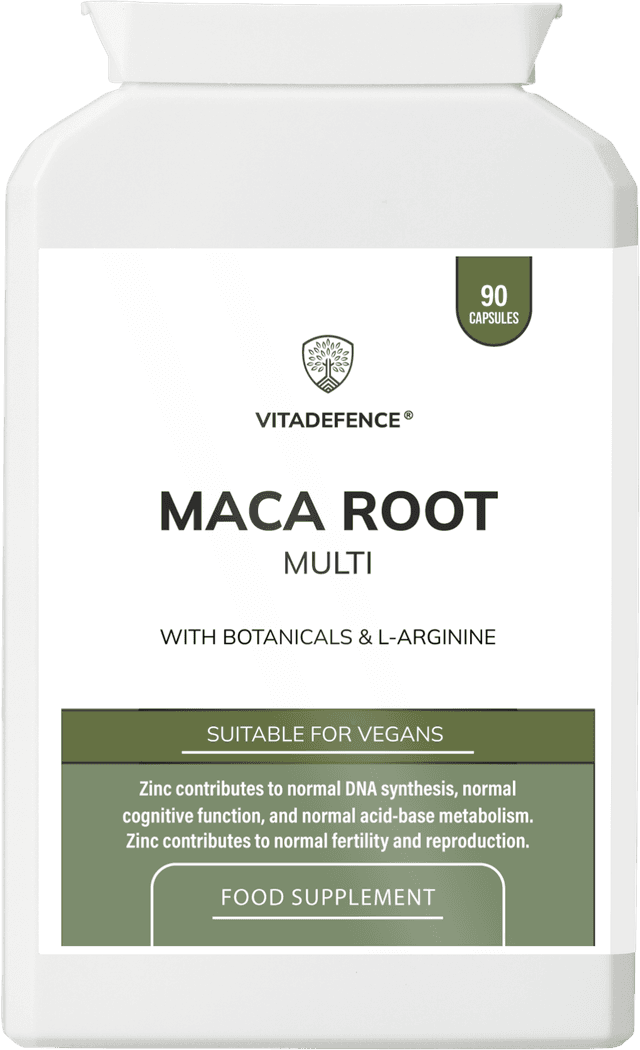
The Andean mountain root, with seven of its quiet companions.
When the morning is asking for more than coffee
There is a kind of week — most of us know it — when coffee stops working. The first cup gets you out the door. The second sharpens the meeting. The third does nothing except make you feel slightly wired and slightly less hungry. By Wednesday afternoon you are running on something that isn't quite tiredness and isn't quite stress; just a low, flat hum where the spark used to be.
Modern life is built to take this hum out of you. Late nights, blue light, dinners at nine, early-morning starts, sedentary days, beige food. None of it is dramatic. All of it, accumulated, leaves a person at thirty-five quietly less alive than they were at twenty-five.
You can chase it with caffeine. Or you can do what the people of the Peruvian high Andes have done for two thousand years, and reach for a root that grows where almost nothing else does — at thirteen thousand feet of altitude, in punishing wind, on a brown plateau where potatoes will not survive — and ask it to lend you some of its hardiness.
This little bottle is one quiet way to do that. 3000mg of equivalent maca root, alongside seven of the plants and minerals that traditional Andean and herbal practice has paired with it for centuries. Not a stimulant. A daily nudge from a high-altitude root that has been keeping people walking up mountains since long before any of us were born.
The bottle, in your hand
A clean cream pot, the green band of our label running around it. Ninety vegan capsules inside — three months at one a day, one month at three a day if a coach or a clinician has set you a higher dose. The capsules are HPMC, plant-derived, suitable for vegetarian, vegan, kosher and halal kitchens.
Inside each capsule, a quiet seven-and-a-half-gram blend: 3000mg equivalent maca, 100mg equivalent ginkgo, 100mg panax ginseng, 50mg equivalent ginger, 50mg L-arginine, 25mg damiana, 5mg organic black pepper, and 5mg of zinc — half the daily nutrient reference value. The brown rice flour around them is a humble bulking medium that keeps the capsule even and the dose consistent.
There is no caffeine in this bottle. Maca is sometimes mistaken for a stimulant — it is not. The energy story it tells is slow, cumulative, and, importantly, sleep-friendly. Most people take theirs in the morning, but a late-afternoon dose does not keep them awake at night.
The story of maca
Above the cloud line, on a wind-flattened plateau called the Junín Pampa, the temperature swings from minus ten degrees overnight to twenty by midday. The air is thin enough that visitors from the coast lose their breath walking. The growing season is short, the soil is poor, the wind never really stops. Almost nothing edible will grow at this altitude.
What does grow is a small, tough crucifer — a relative of mustard, cabbage, and rocket — called Lepidium meyenii. The plant produces a lumpy, turnip-shaped storage root, somewhere between cream and purple-black. The Quechua-speaking people of the central Peruvian Andes have called it maca for as long as oral tradition stretches. Archaeology dates cultivation to at least 1600 BC. By the time of the Inca, maca was a staple — boiled, baked into a dense bread called pan de maca, fermented into a drink called maca chicha, fed to herds before long mountain journeys, given to children through cold months.
When the Spanish arrived, the chroniclers wrote about it with a kind of bafflement. The colonial mining towns where European grains would not grow came to depend on it. For most of the twentieth century, maca was a regional crop almost forgotten outside the highlands. In the 1990s plant chemists looked closer and found an unusually full nutritional profile — a complete amino-acid set, a wide spread of minerals (zinc, iron, copper, manganese, potassium, calcium), B-vitamins, and a unique family of compounds called macamides and macaenes that appear nowhere else in the plant kingdom.
We use 3000mg of equivalent maca per capsule — the headline dose of the formula by some distance.
Ginkgo Biloba — the world's oldest tree
Ginkgo is a survivor. Ginkgo biloba has been on Earth for around 270 million years — predating flowering plants, predating mammals, predating dinosaurs. The species is sometimes called a living fossil because nothing has fundamentally changed about it in geological time.
In Chinese herbal medicine, ginkgo leaf has been used for circulation and for the kind of mental clarity that fades with age — what traditional Chinese practitioners call qi in the head. Modern interest has focused on its flavonoid and terpene lactone content, both studied for circulatory effects. 100mg of equivalent ginkgo per capsule — a quiet supportive presence in a formula about daytime steadiness.
Panax Ginseng — the king root of the Far East
If maca is the Andean root, panax ginseng is its East Asian cousin. Panax ginseng — the genus name comes from the Greek panakos, meaning "all-healing" — has been cultivated in Korea, north-eastern China, and the Russian Far East for at least two thousand years. The Chinese pharmacopoeia Shennong Ben Cao Jing, written roughly two thousand years ago, classes it as a superior herb: one taken not for an immediate problem but for a daily, foundational tonic effect.
The active compounds in panax ginseng — ginsenosides — are a family of plant saponins unique to the genus. Like maca, ginseng belongs to the category of plants traditional practice calls adaptogenic. 100mg of ginseng powder per capsule sits as the second adaptogen alongside maca, the eastern partner to the western root.
Ginger root, damiana, L-arginine, and the trace minerals
Ginger (50mg equivalent extract). One of the oldest medicinal plants in continuous human use — the Egyptians used it, the Arab traders carried it along the spice routes, the Romans paid taxes in it. Warming and digestive, it pairs naturally with the earthy character of maca.
Damiana leaf (25mg). A small flowering shrub from southern Mexico and Central America, traditionally used by the Maya as a daily tea. A lesser-known partner that earns its place on three centuries of folk use.
L-arginine (50mg). An amino acid the body uses to produce nitric oxide — the small molecule that helps blood vessels relax. A modest dose, a quiet nutritional contribution.
Black pepper (5mg organic). The traditional Ayurvedic kitchen partner of warming roots. The piperine in pepper has been studied for its modest contribution to the absorption of plant compounds eaten alongside it.
Zinc (5mg, 50% NRV). The trace mineral with the strongest EFSA-authorised wording for daytime function — zinc contributes to normal cognitive function, normal protein synthesis, normal fertility and reproduction, and the protection of cells from oxidative stress.
The formula as a whole
Lay these eight ingredients on a table — maca, ginkgo, ginseng, ginger, damiana, L-arginine, black pepper, zinc — and what they share is a kind of geographical breadth. Andean root. Chinese tree. Korean root. Indian and Arab spice. Mayan leaf. A trace mineral the body cannot make. A nucleotide-building amino acid.
We did not pick ingredients at random. We picked plants and minerals that traditional practice has reached for, on different continents, for the same broad daily-stamina question — and bound them together with the trace minerals that make their work easier.
The thinking is not more is more. It is centuries of use across multiple cultures, paired sensibly. Maca is the headline because maca has earned the headline. The rest of the formula is what surrounds the root in its natural cultural context.
How to use it
One capsule a day, with food, with water. Most people take theirs with breakfast. If you want to step up — for a sustained period of training, for a stretch of long days, for a specific high-demand week — one capsule with breakfast and one with lunch is fine. Three a day is the upper limit on the bottle.
Maca works in the background. Most people who notice a difference notice it between week three and week six — slightly steadier daytime energy, slightly easier mornings, the feeling of having put a quiet root into the diet that the body seems to like.
If after eight weeks nothing has changed, stop. A supplement that isn't doing anything for you isn't worth the money.
Honest caveats
This is a food supplement — it complements a varied diet, doesn't replace one. If you are pregnant, breastfeeding, taking thyroid medication, taking blood thinners (ginkgo can interact with anticoagulants), or under medical supervision for any condition, talk to your GP or pharmacist before adding this bottle. If you have a thyroid condition specifically, raise maca with your specialist — it is generally well tolerated, but high-dose maca contains goitrogens (as does broccoli and cabbage) and a clinician should be in the loop.
Don't exceed three capsules a day. Keep it cool, dry, sealed, out of reach of children.
If you read this far, thank you. We tried to write the kind of page we'd want to read — no neon promises. Just a wind-cracked Peruvian plateau, a turnip-shaped root the Quechua have eaten for two thousand years, seven of its quiet partners, and a small daily ritual that may help you feel a little more like yourself.
— Vitadefence
— Vitadefence