Showcase
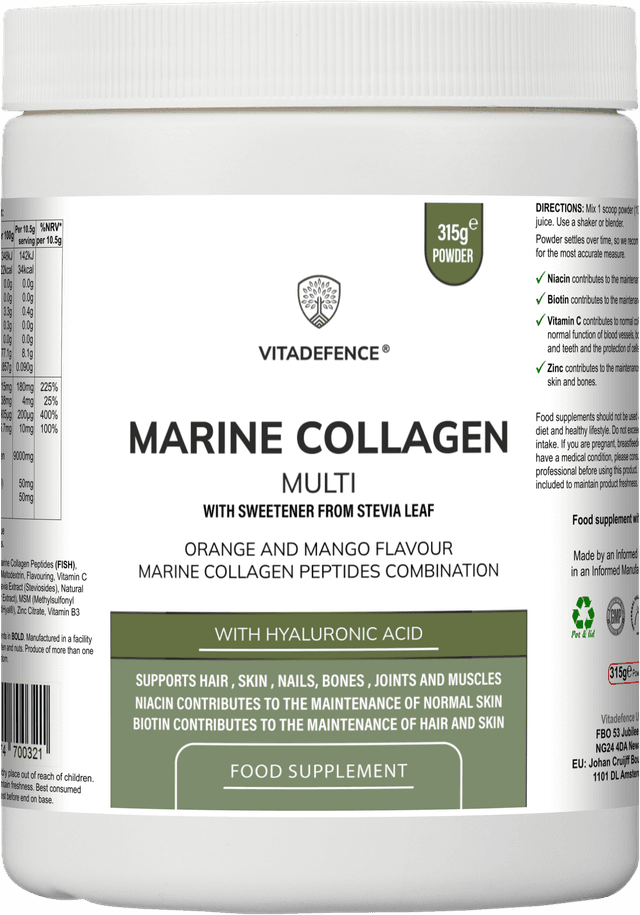
Marine Collagen Multi
A protein your body has been making since you were born — and the quiet ingredients we put alongside it.
Key facts
- What you might already be feeling
- The bottle, in your hand
- The story of marine collagen
- Hyaluronic acid — the molecule of moisture
- Pomegranate seed and pine bark — the dark-pigment partners
A protein your body has been making since you were born — and the quiet ingredients we put alongside it.
What you might already be feeling
Around your mid-thirties something shifts. Your skin, which used to bounce back overnight, takes a day or two to look like itself again. The fine lines next to your eyes don't unfold quite so smoothly when you smile. Your hair feels thinner between your fingers. The cartilage in your knee gives a small, polite crack on the stairs that wasn't there a year ago.
This isn't a problem to fix. It's a slope every human walks. But there are things you can put back.
The single biggest thing your body has been quietly losing since your late twenties is collagen — the structural protein that makes up roughly a third of all the protein in your body. It's the scaffolding under your skin, the matrix in your cartilage, the framework of your hair and nails. Your body still makes it, but slower each year. Sun, smoking, sugar and stress all chip away at the rate. By forty, most people are running a small daily deficit.
This bottle is one quiet way to top up the raw material.
The bottle, in your hand
Sixty vegetable cellulose capsules. The headline is 400mg of hydrolyzed marine collagen per capsule — Type I, the version that lives in skin, hair, nails, bone and tendon. Around it: hyaluronic acid for moisture, pomegranate for ellagic acid, pine bark for proanthocyanidins, vitamin C, zinc, biotin, vitamin E, selenium, copper, astaxanthin, and bamboo silica. One to two capsules a day, with food.
Nothing dramatic. The kind of thing you take for sixty days and then catch your reflection one morning and think: something feels a little springier.
The story of marine collagen
Collagen as a supplement is older than you might think. The Japanese have been simmering fish heads, skin and bones for millennia — the broth, called gyokai-dashi, was both a kitchen staple and a folk remedy for joints and skin. The French have fumet, the same idea with a different accent. Across coastal cultures, the wisdom was the same: don't throw away the parts that make stock cloudy. That cloudiness is collagen, slowly dissolving into the water.
What modern hydrolyzed collagen does is one step further than a long simmer. The protein is broken down — hydrolyzed means split with water — into shorter chains called peptides, typically two to five amino acids long. Smaller peptides are easier for your gut to absorb. Once absorbed, they enter the bloodstream and travel to where your body needs amino acids — including the cells (called fibroblasts) that build new collagen in your skin.
Our marine collagen comes from fish skin — a part of the catch food production would otherwise discard. Two things matter here. First, sustainability: using a byproduct of an existing food chain rather than fishing for collagen alone. Second, the amino acid profile of fish-skin collagen is unusually high in glycine, proline and hydroxyproline — the three amino acids the body specifically uses to assemble new collagen. We use 400mg per capsule of a low-molecular-weight, well-characterised marine peptide grade with a body of human research behind it.
A note on what we are not promising. We are not promising a return to twenty-five-year-old skin. We are not promising wrinkle reversal. What we are saying is this: collagen is a raw material your body uses constantly, you make less of it every year past your mid-twenties, and providing extra raw material in a form your body can absorb is a reasonable thing to do. The connective tissue you build with it is your own.
Hyaluronic acid — the molecule of moisture
Hyaluronic acid is one of the most water-loving molecules in the human body. A single gram can hold up to six litres of water. It lives in the spaces between cells, in the synovial fluid that lubricates your joints, and as a major component of the dermis — the layer of skin where collagen also lives. Together, the two work as a partnership: collagen provides the structure, hyaluronic acid keeps that structure hydrated.
The hyaluronic acid we use is high molecular weight (1 million Daltons), 22.5mg per capsule, made by a microbial fermentation process — the same way most modern hyaluronic acid is produced now, replacing the older method of extracting it from rooster combs.
Pomegranate seed and pine bark — the dark-pigment partners
Pomegranate is older than memory — appearing in Egyptian tombs from 3000 BC, in Greek myth as the fruit that bound Persephone to the underworld, in Persian gardens as the symbol of paradise. The compound concentrated in the seeds and pith is ellagic acid — a polyphenol from the parts most people throw away. We use 270mg of pomegranate seed extract per capsule, standardised to 2.4mg of ellagic acid.
Pine bark — particularly from the maritime pines of southwestern France and the Chinese masson pine — is where the proanthocyanidins concentrate. The same family that makes red wine red and grape seeds bitter, and that the Algonquin of eastern Canada brewed into the tea that saved Jacques Cartier's scurvy-stricken sailors in 1535. We use 78.9mg of pine bark extract, providing 5mg of proanthocyanidins per capsule.
Both belong to a wider family of pigment-rich plant compounds that work in adjacent rooms of the same broad story: the gentle, daily defence of cells from the wear of being alive.
The vitamin C–collagen partnership
Of all the ingredients in this bottle, vitamin C has the most direct evidence behind its place. It is a required co-factor for the enzymes that hydroxylate proline and lysine — the chemical step that lets newly-made collagen strands fold into their characteristic triple helix. Without enough vitamin C, the collagen you build is structurally weak. This is, mechanistically, why scurvy is a disease of bleeding gums and slow-healing wounds: it is collagen failure.
You don't need scurvy to make the partnership matter. We use 40mg per capsule (50% NRV) — meaningful, but not so much it competes with peppers, blackcurrants and citrus.
Zinc, biotin, vitamin E, selenium and copper — the trace-mineral spine
Most of this article has been about plants and proteins. The next five ingredients are essential nutrients with European Food Safety Authority authorised wording, and they belong here for one reason: hair, skin and nails are tissues that turn over constantly, and they fail first when these nutrients run low.
Zinc (5mg, 50% NRV) — contributes to the maintenance of normal hair, nails and skin. Biotin (220μg, 440% NRV) — contributes to the maintenance of normal hair, skin and mucous membranes. Vitamin E (11mg α-TE, 92% NRV) — contributes to the protection of cells from oxidative stress. Selenium (50μg, 91% NRV) — contributes to the maintenance of normal hair and nails. Copper (0.5mg, 50% NRV) — contributes to normal pigmentation of skin and hair, and to the maintenance of normal connective tissues. Worth saying out loud: collagen cross-linking — the chemistry that makes connective tissue strong rather than rubbery — is a copper-dependent reaction.
These five aren't the headline. They are the spine.
A note on astaxanthin and bamboo
Two final ingredients. Astaxanthin (0.2mg per capsule) is the deep red carotenoid pigment that makes salmon flesh pink, from the microalga Haematococcus pluvialis — the most pigment-dense natural source we know of. Bamboo silica (5mg) is a plant-derived source of the trace mineral silicon, which is part of connective tissue and earns a quiet seat at the table by long traditional use rather than any specific authorised claim.
The formula as a whole
Lay these ingredients on a table — marine collagen, hyaluronic acid, pomegranate, pine bark, vitamin C, zinc, biotin, vitamin E, selenium, copper, astaxanthin, bamboo — and what they share is a common job description: feed the connective-tissue story of the body, the slow scaffolding that holds your skin smooth, your nails strong, your hair thick, your joints quiet.
We didn't put twelve things together at random. We put twelve things together that work in adjacent rooms. Marine collagen is the brick. Vitamin C is the mortar. Zinc, biotin, copper and selenium are the trace minerals the masons reach for. Hyaluronic acid is the water in the wall. Pomegranate, pine bark, vitamin E, selenium and astaxanthin are the slow defenders that keep the wall from weathering.
The thinking isn't one ingredient at a heroic dose. It's the right small company, in the right small doses, taken every day, for long enough to matter.
How to use it
One to two capsules a day, preferably with food. Most people start with one capsule with breakfast, then add a second with their evening meal if they want a fuller dose. The bottle holds sixty capsules — at one a day it lasts two months, at two a day it lasts one.
Don't expect the kind of effect you get from a coffee. Connective-tissue work is slow work. Most people who notice a difference notice it between week six and week twelve — slightly springier skin in the mirror, slightly stronger nails, slightly less squeaking from the knees on the stairs. If after ninety days nothing has changed, stop. A supplement that isn't doing anything for you isn't worth the money.
Honest caveats
This is a food supplement — it complements a varied diet, doesn't replace one. It contains fish (Type I marine collagen from fish skin) — please don't take this if you have a fish allergy. It is not suitable for vegetarians or vegans; if that's important to you, our plant-based collagen multis use vitamin C, silica and amino-acid co-factors that support your own collagen synthesis pathway instead. The bottle is Halal approved.
If you are pregnant, breastfeeding, taking medication (particularly blood thinners, given the polyphenol load), or living with a medical condition, talk to your GP or pharmacist first. Keep it cool, dry, sealed, out of reach of children. Don't exceed two capsules a day.
A protein from the sea, eleven companions, and a small daily ritual that may help your body keep building the scaffolding it has been building since you were born.
— Vitadefence
— Vitadefence