Showcase
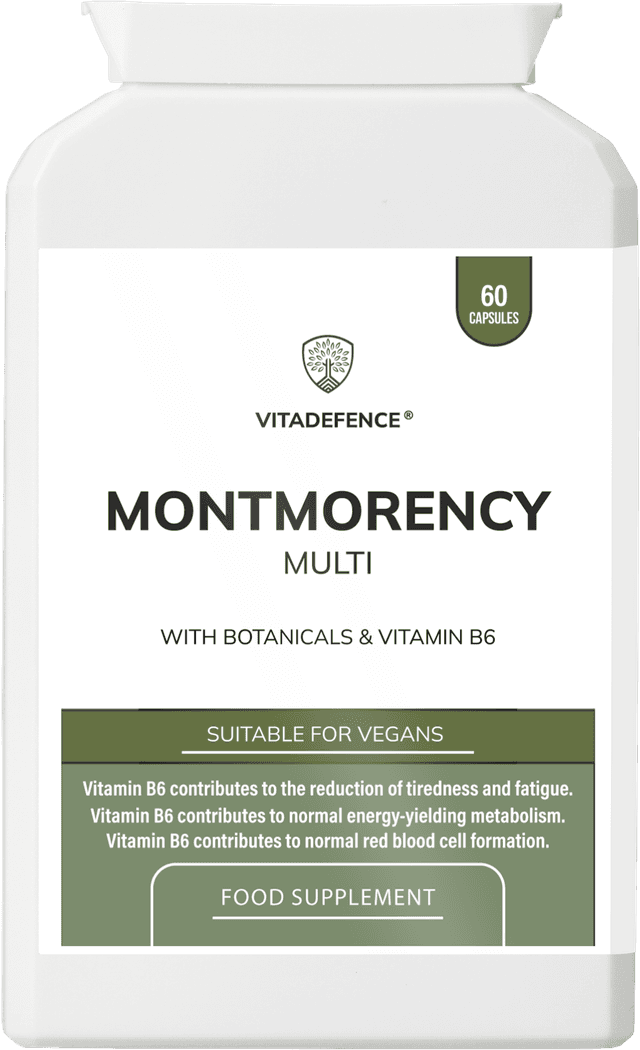
Montmorency Multi
The same Montmorency cherry — but with three daytime partners and a different ritual.
Key facts
- Why this bottle exists alongside the pure one
- The bottle, in your hand
- The story of Montmorency — the cherry
- Beetroot — the deep red root from the kitchen garden
- Turmeric — the golden spice from the Indian kitchen
The same Montmorency cherry — but with three daytime partners and a different ritual.
Why this bottle exists alongside the pure one
If you've already read about our pure Montmorency capsule — the single-ingredient evening one — you might be wondering why this second bottle sits next to it on the same shelf.
The honest answer is that the cherry plays two different roles for two different kinds of people, and we'd rather make two clean bottles than one cluttered one. Pure Montmorency is for the person who wants the cherry alone, taken in the evening, as a quiet end-of-day ritual. This bottle — Montmorency Multi — is for the person who wants the cherry as part of a daytime formula: paired with beetroot for the deep-red root tradition, turmeric for the golden-spice tradition, black pepper to help the turmeric do its work, and a meaningful dose of vitamin B6 to give the formula a label-accurate spine.
It's the same fruit. Different company. Different time of day.
The bottle, in your hand
Sixty vegetable cellulose capsules, the cream pot with our forest-green band. One capsule, one to three times a day, preferably with food. Inside each capsule is 2250mg of Montmorency tart cherry extract (equivalent weight from the fruit), 2250mg of beetroot extract, 50mg of turmeric root extract, 5mg of black pepper, and 2mg of vitamin B6 — 142% of the daily Nutrient Reference Value.
The capsule is plant-based (HPMC), suitable for vegetarians and vegans, and Halal and Kosher approved. We mention up front: this formula may turn your urine a faint pink colour. That's the betalains from the beetroot doing exactly what they did in the kitchen of your grandmother when she boiled a beetroot for Sunday lunch. It is not a cause for concern.
The story of Montmorency — the cherry
Montmorency is a place before it is a cherry. The Montmorency valley sits twenty kilometres north of central Paris, the old hunting grounds of the Dukes of Montmorency, who were among the oldest noble families of France. The valley gave its name to one specific cultivar — Prunus cerasus, the sour cherry — that became the signature of French confiture, of clafoutis, of the tart-cherry pies that crossed the Atlantic with French settlers and became the official state dessert of Michigan.
What science noticed, much later, is that the same compounds that make Montmorency taste sour and stain your shirt deep red are an unusually rich source of anthocyanins — the dark purple pigments shared by blueberries, blackberries, elderberries and acai. Anthocyanins are polyphenols, the plant's own sunscreen against ultraviolet light, and when humans eat them, evidence suggests they may support our own internal balance against the wear-and-tear process called oxidative stress.
We use 2250mg of cherry extract per capsule — a meaningful, weighable dose, much closer to the levels used in human research than the 100mg or 200mg of cherry you find in many sleep blends.
In our pure Montmorency capsule, the cherry is pitched at the evening — it has a small natural amount of melatonin, the hormone the body uses to signal that night has begun, and it has earned a place as a fruit you might choose at the end of the day. In this Multi formula, the cherry is paired with two other deep-pigment plants and asked to play a different role: the antioxidant cherry of a daytime polyphenol stack, alongside the beetroot and the turmeric.
Same cherry. Different room of the house.
Beetroot — the deep red root from the kitchen garden
Long before beetroot was a sports-nutrition ingredient, it was Sunday lunch. The Romans cultivated it first for its leaves, then for its root. By medieval Europe it was a monastery-garden staple — easy to grow, stores all winter, dyes everything it touches a colour somewhere between burgundy and oxblood.
What is special about beetroot is twofold. First, the deep red pigment — a class of compounds called betalains — sits in the same broad family of pigment polyphenols as the anthocyanins from the cherry. Most of the dark plants our grandparents ate by accident were dark for a reason: pigment-rich foods were also nutrient-rich foods. Second, beetroot is unusually high in dietary nitrate, which the body converts in stages into nitric oxide — a small molecule that helps blood vessels relax and widen. That mechanism is why beetroot juice has become popular with cyclists and middle-distance runners.
We are not promising a faster 5K. We are saying that 2250mg of concentrated beetroot extract — roughly equivalent to a generous portion of the fresh root — is a meaningful daily contribution to the deep-red plant story this formula is built around.
Turmeric — the golden spice from the Indian kitchen
If you walk through any market in southern India, the colour you cannot miss is the colour of turmeric powder — a yellow so saturated it dyes the air around it. Turmeric (Curcuma longa) is a rhizome of the ginger family, native to the Indian subcontinent. It has been used in Ayurvedic and Siddha medicine for at least 4,000 years, and it has been the soul of curry — the actual yellow of golden milk, of daal, of kichdi — for as long as there has been an Indian kitchen.
The compound that gives turmeric its colour and most of its modern interest is curcumin — a polyphenol with a particularly broad activity profile in laboratory work. Curcumin is poorly absorbed on its own, however, which is why the formulators of every reasonable turmeric supplement pair it with one of two things: a fat, or piperine. Piperine is the alkaloid in black pepper that gives the spice its bite. We've used piperine.
We use 50mg of turmeric root extract and 5mg of black pepper per capsule — a modest, supportive dose, sized to round out the polyphenol stack rather than to act as the headline. If you want turmeric as the star of its own bottle, our Turmeric Max and Turmeric Multi both put it centre stage. Here, it earns a quiet seat at the cherry-and-beetroot table.
Vitamin B6 — the nutrient the label can speak plainly about
Most of this article has been about plants and history. The last ingredient in the bottle is an essential nutrient with European Food Safety Authority authorised wording, and it earns its place precisely because of that.
Vitamin B6 (2mg, 142% NRV) — contributes to normal red blood cell formation, normal nervous system function, and to the reduction of tiredness and fatigue. It is the spine of the formula — the label-accurate nutrient anchor behind the polyphenol plant story. Many people running on the modern Western diet are mildly low in B6, particularly those drinking moderately or taking the contraceptive pill, both of which gently lower B6 status.
The formula as a whole
Lay these five ingredients on a table — cherry, beetroot, turmeric, black pepper, vitamin B6 — and what they share is a kind of colour-and-warmth family resemblance. The cherry is dark red. The beetroot is deeper red. The turmeric is gold. The black pepper is black. The B6 is the invisible thread that makes the label honest.
We didn't pick five things at random. We picked five that work in adjacent rooms of the same house. Anthocyanins from the cherry. Betalains from the beetroot. Curcumin from the turmeric. Piperine from the pepper to lift the curcumin. And then a real, weighable dose of an essential B-vitamin to keep the rest honest.
The thinking isn't more is more. It's the right small company, taken every day, for long enough to matter.
How to use it
One capsule, one to three times a day, with food. Most people take one with breakfast and find that's plenty. The bottle holds sixty capsules — at one a day it lasts two months, at three a day three weeks. Take it in the morning or with lunch rather than at night — this formula is designed for daytime use, and the cherry's small natural melatonin content is overshadowed here by the daytime spine of beetroot, turmeric and B6. (For the evening cherry ritual, use our pure Montmorency capsule.)
Don't expect the kind of effect you get from a coffee. Plants of this kind work in the background. Most people who notice a difference notice it between week three and week eight: a small thing, often felt as the steady hum of energy that the modern shopping basket has slowly engineered out of itself.
If after sixty days nothing has changed, stop. A supplement that isn't doing anything for you isn't worth the money.
Honest caveats
This is a food supplement — it complements a varied diet, doesn't replace one. May turn urine a pink colour (this is normal — betalain pigments from beetroot). If you are pregnant, breastfeeding, taking medication (particularly blood thinners — turmeric and beetroot both interact gently — or iron supplements), or living with a medical condition, talk to your GP or pharmacist first. Keep it cool, dry, sealed, out of reach of children. Don't exceed three capsules a day.
The bottle is suitable for vegetarians and vegans, Kosher and Halal approved. The beetroot and Montmorency cherry do not originate from the UK; we source from established growing regions and process to UK GMP standards.
If you've read this far, thank you. We tried to write the kind of page we'd want to read before spending money — no neon promises, no overblown language. Just a sour cherry from a French valley, a deep red root from the kitchen garden, a golden spice from the Indian kitchen, the bite of black pepper, and a real dose of an essential B-vitamin. One quiet daily capsule, the daytime version of the Montmorency ritual.
— Vitadefence
— Vitadefence