Showcase
Moringa Oleifera
A tree that grows in poor soil, feeds whole villages, and lives up to two of its names: the drumstick, and the never-die.
Key facts
- Why someone reaches for moringa
- The bottle, in your hand
- The story of moringa
- Why pure, not a blend
- How to use it
A tree that grows in poor soil, feeds whole villages, and lives up to two of its names: the drumstick, and the never-die.
Why someone reaches for moringa
You eat reasonably well. Maybe even better than reasonably. There's a salad in the fridge, the bread is wholemeal, you make an effort with vegetables when you remember. And yet — quietly — you suspect that the modern shopping basket is a narrower thing than your grandparents' was. Six or seven vegetables on rotation, mostly green, mostly bland, mostly grown for shelf-life rather than nutrient-density.
You're not wrong. The vegetables we ate fifty years ago are not the vegetables we eat now. Soil mineral content has dropped. The bitter, deeply pigmented, traditionally foraged greens that once made up a quiet third of any human diet have largely disappeared from the supermarket aisle.
This little capsule is one quiet way to put some of that lost variety back in.
The bottle, in your hand
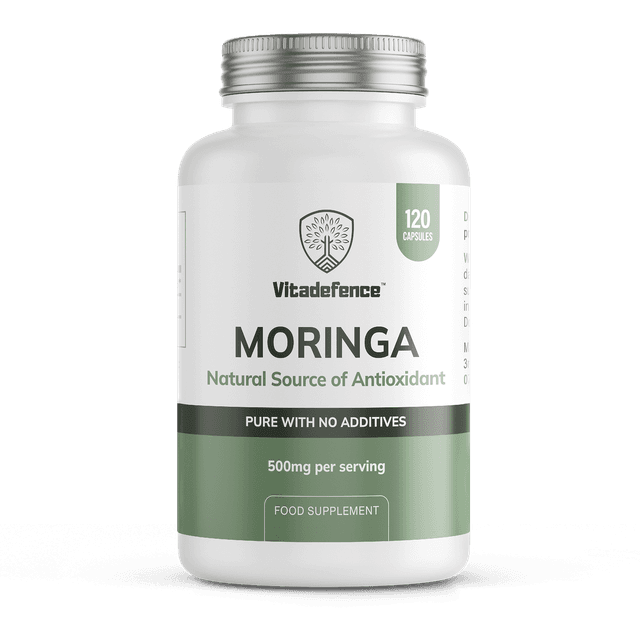
A clean cream pot, the green band of our label running around it. One hundred and twenty vegetable cellulose capsules inside. Five hundred milligrams of pure moringa leaf powder per capsule. One capsule a day with water, preferably with food. The whole pot lasts four months at one a day. The cherry on top: it's vegan, suitable for almost everyone, the capsule shell is plant-based (HPMC), no allergens directly declared in the ingredients.
Nothing dramatic. The kind of thing you take for sixty days and find that the green vegetables you weren't quite eating got an honest, daily backup.
The story of moringa
In northern India, moringa is called the drumstick tree. The English name comes from the long, thin, drumstick-shaped seed pods that hang from the branches in their hundreds. In Tamil it is murungai. In Hindi, sahjan. In the Philippines, malunggay. In the dry sub-Saharan strip from Senegal across to Niger and Sudan, it is nebeday — never die — because the cuttings will root in almost any soil, the tree will produce leaves through drought, and a single mature tree can feed a small family.
The taxonomic name — Moringa oleifera — comes from the Tamil murungai (Latinised by 18th-century European botanists into Moringa) and the Latin oleifera, meaning oil-bearing, because the seeds yield ben oil — a clear, mild oil that doesn't go rancid easily and was used for centuries as a base for perfume.
Almost every part of the tree is edible. The young leaves are a vegetable — picked, washed, sautéed with onion and garlic, eaten the way you would spinach. The young pods are cooked like green beans (the famous drumstick sambar of South India, where green papaya, tamarind and moringa pod simmer together in a sour-spicy broth that has fed millions of breakfast tables for generations). The seeds are roasted like a peanut, or pressed for the oil. The roots have a horseradish-like flavour, used in older Ayurvedic preparations. The seed cake left over from oil pressing is used to clarify drinking water — the proteins in moringa seed are extraordinary water purifiers, binding to suspended particles and pulling them out of suspension, a property that has made the tree quietly important in international development work for the last forty years across the Sahel, the Andes, and the dry valleys of east Africa where access to clean drinking water is the difference between a healthy childhood and one cut short by waterborne illness.
There is no other tree on earth — at least, none in widespread cultivation — where the leaf is the daily vegetable, the pod is the daily side dish, the seed is the cooking oil, the seed cake purifies the water you drink, and the root is the medicine cabinet. Sahjan, malunggay, nebeday, the drumstick tree — wherever it grew, it earned a name in the local language, and the name was rarely about the leaf alone.
This capsule contains the leaf — the part of the tree that has the broadest nutritional profile. The leaf has a wide spread of vitamins and minerals in a single plant. We use 500mg per capsule of the dried leaf powder, processed gently to preserve the colour (a deep, slightly grey-green that smells faintly of fresh-cut grass and matcha).
A note on what we are not promising. We are not promising you a superfood-aisle miracle. We are not promising fewer colds, more energy, faster recovery. What we are saying is this: if your diet is missing the deep, dark, slightly bitter green leaves that have been part of the human food supply for as long as humans have been eating, a daily moringa capsule is a small, sensible, plant-derived contribution toward dietary variety. The benefits, if there are any for you specifically, will reveal themselves slowly.
Why pure, not a blend
Most supplement brands would mix moringa into a green-superfood powder with seven other ingredients. We have a moringa entry in our own daily plant-pigment formula too — it sits as a quiet co-pilot in our Acai Berry Multi, where it earns one paragraph of credit alongside ten other ingredients.
This bottle is different. This is moringa as the headline. There are two reasons we made it.
The first is dose. To get a meaningful daily contribution from any plant, you usually need to spend most of the capsule space on it. 500mg of moringa leaf is enough to feel like a real handful of green vegetable. In a multi-blend it would be 50mg or 100mg — there for the marketing, not for the body.
The second is patience. A pure-extract supplement lets you find out whether this one ingredient is helping you. If you take a six-ingredient green superfood blend for a month and feel better, you don't know what worked. If you take pure moringa for a month and feel better, you know.
If you want the cherry on the cake — moringa as part of a wider plant-pigment family alongside acai, beetroot and pomegranate — that is what our Acai Berry Multi is for. This bottle, the one in your hand, is the leaf alone.
How to use it
One capsule daily with water, preferably with food. Don't exceed the recommended daily intake. The capsule shell is plant-derived (HPMC). The leaf has a faint grassy taste if you crack the capsule open — most people just swallow it whole, but if you cook, you can also empty the capsule into a green smoothie or a herbal soup the way moringa is traditionally used in its country of origin.
Don't expect the kind of effect you get from a coffee. Plants of this kind work in the background — gently, quietly, like the slow donation of a daily green vegetable. Most people who notice anything at all notice it between week three and week eight, and what they notice tends to be small: slightly steadier afternoons, slightly clearer skin, the unspectacular feeling of having put a piece of green back into a diet that had quietly slipped without it.
If after sixty days nothing has changed, stop. A supplement that isn't doing anything for you isn't worth the money, and we'd rather have your trust for the next thing than your guilt over the wrong thing.
Honest caveats
This is a food supplement — it complements a varied diet, doesn't replace one. If you are pregnant, breastfeeding, taking medication, or living with a medical condition, talk to your GP or pharmacist first. There is some traditional caution around the moringa root and seed in pregnancy, and although this product is the leaf only, conservatism is the right default. Keep it cool, dry, sealed, out of reach of children.
The bottle is suitable for vegetarians and vegans (HPMC capsule, no gelatin). The moringa does not originate from the UK; we source from established growing regions in northern India and Africa, and process to UK GMP standards.
If you've read this far, thank you. We tried to write the kind of page we'd want to read before spending money — no neon promises, no overblown language. Just a leaf from a tree that two cultures gave the name never die to, concentrated into one daily capsule, and the small ritual of putting a green vegetable back into a week that has slowly forgotten how.
— Vitadefence
Related articles
— Vitadefence