Showcase
Nattokinase Multi — a sumo wrestler, a fermented bean, and a circulation story
In a Tokyo lab in the 1980s, a Japanese researcher dropped a piece of sticky breakfast natto onto a Petri dish — and watched something dissolve. Forty years later, the enzyme he isolated has crossed the Pacific. We've blended it with eight quiet partners and put it in a vegan capsule.
Key facts
- When the doctor mentions your circulation
- The bottle, in your hand
- The story of nattokinase
- Black seed — the prophet's seed
- Carrageen sea moss — the Atlantic seaweed
When the doctor mentions your circulation
Maybe you're in your fifties or sixties. Your last appointment had a different tone — the GP looked at your bloods, your blood pressure, your family history, and said something gentle but pointed about vascular health. Maybe you're on a baby aspirin. Maybe you're not, but you can feel the conversation moving in that direction.
Or maybe you're younger — a desk-and-laptop life, long flights for work, swollen ankles after thirteen hours in economy, the quiet awareness that humans weren't built to sit still for that long. Either way, your blood is on your mind in a way it never used to be.
This bottle is one quiet contribution to that conversation. Not a medicine. A fermented bean from a Japanese breakfast bowl with eight traditional companions around it. One small, considered habit to add to whatever else you and your doctor are already doing.
The bottle, in your hand
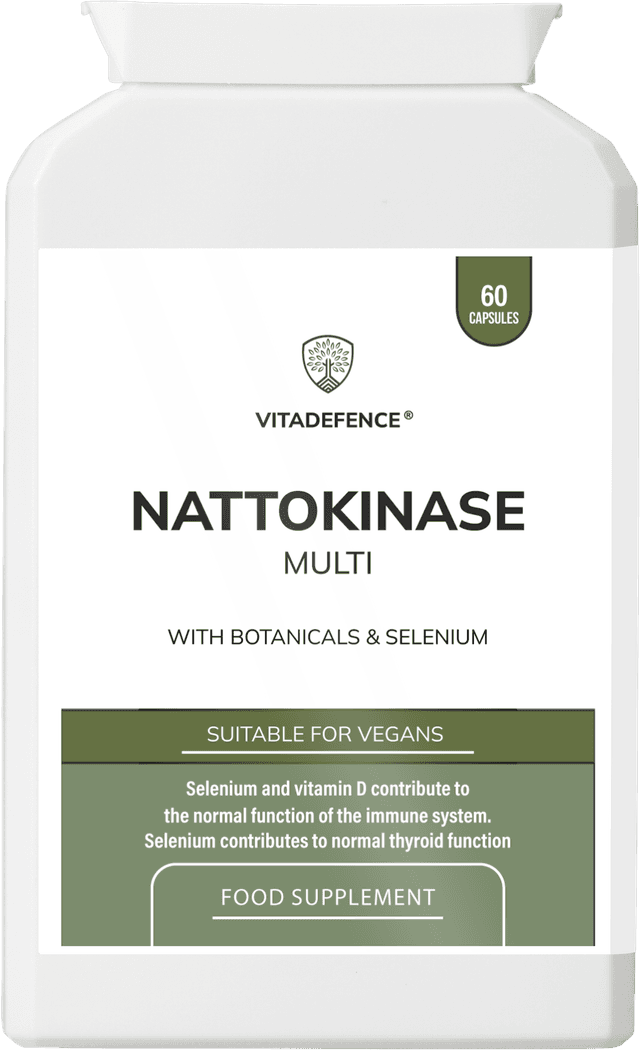
A clean cream pot, the green Vitadefence band running around it. Sixty vegan HPMC capsules. One a day, with water — a sixty-day course before you'd reorder. The kind of bottle that sits next to the kettle and disappears into the morning routine.
One note up front: if you are on warfarin, aspirin, clopidogrel, rivaroxaban, apixaban, or any other blood-thinning medication — or you're scheduled for surgery, or you're pregnant or breastfeeding — please don't take this without talking to your GP or pharmacist first. We'd rather you skipped this bottle than took it without asking.
The story of nattokinase
Natto is breakfast. In Japan, in a kitchen in Sendai or Mito, someone is opening a polystyrene pot of fermented soybeans, stirring them with chopsticks until the long sticky strands rise like spider silk, and tipping them over rice. The smell is intense — something between aged cheese and a damp gym bag — and most non-Japanese visitors recoil at the first taste. The locals laugh, eat it anyway, and live longer than almost anyone else on Earth.
Natto has been part of the Japanese diet for over a thousand years. The origin story has twelfth-century soldiers boiling soybeans, packing them in straw bales, and finding the next morning that wild Bacillus subtilis spores in the rice straw had transformed them into something stringy, savoury, and curiously alive. The Mito region of Ibaraki Prefecture has claimed the dish as its own ever since.
The modern chapter begins with Hiroyuki Sumi, a young Japanese researcher (discovery dated to 1980 at the University of Chicago, first published in Experientia in 1987). He placed a sample of natto onto a Petri dish containing fibrin — the protein that forms the lattice of a blood clot — and went to lunch. When he came back, the fibrin around the natto had liquefied. He named the enzyme nattokinase, the kinase from natto, and spent the next four decades studying it.
What nattokinase does, in plain language: it is a serine protease — a class of enzyme that breaks down certain proteins. In vitro, it acts on fibrin. In the living human body the picture is more complicated, the research still being assembled — small studies, varied doses, encouraging signals around circulation, plenty of unanswered questions. We're not going to overstate it. What we will say is this: a fermented food eaten by tens of millions for a thousand years, whose population shows some of the lowest cardiovascular mortality on Earth, is worth taking seriously. We use 100mg of extract per capsule, providing 2,000 fibrinolytic units (FU).
Black seed — the prophet's seed
A tiny black seed with its own thousand-year story. Nigella sativa — black seed, kalonji, habbat al-barakah, the seed of blessing — is mentioned in the Hadith of the Prophet Muhammad as a remedy for everything except death. The Romans called it black cumin. Modern interest centres on a compound called thymoquinone in the seed's pungent oil. We use 250mg per capsule — a meaningful daily dose from a tradition that has outlasted most empires.
Carrageen sea moss — the Atlantic seaweed
On the rocky shores of County Cork and County Donegal, low tide reveals dark red-purple fronds clinging to the granite. Chondrus crispus — Irish sea moss — has been harvested by Atlantic coastal communities for at least a thousand years. During the 1840s famine it was used as both food and folk medicine. The cooked moss yields a mucilage rich in iodine, magnesium, and trace minerals. We use 250mg of extract per capsule — a small daily contribution to a sea-vegetable cuisine most modern Western shoppers no longer eat.
Green tea — the leaf that built a culture
Cultivated in China for at least two thousand years, ritualised in Japan in the twelfth century, drunk now in nearly every country on Earth. The catechins — particularly EGCG — are a polyphenol family with a long laboratory record. 150mg of green tea extract per capsule. Quiet, supportive, traditional.
Dandelion root — the lawn that wasn't a weed
Before suburban lawns, dandelion was a vegetable. The French called it dent de lion — lion's tooth. The roots were roasted as coffee through both world wars. In Chinese herbal practice, pu gong ying has been used for centuries as a gentle support for the liver and lymphatic flow. 50mg of root extract per capsule. A quiet partner.
N-Acetyl Cysteine — the modern molecule with the hospital pedigree
NAC is the one ingredient on this label that didn't come from a forest or a fermentation barrel. It's a stable form of the amino acid cysteine, a precursor to glutathione — the body's master antioxidant peptide. NAC has been on the WHO List of Essential Medicines for decades, used in hospital settings for various clinical purposes well outside the remit of a food supplement page like this one.
In our formula, at 40mg, it sits as a small supportive dose alongside the plant ingredients — recognising that the modern body, faced with modern air, modern food, and modern stress, can use a hand keeping its glutathione stocks topped up.
Coriander leaf and fennel seed — the kitchen partners
Two more from the herb garden. Coriander leaf (cilantro), 30mg per capsule, used in kitchens from Mexico to India to Morocco for three thousand years and found in Tutankhamun's tomb. Fennel seed, 30mg, is the small green-grey seed served alongside Indian restaurant bills as a digestive — a habit from Ayurvedic tradition. Both earn quiet seats on the strength of their long human use.
Vitamin D and selenium — the two that the label can speak plainly about
Most of this article has been about plants and ferments. Two ingredients on the label are essential nutrients with European Food Safety Authority authorised wording.
Vitamin D (5.5µg, 110% NRV) — contributes to the normal function of the immune system and to the maintenance of normal bones, teeth and muscle function. The British winter is a vitamin D problem. From October to March our latitude doesn't deliver enough UVB for the skin to make any meaningful amount of it.
Selenium (55µg, 100% NRV) — contributes to normal thyroid function, normal immune function, and the protection of cells from oxidative stress. The UK soil is genuinely depleted in selenium compared with many other parts of Europe, and most of us are not eating Brazil nuts every day.
The formula as a whole
Lay these on a kitchen table — nattokinase, black seed, sea moss, green tea, dandelion, NAC, coriander, fennel, vitamin D, selenium — and what you see is a stack that respects the body's complexity. A fermented enzyme at the centre. A pair of essential nutrients with label-accurate wording. Traditional plants humans have lived alongside for centuries. One modern molecule with a clinical pedigree.
The thinking is gentle: not one heroic dose, but a constellation of small contributions speaking to circulation, immunity, and the quiet daily wear of being alive. None alone is a substitute for the conversation you should be having with your GP. A daily ritual, considered, that earns its place because everything in it has earned its place across continents and centuries.
How to use it
One capsule per day, with water, with or without food. Most take it with breakfast. Sixty capsules — a two-month course at one a day. Stop at least seven to ten days before any planned surgery or invasive procedure, and tell the surgical team.
Plant-and-enzyme stacks of this kind are a slow read. Don't expect the kind of effect you get from a coffee. The quietness is the point.
Honest caveats
This is a food supplement — it complements a varied diet, doesn't replace one, and is not intended to alter any medical condition. Do not take if you are using blood pressure medication or any blood-thinning medication (warfarin, aspirin, clopidogrel, DOACs such as apixaban or rivaroxaban) without first consulting your GP or pharmacist. Do not take if pregnant or breastfeeding. Stop seven to ten days before surgery. People with bleeding disorders, recent stroke, or active ulcers should also avoid without medical guidance.
Contains soy (nattokinase is derived from fermented soybean). Vegan, kosher and halal-approved. Keep cool, dry and sealed, out of reach of children. Do not exceed the recommended dose.
A traditional Japanese ferment, eight quiet partners, and a daily ritual considered enough to take seriously without taking lightly.
— Vitadefence
— Vitadefence