Showcase
Nitric Oxide Multi — what your body already makes, and the partners that help it
Nitric oxide is one of the smallest molecules your body makes — three atoms — and one of the most quietly important. We didn't try to give you the molecule itself. We gave you the raw materials, the same ones in beetroot, watermelon, and a salad your grandmother would recognise.
Key facts
- When the warm-up takes longer than it used to
- The tub, in your hand
- The story of nitric oxide
- L-arginine and L-citrulline — the amino-acid duet
- Beetroot nitrate — the deep red root
When the warm-up takes longer than it used to
You used to roll out of bed, lace up, and go. Two miles before your watch buzzed. Now there's a stretch ten minutes long before your legs decide they're awake. The first hill of every ride feels heavier than the last hill of last summer's. You haven't slowed down on paper — your splits are similar — but the getting started is different.
This is normal. It is what every human body does eventually. The vasodilation response — the small daily widening of blood vessels that delivers oxygen to working muscle — gets a little less responsive as the decades go on. Sleep, late nights, sugar, stress, the post-fifty hum of being alive — all of it tightens the dial.
This little tub of powder is one quiet contribution to that mechanism. Not a stimulant. Not a magic formula. Mostly the raw materials your own body already uses to make a small signalling molecule called nitric oxide, alongside a few traditional partners — beetroot, taurine, beta-alanine, B-vitamins — that have earned their place in serious sports nutrition.
The tub, in your hand
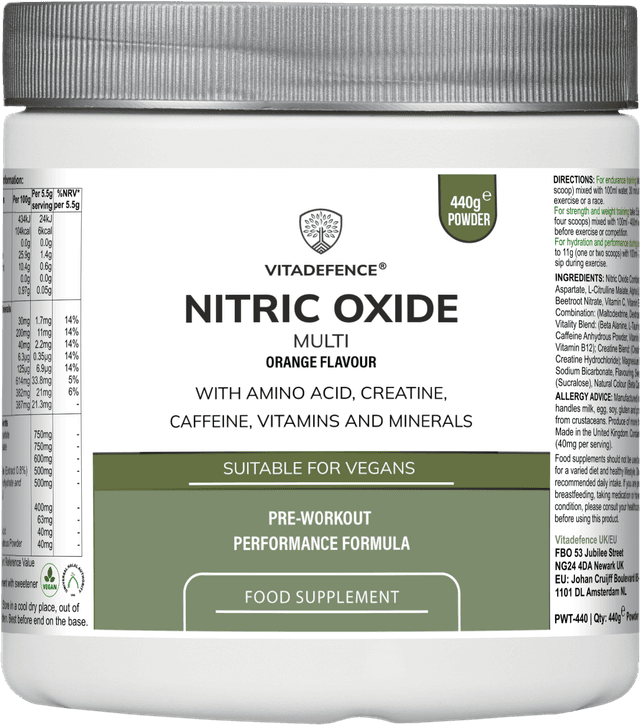
A 440g powder. One scoop is 5.5g. At the gentlest end, twenty servings; at the heaviest pre-race serving, eighty. It tastes faintly fruit-flavoured — sweetened with sucralose, coloured with beta-carotene from carrots, no synthetic dyes. You mix one scoop with 100ml of water about thirty minutes before training, sip it down, and head out.
A note up front: this powder contains caffeine — 40mg per 100g, roughly equivalent to a quarter of a small espresso per scoop, scaling up if you take multiple scoops. If you are sensitive to caffeine, pregnant, breastfeeding, on heart medication, or you already drink several coffees a day, please read the caveats at the end of this page.
The story of nitric oxide
For most of medical history, nitric oxide was thought of as a poisonous component of car exhaust and acid rain. Three atoms — one nitrogen, one oxygen — the kind of molecule a chemistry teacher mentioned with a warning.
Then in the 1980s three American researchers — Furchgott, Ignarro, and Murad — demonstrated that the same molecule was being made in tiny amounts inside the lining of human blood vessels and used as a signal: a message from the vessel wall to the smooth muscle around it, telling that muscle to relax. When the muscle relaxed, the vessel widened, and blood flowed more freely. In 1998 the three shared the Nobel Prize in Physiology or Medicine.
The idea behind this powder is simple: nitric oxide is something your body makes. It cannot be put into a jar — it has a half-life measured in seconds. But the materials the body uses to make it, and the small daily co-factors that keep that pathway running, can be measured, packaged and delivered. That is the spirit in which we built this tub.
L-arginine and L-citrulline — the amino-acid duet
Two amino acids do most of the work upstream of nitric oxide. L-arginine (750mg per 100g, as L-arginine aspartate) is the direct precursor — an enzyme called nitric oxide synthase converts arginine into nitric oxide and citrulline. L-citrulline (750mg per 100g, as L-citrulline malate) is then recycled back into arginine in a separate cycle.
Researchers found, slightly to their surprise, that supplementing citrulline often raises plasma arginine more reliably than supplementing arginine itself — arginine is heavily metabolised by gut and liver before reaching the bloodstream; citrulline slips through that first-pass and is recycled into arginine in the kidneys. So both are useful — arginine for the front of the pathway, citrulline as the slower top-up.
Citrulline takes its name from Citrullus, the watermelon genus, and was first isolated in 1914 from watermelon juice — the rind in particular is rich in it.
Beetroot nitrate — the deep red root
Beetroot is the other route to nitric oxide, working through a completely different pathway. Long before sports scientists got involved, beetroot was a Sunday roast vegetable. Romans cultivated it. Medieval monasteries planted it for winter storage. It dyes everything it touches a colour somewhere between burgundy and oxblood.
What's special about beetroot is its dietary nitrate content. Inside the body, that nitrate is converted in stages — first by friendly bacteria living on the surface of the tongue (which is why scrubbing your tongue too aggressively or using strong antibacterial mouthwash actually blunts the effect), then in the stomach and bloodstream — into nitrite, and finally into nitric oxide. This pathway is independent of the arginine route, which is why beetroot has earned its reputation among middle-distance runners and cyclists: a real, measurable, modest improvement in time-to-exhaustion in tightly controlled trials.
We use 500mg of beetroot extract standardised to 0.8% nitrate per 100g of powder. Concentrated, no need to roast a beet a day.
Beta-alanine, taurine, tyrosine — the muscle-and-mind partners
Beta-alanine (400mg per 100g) raises muscle carnosine, a compound that buffers the acid build-up of intense effort. The signature sensation is a harmless brief tingle on the skin — paraesthesia. After a few sessions most people stop noticing.
Taurine (600mg per 100g) is highly concentrated in the heart, retina, and skeletal muscle. The name comes from Bos taurus, the bull — it was first isolated from ox bile in 1827.
L-tyrosine (63mg per 100g) is the precursor to dopamine, noradrenaline and adrenaline — the brain's "go" chemistry. A small but meaningful dose before a hard session.
Creatine — the most studied sports supplement on Earth
Creatine has been studied more times in human trials than almost any other nutritional compound. The body uses it inside muscle cells to recharge ATP, the molecule that fires every muscle contraction. We use 500mg of creatine per 100g, supplied as a blend of creatine monohydrate (the gold-standard form) and creatine hydrochloride (a slightly more soluble form some people prefer). Pure, well-evidenced, traditional in the gym world for over thirty years.
Alpha-lipoic acid and B-vitamins — the metabolism partners
Alpha-lipoic acid (40mg per 100g) is a small fatty-acid-like molecule made naturally inside every cell, where it sits at the centre of energy metabolism. It earns its place as a quiet co-factor in this stack.
Vitamins C, E, niacin (B3), biotin and B12 appear at meaningful daily doses. Niacin (40mg per 100g) supports the normal function of the nervous system and reduction of tiredness. B12 supports normal energy-yielding metabolism and red blood cell formation. Vitamin C contributes to normal collagen formation for the normal function of blood vessels.
The formula as a whole
What ties this tub together is a single idea: the body already knows how to make nitric oxide. It already knows how to recharge ATP, how to buffer acid, how to fire muscle contractions. We are not asking you to swallow a finished molecule. We are giving you a careful selection of the raw materials your body uses for those processes — arginine and citrulline at the front of the NO pathway, beetroot at the back, taurine and beta-alanine and creatine in the muscle, B-vitamins keeping the whole metabolic machinery turning, a small caffeine kicker to wake the central nervous system up.
This is not a stimulant powder. It contains some caffeine, but the heart of the formula is not caffeine — it is the support of pathways your own body already runs.
How to use it
For endurance training: 5.5g (one scoop) in 100ml water, thirty minutes before. For strength training: one to four scoops thirty minutes before, depending on the session and your tolerance. For hydration during a long event: one or two scoops in 100-200ml water, sipped through the session. Don't pile it on top of three other pre-workouts — cumulative caffeine adds up faster than people realise.
Build up beta-alanine gradually if you're new to it. The tingle is not dangerous, but a full four-scoop dose on day one will make you feel like ants are crawling under your shirt for ten minutes.
Honest caveats
This is a food supplement — it complements a varied diet and a sensible training programme, doesn't replace either. Contains caffeine (40mg per 100g of powder, roughly 2.2mg per scoop). Not recommended for pregnant or breastfeeding women. Speak to your GP or pharmacist if you take medication for blood pressure, heart rhythm, or erectile dysfunction (the nitric-oxide pathway interacts with several drug families, particularly nitrates and PDE5 inhibitors). Do not exceed the highest recommended dose.
Suitable for vegetarians and vegans. Halal-approved. Made in an Informed Manufacturer facility — informed-sport screening on the production line, useful if you compete in tested sport. Keep cool, dry, sealed, out of reach of children.
A finished molecule, three atoms wide, nobody can put in a tub. The materials your body uses to make it — those, we can. That is what we have tried to give you here.
— Vitadefence
— Vitadefence