Showcase
Omega 3-6-9 Multi — three fats, one bottle, the balance the modern plate forgot
The modern shopping basket is heavy in one essential fat and light in another. Sunflower oil, soya oil, vegetable shortenings and seed-fed meat all push the same omega-6 family. The dark green leaves, the small oily fish, the wild greens — the omega-3 side of the plate — have quietly drifted off. This bottle is one small attempt to put it back.
Key facts
- What our great-grandmothers ate by accident
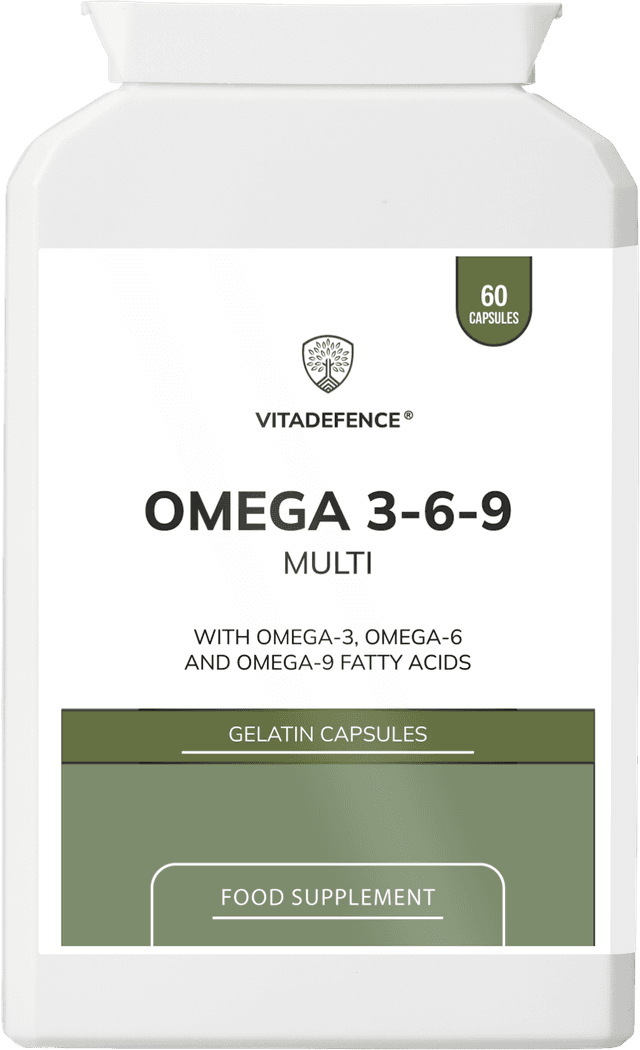
- The bottle, in your hand
- The story of the three families
- Omega-3 — the fragile family from cold water
- Omega-6 — the family the modern diet already over-supplies
What our great-grandmothers ate by accident
Two hundred years ago, a working family in northern Europe ate dark leafy greens from the kitchen patch, small oily fish from the local river or the coast, eggs from chickens that scratched in real grass, and butter from cows that grazed wild meadow. They didn't know what omega-3 was. They didn't need to.
The modern shopping basket has quietly tilted. Sunflower oil in the bread, in the dressing, in the chip-shop fryer. Soya in the margarine. Seed-fed beef and grain-fed salmon. The omega-6 family of fats — useful, essential, but only in moderate amounts — has flooded the modern plate. The omega-3 side — the cold-water fish, the dark greens, the flax, the walnut — has thinned out.
This bottle is one quiet correction. Not a magic bullet. Not a miracle. Three of the essential fat families in one daily capsule, in roughly the proportions our biochemistry was built for. A way to nudge the dial, day by day, back towards the balance the modern food chain has forgotten.
The bottle, in your hand
A small cream pot. Sixty soft gelatin capsules inside, each 1000mg. The capsule shell is bovine gelatin — this product is therefore not suitable for vegetarians or vegans, and we want to be plain about that up front. (For a strictly plant-based alternative, our Algal Omega bottles use the same omega-3 oils harvested directly from the marine algae that fish themselves get them from.)
Take one capsule, one to three times a day, with meals. The taste is mildly fishy if you bite into it; we recommend swallowing whole. Sixty capsules at one a day will last you two months.
The story of the three families
Fats are not a single substance. There are several distinct families of fatty acid, each with its own length, structure, and biological role. Three of those families are essential — meaning the body cannot make them and must absorb them from food.
The naming convention sounds technical but is simple: each fat is named after how far along the carbon chain its first double bond appears. Omega-3 has the bond at the third carbon. Omega-6, the sixth. Omega-9 at the ninth. The body builds membranes, hormones, and signalling molecules from each, and the balance between them is more important than the absolute amount of any one.
A century ago, the hunter-gatherer ratio of dietary omega-6 to omega-3 sat at about 1:1 to 4:1. The modern Western diet has drifted to somewhere between 15:1 and 25:1 — a fifteen- to twenty-five-fold tilt towards omega-6, mostly through industrial seed oils. That is the imbalance this bottle is built around.
Omega-3 — the fragile family from cold water
The omega-3 family is the headline. Three molecules in particular: ALA (alpha-linolenic acid) from plants, and EPA and DHA from marine sources.
ALA is found in flax seeds, chia seeds, walnuts, hemp, and dark leafy greens like purslane. It is the only omega-3 your body can technically convert (slowly, inefficiently — single-digit percentages) into the marine forms.
EPA and DHA are made directly by certain cold-water marine algae. The fish that eat the algae — anchovies, sardines, herring, mackerel, salmon, krill — accumulate the EPA and DHA in their flesh. The Inuit, the Greek islanders, the coastal Japanese, every traditional society with regular access to oily fish — all of them eat several grams of EPA and DHA per week without thinking about it.
EPA and DHA are essential to the structure of brain tissue (DHA in particular makes up around 8% of the dry weight of the human brain), the retina, the heart muscle, and the membranes of every cell. We use 400mg of fish oil concentrate per capsule, providing 60mg EPA, 35mg DHA, and a useful background of other long-chain marine fats. The fish are sourced from established small-fish fisheries — anchovy and sardine populations that reproduce fast and sit low on the food chain, where heavy-metal contamination is least concentrated.
Omega-6 — the family the modern diet already over-supplies
Omega-6 fats are essential too — the body cannot live without them — but the modern Western plate already supplies them in abundance. Linoleic acid (LA) is the main one, found in vegetable oils, seeds, nuts, and grain-fed meat. The body uses LA to build certain signalling molecules, including some involved in inflammation and immunity.
We include 290mg of sunflower seed oil per capsule, providing 165mg of linoleic acid. This is a moderate dose — deliberately so. The point is not to add to your omega-6 intake but to give the bottle a balanced essential-fatty-acid profile, with a higher relative weighting on omega-3 than the modern food chain does.
Omega-9 — the Mediterranean fat
Omega-9 — chiefly oleic acid — is the fat that makes olive oil what it is. Of the three families it is the only one the body can make for itself, so it is not strictly essential. But the populations who have eaten the most of it for the longest — the Cretans, Spanish, Italians, southern Greeks — have shown some of the most enviable cardiovascular profiles in modern epidemiology. 100mg of oleic acid per capsule. A daily nod to the Mediterranean larder.
Flaxseed oil — the plant bridge between omega-3 and the kitchen garden
Beside the fish oil, each capsule contains 300mg of cold-pressed organic flaxseed oil. Flax is one of the oldest cultivated crops in human history — Egyptian linen comes from its stem, the seeds turn up in archaeological digs from the Bronze Age forwards, and German and Russian peasant kitchens have used flaxseed oil drizzled over potatoes and quark for centuries.
Flaxseed oil is the richest plant source of ALA. The body converts a small fraction of that into EPA, but the conversion is partial and varies between individuals. Including flax alongside the marine oil gives you both the direct EPA and DHA and a precursor pool the body can pull from for its own conversion — the way a varied traditional diet would have done.
Vitamin E — the small label note that matters
Each capsule contains 6.7mg of vitamin E (10 international units, 56% of the EU Nutrient Reference Value), supplied as natural d-alpha tocopherol. The European Food Safety Authority authorised wording for vitamin E is precise and useful: it contributes to the protection of cells from oxidative stress.
Why does that matter in an oil capsule specifically? Because the long-chain marine fats are the most chemically delicate fats in human nutrition. They oxidise easily — meaning they can go rancid in the bottle if not stored well, or in the cell if not surrounded by enough antioxidant cover. Vitamin E sits in the same oily compartments as the omegas and protects them from that oxidation. It is the small daily insurance policy that keeps the rest of the formula doing its job.
The formula as a whole
Lay it out: omega-3 from concentrated cold-water fish, ALA from organic flax, omega-6 from sunflower (modest), omega-9 from olive-family oils, vitamin E as the antioxidant chaperone. One capsule, one to three times a day. Nothing dramatic. The balance, in a bottle.
This is not a stack designed to deliver a single heroic effect. It is a daily nudge of three essential fat families, towards the proportions the human body was eating for a hundred thousand years before the seed oils arrived.
How to use it
One capsule, one to three times a day, with meals. The fats absorb best alongside other dietary fat — so taking it with breakfast, lunch, or dinner is better than on an empty stomach. People with reflux or a sensitive stomach sometimes prefer to take it mid-meal rather than at the start.
Most people who notice a difference notice it gradually — drier skin softening over a few weeks, hair feeling less brittle, the kind of slow change that creeps up on you rather than announcing itself. EPA and DHA accumulate in tissue gradually; this is not a fast-acting nutrient.
Honest caveats
This is a food supplement — it complements a varied diet, it does not replace one, and it is not intended to alter any medical condition. Contains FISH (Piscis) oil. People with epilepsy should consult their doctor before taking this food supplement or changing their diet. Speak to your GP or pharmacist if you take blood-thinning medication, as long-chain omega-3 fats can have a mild additive effect at high doses. Stop seven to ten days before any planned surgical procedure unless your doctor advises otherwise.
The capsule shell is bovine gelatin — not suitable for vegetarians or vegans. Halal-approved. Keep cool, dry and sealed; oils of this type oxidise faster in heat and light. Out of reach of children. Do not exceed three capsules per day.
The dark green leaves, the small oily fish, the cold-pressed seed oil drizzled over a winter potato — none of those are coming back to the average British kitchen any time soon. This bottle is one small daily attempt to put a little of that lost balance back.
— Vitadefence
— Vitadefence