Showcase
Panax Ginseng Multi — the man-shaped root, fifteen quiet partners, one daily focus ritual
Five thousand years ago, in the mountain forests of Manchuria and Korea, a forager dug up a root that looked uncannily like a small human body — two arms, two legs, sometimes a face. They called it 'man-root'. The Chinese imperial court paid a king's ransom for it. We've put 1000mg of it in a capsule, with fifteen quiet partners, and asked you not to expect miracles.
Key facts
- When the afternoon used to be yours
- The bottle, in your hand
- The story of Panax ginseng
- Bacopa, ginkgo, guarana — the focus partners
- L-theanine, L-tyrosine, acetyl-L-carnitine — the amino-acid trio
When the afternoon used to be yours
There was a stretch of your working day, somewhere around two in the afternoon, that used to feel like the sharp end of the week. You did your hardest thinking, your best emails, your most cunning negotiations between two and four. Now that hour has gone soft. The third coffee of the day has stopped reaching the parts the first one used to. You sit in front of the screen and read the same paragraph three times.
This is one of the quiet costs of midlife, of long screen hours, of poor sleep, of the stress of small businesses and small children and small windows in an open-plan office. The afternoon brain dims. The morning brain stays a little longer in the evening. Caffeine takes more to do less.
This bottle is one quiet contribution to the daytime side of that ledger. It is not a stimulant in the sense of an energy drink. It is a careful pairing of a five-thousand-year-old Korean root with fourteen modern partners — adaptogens, amino acids, B-vitamins, a measured dose of caffeine — built around the idea that focus is not the same thing as wired.
The bottle, in your hand
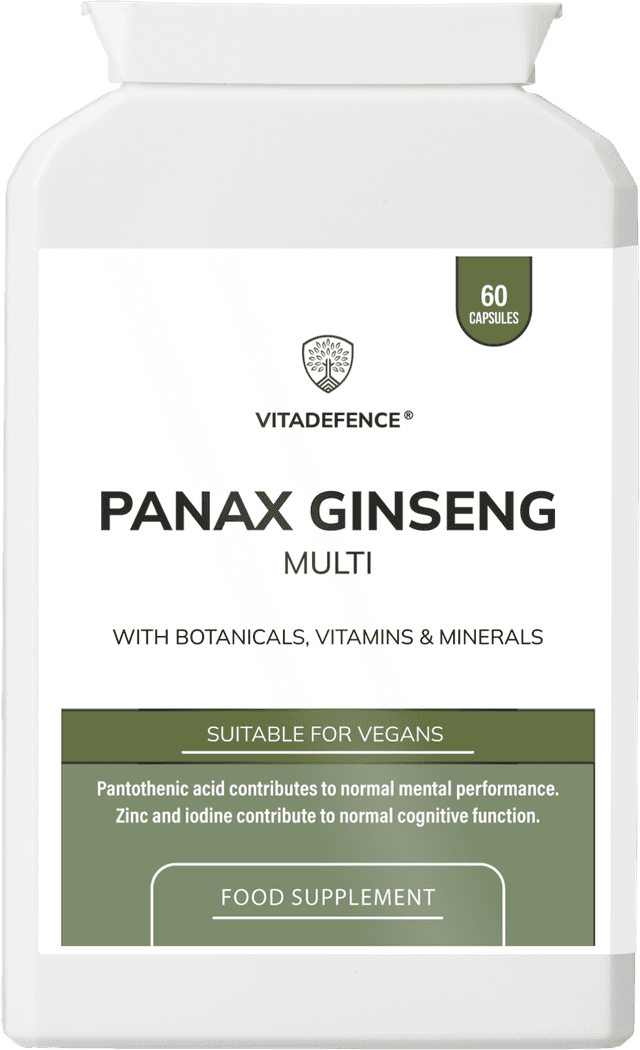
A small cream pot. Sixty vegan capsules inside. The serving is two capsules, taken in the morning or before a hard afternoon. Sixty capsules at one serving a day will last you a month.
A note up front. This formula contains 100mg of caffeine per two-capsule serving — slightly more than a small espresso, slightly less than a strong cup of filter coffee. It is a daytime bottle, not an evening one. It is not suitable for children, pregnant or breastfeeding women, or anyone who has been told by their doctor to limit caffeine. The full caveats sit at the end of this page; please read them before your first capsule.
The story of Panax ginseng
In the mountain forests of Manchuria, Korea, and the Russian Far East, in soil so cold it freezes solid for half the year, a small woodland herb spends six to eight years quietly building its root. The plant above ground is unremarkable — a few leaves, a small cluster of pale berries. The root below is the prize. By year six it can resemble, with some imagination, a small human body — a torso, two arms, two legs, sometimes the suggestion of a face. The Chinese name is renshen, man-root. The English botanical name Panax comes from the Greek for "all-healing" — the same root as our word panacea.
The root has been part of East Asian medicine for over five thousand years. The earliest written reference dates from a Chinese pharmacopoeia of the Han dynasty around 100 BC. By the eighteenth century the demand from the Chinese imperial court was so intense that wild Korean ginseng was being smuggled across the Manchurian border in convoys, and a single old root could cost more than gold by weight. The Russians who pushed eastward through Siberia found a related but botanically distinct plant — Eleutherococcus senticosus, sometimes called Siberian ginseng — and an entire field of study eventually grew up around the adaptogens, plants that help the body deal with the wear of stress.
(That is one of the reasons our product line carries both. Siberian ginseng — Eleutherococcus — is a different plant from a different family with a different chemistry. The two are sometimes confused on supermarket shelves. They are not interchangeable. We list each by its proper name, and explain the difference here so you know which is which.)
What does Panax ginseng actually do? In plain language: the root contains a family of compounds called ginsenosides, plant steroid molecules that the long literature suggests help the body handle stress and fatigue. The research data is genuinely interesting and hedged — small studies, mixed populations, encouraging signals on subjective fatigue and certain measures of cognitive performance, plenty of unanswered questions. We use 1000mg of Korean Panax ginseng extract per two-capsule serving — a meaningful daily dose drawn from a tradition that has outlasted dynasties.
Bacopa, ginkgo, guarana — the focus partners
Bacopa monnieri (300mg per serving) is the small creeping herb known in Sanskrit as brahmi, named after Brahma, the creator. Used in Ayurvedic medicine for over two thousand years to support memory and concentration, it earns a quiet seat at the focus table.
Ginkgo biloba (300mg) is one of the oldest living plant species on Earth — fossil specimens 270 million years old are nearly indistinguishable from the leaves you can pick off a Ginkgo tree on a London street today. The leaf has been used in Chinese medicine for over a thousand years; modern interest centres on flavonoid and terpene compounds linked in the literature to cerebral microcirculation.
Guarana (400mg) is the small red-and-black seed harvested from a climbing vine in the Brazilian Amazon, where the Tupi people have used it for centuries to fuel long days of hunting and trade. The seed is rich in caffeine, slow-released alongside its companion alkaloids and tannins.
L-theanine, L-tyrosine, acetyl-L-carnitine — the amino-acid trio
L-theanine (100mg) is the amino acid responsible for the calm-but-alert quality of green tea — the reason a cup of tea feels different from a cup of coffee even at the same caffeine dose. Pairing theanine with caffeine is one of the best-evidenced "smart" combinations in all of nutrition science.
L-tyrosine (100mg) is the precursor to dopamine, noradrenaline and adrenaline — the brain's "go" chemistry, the same one we use in our pre-workout powder for the same reason.
Acetyl-L-carnitine (100mg) is a small molecule that shuttles fatty acids into mitochondria — the cell's energy factories. The acetyl form crosses the blood-brain barrier more readily than plain carnitine.
Choline, phosphatidylserine, phosphatidylcholine, DHA — the membrane group
Brain tissue is largely fat. Choline (37mg) and phosphatidylcholine (12mg, soy-derived) are precursors to acetylcholine, central to memory formation. Phosphatidylserine (8mg, soy-derived) is concentrated in brain cell membranes. DHA (50mg, from marine algae — vegan-friendly) makes up around 8% of the dry weight of the human brain. A small group of structural ingredients in modest doses — a daily nutritional contribution to the architecture of the brain, not a quick-acting punch.
The B-vitamin spine and a few minerals
Niacin (B3) 10mg, pantothenic acid (B5) 8mg, folate 200µg, B12 400µg, zinc 3mg, iodine 45µg — the label-accurate spine of the formula. Each contributes to authorised wording around energy metabolism, normal psychological function, normal immune function, and normal cognitive function. The B12 dose is high (400µg, 16,000% NRV) — water-soluble B-vitamins are excreted rather than stored, so a generous dose on the label simply reflects a margin of safety, not pharmacological intent.
Caffeine and the kitchen-garden notes
Caffeine anhydrous (100mg per serving) is the steady backbone behind the guarana — together they deliver a measured caffeine dose, less stimulant-spiky than an espresso shot.
Cinnamon (300mg), turmeric (212mg), rosemary (100mg), green tea leaf (200mg) and black pepper (10mg) round out the formula — kitchen-garden spices that have travelled with humans for thousands of years.
The formula as a whole
Sixteen ingredients, one capsule shell, two-capsule serving. The thinking is layered: a five-thousand-year-old Korean root at the centre; three traditional focus plants around it; an amino-acid trio that pairs caffeine with calm; a structural-fats group for the brain's own architecture; a B-vitamin spine; and a few kitchen-garden notes for synergy and complexity.
This is not a drug. It will not turn a tired Tuesday into a sharp one in twenty minutes the way a strong coffee can. What we have tried to build is a daily ritual — a measured caffeine envelope, with a careful set of partners around it — that respects the way the brain actually works.
How to use it
Two capsules with a glass of water, in the morning or before a focused afternoon. For best results, take 45 minutes before food or 90 minutes after. Do not exceed six capsules per day. Do not take in the evening — the caffeine will affect your sleep.
Bacopa is a slow ingredient: research traditions suggest it earns its place over four to twelve weeks of regular daily use, not on day one. Be patient with it.
Honest caveats
This is a food supplement — it complements a varied diet, doesn't replace one, and is not intended to alter any medical condition. Contains caffeine — 100mg per two-capsule serving. Not recommended for children, pregnant or breastfeeding women, or anyone advised by their doctor to limit caffeine. Speak to your GP or pharmacist if you take blood-thinning medication (ginkgo can have a mild additive effect), antidepressants, or medication for mood, blood pressure, blood sugar or thyroid. Contains soy (phosphatidylserine and phosphatidylcholine). Stop seven to ten days before any planned surgery.
Suitable for vegetarians and vegans. Kosher and halal-approved. Keep cool, dry and sealed; out of reach of children. Do not exceed the recommended dose.
A man-shaped root from a Korean forest, fifteen quiet partners, and a daily focus ritual that has earned its place across continents and centuries.
— Vitadefence
— Vitadefence