Showcase
Passion Flower Multi — a Spanish missionary's symbol, eight quiet evening companions
When the Jesuits arrived in the New World in the seventeenth century, they found a flower so strange that they read its parts as the entire Crucifixion — three nails, five wounds, twelve apostles, a crown of thorns. The locals had been brewing the same vine into a calming tea for centuries before. We've put 100mg of it in a capsule, with seven evening partners around it.
Key facts
- When the body lies down but the mind doesn't
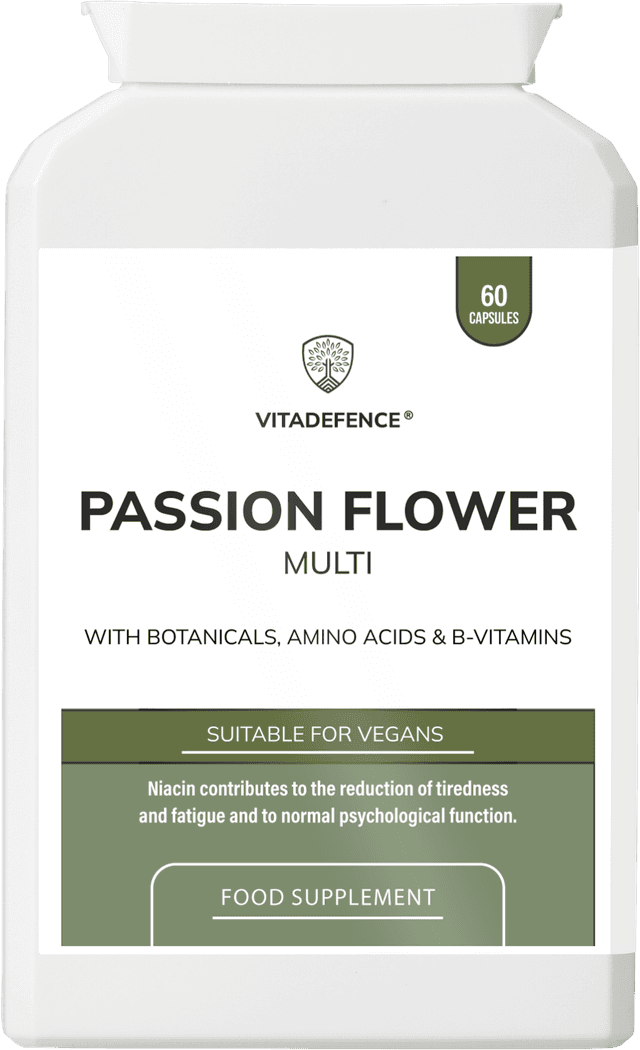
- The bottle, in your hand
- The story of the passion flower
- Montmorency tart cherry — the upstate orchard
- Ashwagandha KSM-66 — the Indian root for the morning *and* the evening
When the body lies down but the mind doesn't
You've been horizontal for forty minutes. The room is dark, the phone is across the room, the breathing exercises have been done, and your brain is still rehearsing tomorrow's awkward email. You aren't anxious in the diagnostic sense — your GP would tell you you're fine. But the gap between body lying down and mind switching off has stretched into something that costs you, on a bad night, ninety minutes of life.
The over-the-counter answers — antihistamines, melatonin where you can get it — work, but they leave their own drag the next morning. This bottle is one of the older, quieter alternatives.
Eight ingredients in a small cream pot, taken in the evening. A passion flower from a sixteenth-century Spanish mission garden, a tart cherry from upstate Michigan, an ancient Indian root, a German farmhouse meadow flower, a Mediterranean lavender — and a small backbone of magnesium and B-vitamins. None of it is a sedative. The point is the gentle return of the gap between getting into bed and being asleep to something closer to what you remember.
The bottle, in your hand
A small cream pot. Sixty vegan capsules inside. Take one or two with water in the evening — most people start at one and add the second only if they want a fuller dose. At one capsule a day the bottle lasts two months; at two, one. Nothing dramatic. The kind of bottle that lives by the bedside and disappears into the wind-down routine.
A note up front: this is a calming-herb formula, not a sedative. It pairs poorly with sedative medication (sleeping tablets, benzodiazepines, certain antihistamines) and with alcohol. If you take medication for anxiety, sleep, or mood, please read the caveats at the end of this page before your first capsule and speak to your GP or pharmacist if you're unsure.
The story of the passion flower
In the early 1600s, a Spanish monk in what is now Mexico noticed a vine in a Jesuit mission garden that he had never seen in any European herbal. The flower was extraordinary — a fringed corona of purple and white filaments, three styles standing above ten petals, five anthers below.
To a seventeenth-century European eye, especially a religious one, the flower read like a sermon. The three styles became the three nails of the Crucifixion. The five anthers, the five wounds. The fringed corona, the crown of thorns. The ten "petals" (actually five sepals plus five petals), the ten faithful apostles. The coiling tendrils were the whips. They sent drawings back to Rome, and Passiflora was given the name we still use — passion not in the modern romantic sense, but in the older sense of suffering, from the Latin passio.
What the missionaries did not record with the same attention was that the indigenous peoples of the region — including the Cherokee further north — had been using the leaves and flowering tops of Passiflora incarnata for centuries as a calming evening infusion. The use travelled north through Cherokee lands and into German pharmacopoeia; by the late nineteenth century European apothecaries kept it on the shelf as a traditional herb for what doctors of the era called "nervous excitability."
Modern research data on passion flower is, honestly, modest in size and mixed in result — encouraging small trials around generalised anxiety scales and pre-procedure dental anxiety, alongside a long unbroken thread of traditional use across cultures. We use 100mg per capsule — a sensible daily dose drawn from a tradition that has crossed an ocean.
Montmorency tart cherry — the upstate orchard
In the orchards of Door County, Wisconsin, and Old Mission Peninsula, Michigan, and parts of Ontario, a small sour cherry has been grown for a hundred and fifty years. Montmorency — named after a French valley near Paris where the variety was first cultivated in the 1600s — is the cherry behind every American cherry pie. It is also unusually high in melatonin, the small hormone the body makes naturally to time the sleep-wake cycle.
Cherry-derived melatonin is not the same as a melatonin tablet — the dose from food sources is much smaller, and the cherry brings dozens of accompanying polyphenols (anthocyanins, in particular) that pure melatonin does not. We use 350mg of Montmorency tart cherry extract per capsule — equivalent weight from concentrated whole-fruit, the way the orchards have eaten it for generations.
Ashwagandha KSM-66 — the Indian root for the morning and the evening
Ashwagandha — Withania somnifera, the second word literally meaning sleep-bringing — has been a daily Ayurvedic root for three thousand years. The KSM-66 designation refers to a specific full-spectrum extract from the root only (no leaf), with a particular standardisation profile that has accumulated the most published human research of any ashwagandha extract on the market.
We use 250mg of KSM-66 per capsule. The story we have written about ashwagandha at length elsewhere in our line — its name (the smell of horse in Sanskrit, for the strong aroma of fresh root); its use as both a daytime adaptogen and an evening calming root; its slow, weeks-long cumulative pattern of action. In this evening formula, it sits as a quiet partner to the passion flower.
Chamomile, lemon balm, lavender — the kitchen-garden trio
Three calming plants from three European traditions.
German chamomile (Matricaria recutita, 50mg) — the small white flower at the heart of every farmhouse evening tea cabinet from the Black Forest to the Cotswolds. Active compounds: flavonoids and bisabolol.
Lemon balm (Melissa officinalis, 50mg) — the soft mint-scented herb that self-seeds aggressively in any English garden. Romans planted it; medieval monasteries kept it for evening tisanes; the Carmelite nuns of seventeenth-century Paris distilled it into Eau de Mélisse, still sold in French pharmacies today.
Lavender (25mg) — the silver-grey, purple-spiked plant of every dry hillside from Provence to the southern English coast, used in pillows, sachets and steam inhalations for at least a thousand years.
L-taurine and L-tyrosine — the two amino-acid notes
L-taurine (50mg) and L-tyrosine (50mg) appear here at modest doses. Taurine is famously concentrated in the heart, retina, and skeletal muscle. L-tyrosine is the precursor to dopamine and adrenaline. In an evening calming formula, the doses are deliberately small — they are background notes, not the headline.
The label-accurate spine — magnesium and the B-vitamins
Several nutrients on this label have European Food Safety Authority authorised wording.
Magnesium (50mg, 13% NRV) — contributes to normal psychological function, normal nervous system function, and the reduction of tiredness. Modern UK diets are mildly magnesium-light from soil depletion and lower whole-grain consumption.
Pantothenic acid (B5) (50mg, 833% NRV), vitamin B6 (2mg, 143% NRV), niacin (B3) (12mg, 75% NRV) and biotin (73.3µg, 147% NRV) round out the B-vitamin spine — contributing to normal psychological and nervous-system function and the reduction of tiredness.
The boring, label-accurate backbone behind the more romantic plant story.
The formula as a whole
Eight botanicals and a B-vitamin spine: passion flower at the centre, Montmorency cherry as the gentle melatonin nudge, ashwagandha as the slow-burn adaptogen, chamomile and lemon balm and lavender as the kitchen-garden trio, taurine and tyrosine as small amino-acid notes, magnesium and B-vitamins as the label-accurate backbone. One capsule, with water, in the evening.
Not a sedative. Not a sleeping tablet. A daily wind-down ritual whose ingredients have travelled centuries to arrive at the bedside table.
How to use it
One or two capsules with a glass of water in the evening — most people take it about thirty to ninety minutes before bed. Don't take it in the morning unless you want to feel a quiet softness through the working day. Pair the capsule with a wind-down routine — dim lights, screens off, a real book — and give the formula three to four weeks before judging it. Plant-and-mineral stacks of this kind work cumulatively.
If you find one capsule leaves you a little too soft the next morning, drop back. If you find two leave you flat, drop to one. The bottle is meant to fit your sleep, not the other way round.
Honest caveats
This is a food supplement — it complements a varied diet, doesn't replace one, and is not intended to alter any medical condition. It is not a sleeping tablet and is not a substitute for medical advice on persistent insomnia or anxiety. Speak to your GP or pharmacist if you take medication for sleep, anxiety, mood, blood pressure, blood sugar, or thyroid. Avoid combining with alcohol or other sedatives. Not recommended for pregnant or breastfeeding women, or for children. Stop seven to ten days before any planned surgical procedure.
Suitable for vegetarians and vegans. Kosher and halal-approved. Keep cool, dry and sealed; out of reach of children. Do not exceed two capsules per day.
A flower the Spanish missionaries read as a sermon, a cherry from a Michigan orchard, an Indian root older than memory, three quiet plants from three European meadows, and a label-accurate spine to keep them honest. A small evening offering at the bedside.
— Vitadefence
— Vitadefence