Showcase
Psyllium Husk Multi — an Indian seed husk, ten quiet companions, and the thing they all do well
Psyllium husk is one of the most studied soluble fibres on Earth. We've paired it with rhubarb, flaxseed, broccoli, prune, fenugreek and six more — a daily fibre top-up. Read with the choking warning at the top.
An Indian seed husk, ten quiet companions, and the thing they all do well.
Read this first — the warning that goes at the top
Psyllium husk is one of the most useful fibres in nature. It is also a real choking risk if you take it dry. Always swallow these capsules with a minimum of 250ml of water — about a generous mug — and don't lie down for at least thirty minutes after. If you have a swallowing difficulty, an oesophageal narrowing, or any GI obstruction history, talk to your GP before you start.
That's the warning. It belongs at the top, not buried in small print at the bottom. The rest of this page is the story.
If your gut has been quietly less reliable than it used to be
Maybe it's been creeping up on you. The mornings that used to be predictable have stopped being predictable. You feel heavier than you should after dinner. The bloating that used to be a once-a-month thing has become a Tuesday thing. You've tried more vegetables, you've tried more water, you've tried the kombucha. It's better, but it's not back to what it was when you were twenty-five.
Most adults in the UK eat under twenty grams of fibre a day. The official recommendation is thirty. The gap — that ten grams — is roughly what you'd get from a pear, a slice of wholegrain bread, half a tin of beans and a handful of broccoli. Doable on a good day, hard on a busy one. The modern shopping basket is white, soft, and stripped — the bran has been milled out of the bread, the skin has been peeled off the apple, the husk has been polished off the rice.
This little pot is one quiet way to put some of that lost fibre back. Five hundred milligrams of psyllium husk per capsule, sitting at the head of a ten-ingredient blend of fibres, fruit extracts and seed powders. One to two capsules, one to three times a day, with a tall glass of water.
The pot, in your hand
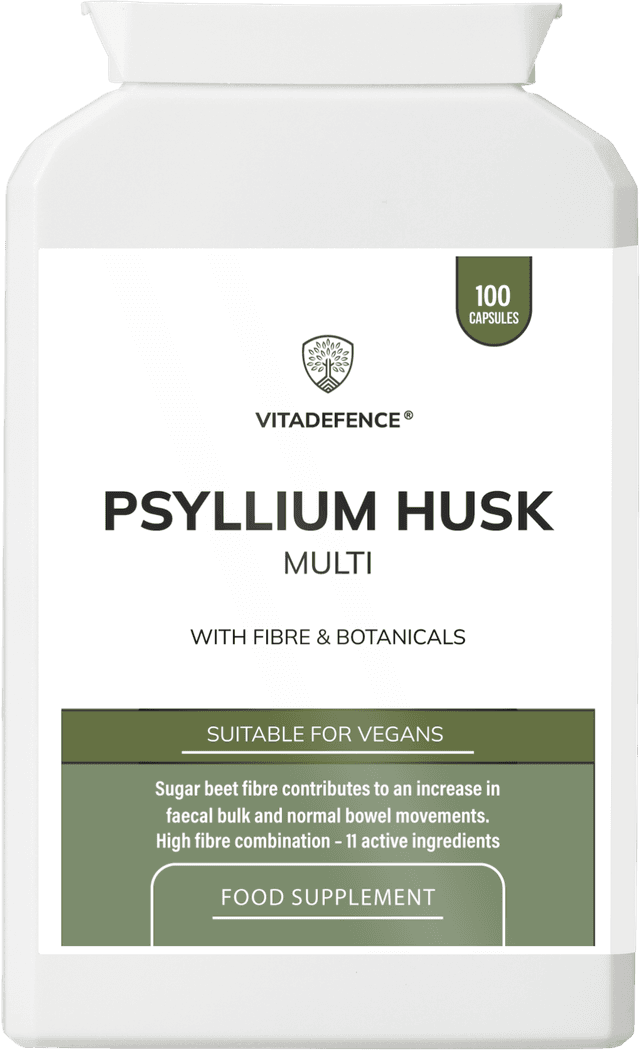
A clean cream pot, the green band of our label running around it like a hedgerow line. One hundred vegan capsules inside, each one delivering at least 513mg of dietary fibre, of which a generous portion is the soluble, water-loving kind that psyllium is known for. The capsule shell itself is plant-based — hydroxypropyl methylcellulose, derived from cellulose, no animal gelatine.
There's a slightly grassy-sweet smell when you open the lid. That's the rhubarb root and the fenugreek doing their bit. Take it with the evening meal, or split the dose across two meals, with plenty of water. Don't take it dry. We mean it.
The story of psyllium
Psyllium (Plantago ovata) is a low-growing, wiry annual plant native to the dry plains of northern India and Pakistan, particularly the state of Gujarat where it has been cultivated as a smallholder crop for at least a thousand years. The seeds are tiny — about a millimetre long, pale pink-brown — and the husk is the thin gel-forming coat that wraps each seed.
In Ayurveda, psyllium husk is isabgol — prescribed for travellers, the elderly, those whose digestion had become irregular. Persian and Unani medicine borrowed the same word. By the nineteenth century, British colonial pharmacopoeias had absorbed it as ispaghula. Modern pharmacology has a name for what was happening: psyllium husk is a mucilage — a long-chain polysaccharide that, on contact with water, swells into a soft gel many times its dry weight.
What that gel does inside the gut is two things. First, it bulks the stool — adds soft, hydrated volume that the colon's smooth muscle can grip and move forward without strain. Second, it slows the absorption of sugars and lipids in the small intestine, which is part of why dietary authorities have recognised soluble fibre's relationship to maintaining normal blood cholesterol levels when consumed at meaningful daily doses (the figure widely cited in European nutrition guidance is around three grams per day of soluble fibre, of which psyllium counts).
We use psyllium at 500mg per capsule. At one to three capsules a day, you'll get between 0.5 and 1.5g of psyllium-derived fibre, supplementing the rest of your day's plate. This is a top-up, not a replacement for a fibre-rich diet.
Rhubarb root — the kitchen-garden plant with a longer history than the crumble
Rhubarb (Rheum palmatum) is the same plant family as the pink stalks you put in a crumble, but the medicinal varieties — the species native to the high-altitude meadows of central and western China — are a different cultivar. The root, not the stalk, is what traditional Chinese medicine has used for over two thousand years, where it appears in the Shennong Bencao Jing (the Divine Farmer's herbal classic, c. 200 AD) as a gentle digestive remedy.
What rhubarb root brings to a fibre formula is its anthraquinone glycosides and its bitter principles — gentle digestive cues that work in concert with bulk-fibre. We use it at 450mg of equivalent weight from extract per capsule. As with all rhubarb-root preparations, it's not designed for daily use over many months — short courses are the traditional pattern. (See the caveats section.)
Flaxseed — the seed the ancient Egyptians wove into linen
Flaxseed (Linum usitatissimum) is one of the oldest cultivated plants on Earth — domesticated in the Fertile Crescent more than nine thousand years ago, woven into the linen wrappings of Egyptian mummies, milled into bread by the Greeks. The Latin name usitatissimum means most useful, and they meant it: fibre for cloth, oil for lamps, seeds for food and medicine.
The seed coat is a rich source of mucilage — the same gel-forming fibre family as psyllium, in a different molecular pattern. The seed itself carries lignans (a group of plant polyphenols) and alpha-linolenic acid (the plant-form omega-3). We use 70mg of flaxseed powder per capsule, partly for the fibre layer and partly because flax has earned its quiet seat in any well-built fibre blend.
The kitchen-garden chorus
Six more ingredients round out the formula — none a headline, all earning a quiet seat.
Sugar beet fibre (Beta vulgaris, 60mg) — pectins and hemicelluloses, the fibre gut bacteria love. Broccoli extract (Brassica oleracea, 75mg) — cruciferous green, sulforaphane-bearing. Prune extract (Prunus salicina, 50mg) — the dried-plum digestive remedy of old kitchens, sorbitol and phenolics. Fig fruit extract (Ficus carica, 20mg) — Mediterranean since antiquity, pectin layer and natural enzymes. Apple pectin (Malus pumila, 20mg) — the soluble fibre that makes jam set; in the gut, a feeder for bifidobacteria. Carrot powder (Daucus carota, 5mg) — a token of colour.
Fenugreek seed and fennel seed — two old digestive companions
Fenugreek seed (Trigonella foenum-graecum, 40mg) — Roman Greek hay (literal Latin of foenum-graecum), Ayurvedic methi, the kitchen herb in dal and chai. Unusually high in galactomannan, a soluble fibre with a long traditional reputation.
Fennel seed (Foeniculum vulgare, 5mg) — the aromatic seed served at the end of an Indian meal as mukhwas. A small token dose; an old, well-loved digestive seed across Mediterranean, European and South Asian kitchens.
The formula as a whole
Lay these eleven ingredients on a table — psyllium, rhubarb, flaxseed, sugar beet, prune, broccoli, fenugreek, apple, fig, carrot, fennel — and what they share is fibre. Different molecular shapes of it. Soluble psyllium and apple pectin. Insoluble flax shell. Bitter-and-anthraquinone rhubarb. Galactomannan fenugreek. Pectin-rich fig and prune. Sulforaphane-bearing broccoli.
The thinking is variety inside the same room of the house. A single fibre isolate (just psyllium, on its own) does one job well but narrowly. A blend of ten fibres, each in different proportions, gives the gut more textures to work with — different fermentation rates, different bacterial preferences, different transit-time effects.
This is not a replacement for eating fibre at the plate. It's a top-up for the days the plate is short.
How to use it
One or two capsules, one to three times a day, with at least 250ml of water each time. Read that sentence twice. Always with water.
Most people start with one with breakfast and one with dinner. If your gut is sensitive, start lower — one a day for the first week — and let the body adapt. Fibre supplements can cause temporary gas or bloating in the first ten days as the microbiome shifts; this usually settles.
If you take other oral medications — thyroid, iron, diabetes, or any prescription drug — separate the psyllium dose from the medication by at least two hours. Soluble fibre can slow the absorption of co-ingested drugs.
Honest caveats
This is a food supplement — it complements a varied diet, doesn't replace one. The label warns of possible traces of mustard and sesame from shared processing — read the allergy line if you have a serious allergy.
If you are pregnant, breastfeeding, taking regular medication, or living with a medical condition (especially any GI obstruction history, swallowing difficulty, hiatus hernia, oesophageal narrowing, IBD flare, or recent abdominal surgery), talk to your GP or pharmacist before starting. Anyone on warfarin or other blood-thinning medication should mention the rhubarb-root content; some traditional rhubarb preparations have a mild interaction profile.
Take the capsules with plenty of water. Always. Don't exceed six capsules a day. Don't use long-term as a replacement for a fibre-rich diet — the goal is to close the gap, not to substitute the plate.
If you've read this far, thank you. We tried to write the kind of page we'd want to read before spending money — no overblown gut-health promises, no neon cleanse language. Just a small Indian seed husk, ten quiet companions, a tall glass of water, and a daily ritual that may help if your fibre intake has slipped below where you'd like it.
— Vitadefence
— Vitadefence