Showcase
Pumpkin Seed Multi — a New World seed, fifteen kitchen-spice partners, one daily capsule
Pumpkin seed is one of the oldest cultivated foods in the Americas. We've paired it with garlic, clove, cinnamon, oregano and cayenne — a daily capsule built around the spice rack.
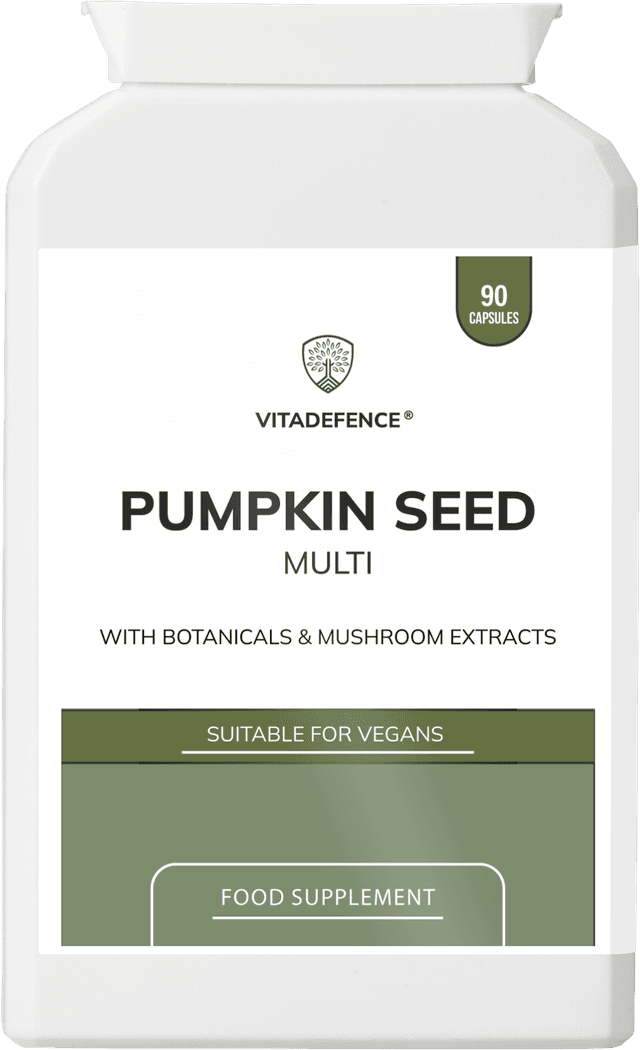
A New World seed, fifteen kitchen-spice partners, one daily capsule.
If you've been quietly looking for the spice rack in a capsule
Maybe it's the way modern eating has flattened. The food on the supermarket shelf is more uniform than it used to be — sweeter, saltier, blander, with the bitter and the pungent edges sanded off. The cinnamon in your latte is the cheap, hot kind, not the soft Ceylon stick your grandmother grated into the rice pudding. The garlic in the jar is mild and slightly metallic. Oregano is the green dust on top of a pizza. Clove is something you remember from Christmas.
What's gone missing is the layer of flavour our ancestors leaned on for thousands of years — the spices and seeds and barks that woke up a meal, settled a stomach, reminded the body it was being fed by something more than carbohydrate and protein. Pumpkin Seed Multi is a small attempt to put a few of those flavours back into your week, in a form you take with a glass of water rather than a meal.
This little pot is built around pumpkin seed at the head of the formula, with fifteen culinary partners woven in — black garlic, Ceylon cinnamon, clove bud, cayenne, olive leaf, oregano, shiitake mushroom, thyme, and seven more. One capsule, one to three times a day. The dose is gentle. The ingredients have been doing their quiet work in human kitchens for centuries.
The pot, in your hand
A clean cream pot, the green band of our label running around it like a hedgerow line. Ninety vegan capsules inside — the shell is hydroxypropyl methylcellulose, plant-derived, no animal gelatine. The capsules carry a faintly warm, slightly toasted smell when you open the lid. That's the cinnamon and the clove, with the cayenne hovering quietly underneath.
Take one to two capsules, one to three times a day, with food. Three months at one a day, six weeks at two. The kind of thing you take as part of a winter ritual or a busy-week ritual, not a year-round megadose.
The story of the pumpkin seed
The pumpkin (Cucurbita pepo) is one of the great gifts of the Americas. Domesticated in southern Mexico more than seven thousand years ago, it spread north into what is now the United States and south into the Andes long before European contact. The Three Sisters — corn, beans and squash — were the foundation of farming across much of pre-Columbian North America, with squash supplying ground cover, calorie-dense flesh, and a particularly valued seed.
The seed itself, pepita in Mexican Spanish, was eaten roasted, ground into mole sauces, and used in traditional Mesoamerican medicine for centuries. When the squash family travelled to Europe in the 1500s, central European countries — particularly Austria, Slovenia and Hungary — fell in love with it. Styrian pumpkin-seed oil, dark green and nutty, now carries a Protected Geographical Indication under EU law.
What pumpkin seeds carry that earned them their place across two continents is a particular nutrient profile: unusually rich in zinc, magnesium, and the amino acid tryptophan. The seed coat also contains cucurbitin, a unique amino acid found nowhere else in the plant world, with a long history of traditional use across Mesoamerican, central European, and Chinese folk medicine.
We use 200mg of pumpkin seed extract per capsule. The dose is supportive, not heroic — the seed sits at the head of a formula whose strength comes from variety, not from any single megadose.
Black garlic — the slow-fermented heart
Garlic (Allium sativum) is one of the most universally adopted plants in the human diet — Egyptian tomb offerings, Roman legion rations, Korean kimchi, Italian aglio. Black garlic is regular garlic aged for weeks in warm, humid conditions, where the natural enzymes convert the pungent allicin into softer, sweeter, fig-and-balsamic Maillard compounds.
What black garlic carries that fresh garlic doesn't is a higher concentration of S-allylcysteine — a stable, water-soluble sulphur compound studied for its antioxidant properties — and a much milder taste profile. We use 100mg of black garlic extract per capsule.
Ceylon cinnamon — the soft, true cinnamon
There are two cinnamons on the supermarket shelf, and most people don't know they're different. The cheap, hot-flavoured, bright-orange-red bark in supermarket shakers is cassia (Cinnamomum aromaticum), grown in China and Vietnam, high in coumarin — a compound that, in large daily doses over years, can be a problem for the liver.
Ceylon cinnamon (Cinnamomum zeylanicum) is grown in Sri Lanka, paler, softer in flavour, dramatically lower in coumarin. It's the cinnamon of fine baking and traditional Ayurveda. We use 100mg of Ceylon cinnamon bark extract per capsule. A small but meaningful choice.
Cayenne pepper — the warming spice that ate the world
Cayenne (Capsicum annuum) is another gift of the Americas. Domesticated in Mexico and Peru more than six thousand years ago, after Columbus carried it back to Spain in the 1490s it spread across Asia and Africa with extraordinary speed — within two centuries, no Indian curry, no Hungarian goulash, no Korean stew could be imagined without it.
What gives cayenne its heat is capsaicin. Beyond flavour, capsaicin has earned a long traditional reputation as a circulation spice — a warming presence in cold-climate cooking. We use 100mg of cayenne pepper fruit extract per capsule. The dose is moderate; you'll feel a faint warmth, not heat.
Olive leaf — the Mediterranean evergreen
Olive (Olea europaea) is the tree that has fed the Mediterranean basin for nearly six thousand years. The fruit and the oil are famous. The leaf, less so — but the silvery-green leaf carries the highest concentration of oleuropein, the bitter polyphenol that has earned olive leaf its place in Mediterranean folk medicine since at least the time of Pliny the Elder. We use 133mg of olive leaf extract per capsule, standardised to 1.00mg of oleuropein.
Clove bud — the dried flower the Europeans went to war over
Clove (Syzygium aromaticum) is the dried unopened flower bud of an evergreen tree native to the Maluku archipelago — the original Spice Islands. The Portuguese, Dutch and English fought a series of long, bloody wars in the 1600s for control of the clove monopoly.
The active aromatic in clove is eugenol, an oil-soluble phenol with a long history in dental folk medicine (the clove-on-the-toothache tradition). We use 80mg of clove bud powder per capsule.
The wider chorus
Ten more ingredients earn their seat at the table — none a headline, all earning a quiet seat:
Chicory root (Cichorium intybus, 120mg, coffee substitute, inulin source). Grapefruit seed extract (Citrus paradisi, 75mg). Fenugreek seed (Trigonella foenum-graecum, 50mg, Roman Greek hay, Ayurvedic methi). Aniseed (Pimpinella anisum, 25mg, eastern Mediterranean licorice-flavoured seed). Oregano leaf (Origanum vulgare, 25mg, wild marjoram of Greek hillsides). Shiitake mushroom fruiting body (Lentinula edodes, 25mg, long-cultivated Japanese mushroom). Konjac powder (Amorphophallus konjac, 20mg, glucomannan source). Lapacho bark (Tabebuia, 15mg, pau d'arco, Andean folk medicine). Thyme leaf (Thymus vulgaris, 10mg, European cottage-garden herb). Bamboo silica (Bambusa vulgaris, traditional silica-rich grass).
Together, they make this capsule a small culinary world rather than a single-ingredient story.
The formula as a whole
Lay these sixteen ingredients on a kitchen table — pumpkin seed, black garlic, Ceylon cinnamon, cayenne, olive leaf, clove, chicory, grapefruit seed, fenugreek, aniseed, oregano, shiitake, konjac, lapacho, thyme, bamboo — and what they share is the spice cabinet. Most of them you'd find on a chef's shelf. All of them have been doing quiet work in human kitchens for centuries — some for thousands of years.
The thinking is flavour-as-medicine — the old kitchen wisdom that the bitters and the warmers and the aromatics are not just garnish, but a layer of the meal that wakes up the digestion and feeds the body something beyond calories. A capsule won't replace cooking with these ingredients fresh. But on the days the cooking is rushed and the supermarket basket is bland, this is one quiet way to keep the spice-rack in your week.
How to use it
One or two capsules, one to three times a day, with food. Most people start with one capsule a day with breakfast, and add a second with dinner if their body welcomes it. Take with food, not on an empty stomach — the cayenne and clove can feel sharp on a hungry gut.
Don't expect a fireworks effect. These are slow ingredients, the kind that earn their place in your week through quiet repetition rather than dramatic single-day impact. If after two months you feel nothing has shifted, stop. A supplement that isn't doing anything for you isn't worth the money.
Honest caveats
This is a food supplement — it complements a varied diet, doesn't replace one. Allergen note: pumpkin seeds are in the wider seed family that some people have sensitivities to — if you have any seed allergy history, talk to your GP before starting.
If you are pregnant or breastfeeding, avoid this product — the cayenne, cinnamon and oregano dose levels here are higher than what you'd get from cooking with these spices, and several of them have a folkloric reputation for not being suited to pregnancy. If you are taking blood-thinning medication (warfarin, apixaban, etc.), mention the garlic and the clove content to your prescriber. If you have any GI ulcer history or active reflux, the cayenne may not suit you.
Keep the pot cool, dry, sealed, out of reach of children. Don't exceed six capsules a day. Don't take it long-term as a replacement for eating actual spices and seeds in cooking — the whole-food matrix is still the gold standard, and this little pot is a top-up for the days the cooking is bland.
If you've read this far, thank you. We tried to write the kind of page we'd want to read before spending money — no kitchen-cabinet wonder promises, no overblown panacea language. Just a New World seed, fifteen kitchen-spice partners, and a small daily capsule built around the idea that flavour, properly chosen, is part of how human beings have been keeping themselves well for a very long time.
— Vitadefence
— Vitadefence