Showcase
Red Clover Multi — a meadow flower with isoflavones, ten quiet companions, one daily capsule
Red clover is a flower with a long European herbal-tradition history. We've paired it with wild yam, sage, schizandra, soya isoflavones, and seven more — a botanical capsule for the second half of life.
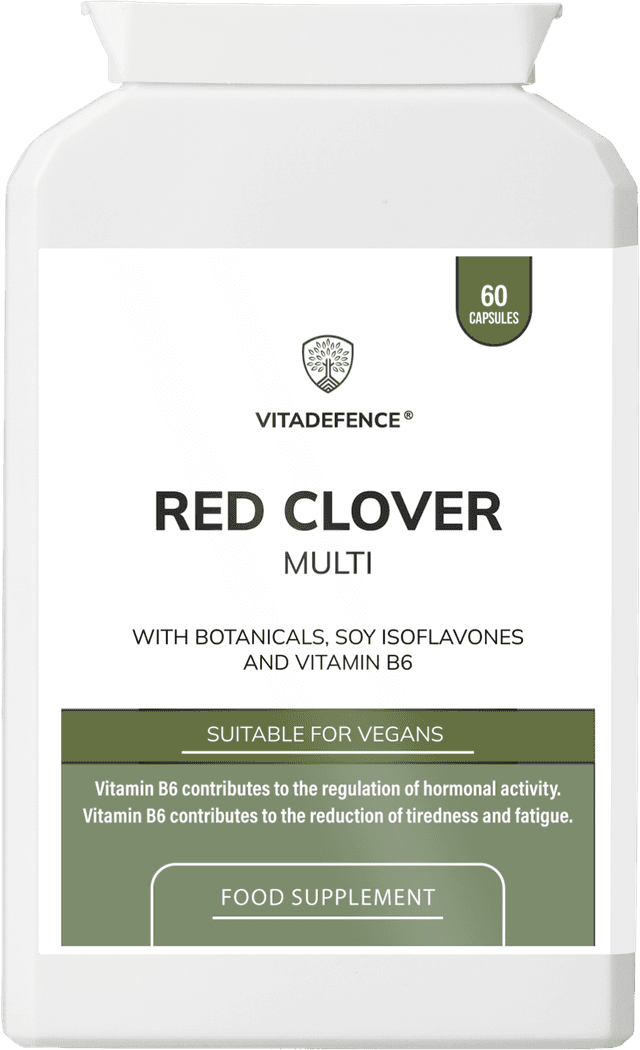
A meadow flower with isoflavones, ten quiet companions, one daily capsule.
A note on what this is and isn't
If you have arrived here after googling herbs for the second half of life, you will have read a lot of bold language elsewhere. We've tried to write the opposite of that. Red clover is a plant with a long European herbal tradition; this is a herbal capsule with a story worth knowing — and a list of cautions worth reading before you start. It is not a substitute for medical advice, HRT, or a prescription medicine. (See Honest caveats at the bottom.)
If your body has been telling you something has shifted
Maybe it started with the sleep. The nights that used to be solid have become broken. You wake up too warm. Your moods slide further than they used to. Your cycle, if you still have one, has stopped behaving like it did. The world keeps going as if nothing has changed, but something has.
For thousands of years, women in cultures with intact herbal traditions had a quiet middle path — the European meadow herbs (red clover, sage, hops) were part of household medicine, drunk as teas and tonics, woven into a daily ritual that didn't promise to fix anything but walked alongside the body through the change. Modern life has largely lost that vocabulary. This pot is one quiet way to put a little of it back.
The pot, in your hand
A clean cream pot, the green band of our label running around it like a hedgerow line. Sixty vegan capsules inside — the shell is hydroxypropyl methylcellulose, plant-derived, no animal gelatine. Take one capsule, two to three times a day, with food. The bottle holds about a month at one capsule three times daily, two months at one twice daily.
The smell when you open the lid is faintly hay-and-sage, with the dry-flower note of the red clover sitting at the top. Take it morning and afternoon, or split as one with breakfast and one with dinner. It is, deliberately, a slow-and-steady ritual rather than a single megadose.
The story of red clover
Red clover (Trifolium pratense) is the pinkish-purple, dome-shaped flower-head most British walkers know from summer hayfields and unmown corners of gardens. The plant is a nitrogen-fixing legume — the same family as peas and beans — long planted as a green manure to improve worn-out soil.
What red clover carries that herbal tradition has paid attention to for centuries is a group of plant compounds called isoflavones — particularly biochanin A, formononetin, daidzein and genistein. Isoflavones belong to the wider class of phytoestrogens — plant compounds with a structural resemblance to the body's own oestrogens, which means they can interact with the same receptors, gently and weakly, in a way studied with growing interest since the 1990s.
Western herbal practice has used red clover for centuries — as a tonic for the second half of a woman's life, as a meadow tea drunk in the slow afternoon. We use 800mg of red clover extract per capsule. It is the headline ingredient.
A note on what we won't claim: results across modern studies have been honestly mixed — some encouraging, some null. We won't claim it cures or prevents anything. It has earned its quiet seat in European herbal practice; that is a different kind of evidence with its own weight.
Wild yam — the Mexican vine
Wild yam (Dioscorea villosa and related species) is a climbing vine native to Central America and the south-eastern United States. The Mayan and Mexican peoples used it for centuries in traditional women's medicine. The plant carries diosgenin, a steroid-like saponin that, in mid-twentieth-century laboratory chemistry, became the starting material for the synthesis of progesterone — the breakthrough that made the contraceptive pill possible.
To be very clear: taking wild yam in capsule form does NOT provide your body with progesterone or an equivalent hormone. The conversion that happens in a laboratory does not happen inside your gut. What wild yam does carry is its long traditional reputation in the herbal canon. We use 800mg of wild yam extract per capsule — co-headline beside the red clover.
Sage leaf — the kitchen herb with a longer history than the stuffing
Sage (Salvia officinalis) has been a European medicine plant for as long as European medicine has been written down. The medieval Salerno medical school had a saying — Cur moriatur homo cui salvia crescit in horto? — Why should a man die if sage grows in his garden? The Latin name itself comes from salvere, to save.
Sage has a particular tradition in supporting women through the years when the body's thermostat starts behaving differently — used in European herbal practice as a cooling, drying, settling herb, particularly for the kind of sweat-disturbance that often accompanies the change. We use 200mg of sage leaf extract per capsule.
Schizandra berry — the five-flavoured fruit
Schizandra (Schisandra chinensis) is a climbing vine native to northeast China and the Russian Far East. In traditional Chinese medicine the berry is wu wei zi — the five-flavour fruit — said to carry sweet, sour, bitter, salty and pungent in a single dried berry. The Chinese tradition has classed it as an adaptogen — a herb that supports the body's resilience to stress and fatigue. We use 100mg of schizandra berry per capsule.
Bamboo silica, hops, alfalfa, kelp, soya isoflavones, Siberian ginseng — the supporting chorus
Six more ingredients earn their seat at the table.
Bamboo extract (Bambusa vulgaris, 200mg, providing 15mg silica) — silica is part of connective tissue, hair, nails and skin; bamboo is one of the richest plant sources. Hops (Humulus lupulus, 80mg) — the bitter cone-flower of the brewing tradition, traditionally calming, with a small phytoestrogen profile of its own. Alfalfa (Medicago sativa, 20mg) — the deep-rooted lucerne, a nutrient-dense leaf in traditional herbal practice. Siberian ginseng (Eleutherococcus senticosus, 20mg) — the Russian eleuthero, a different botanical genus from Asian ginseng, used as a daily-stamina adaptogen. Kelp (Ascophyllum nodosum, 20mg) — the brown seaweed of cold North Atlantic shores, a traditional source of trace minerals and natural iodine. SOYA isoflavones (40% standardised, 20mg) — concentrated phytoestrogens that complement the red clover's isoflavone profile.
The two label-accurate nutrients
Two of the ingredients in this bottle can be spoken about with the precision of nutrition science, because they are essential nutrients with European Food Safety Authority authorised wording.
Vitamin B6 (5mg, 357% NRV) — contributes to the regulation of hormonal activity and to the reduction of tiredness and fatigue. Zinc (2.5mg, 25% NRV) — contributes to normal cognitive function and to the maintenance of normal hair, skin and nails.
These two are the spine of label-accurate nutrition behind the herbal story. The B6 dose carries a warning we surface explicitly — long-term intake of more than 10mg of B6 a day may cause mild tingling and numbness, so don't stack this product on top of other B-complex vitamins.
The formula as a whole
Lay these twelve ingredients on a table — red clover, wild yam, bamboo, sage, schizandra, hops, alfalfa, Siberian ginseng, kelp, soya isoflavones, B6, zinc — and what they share is the second-half-of-life herbal tradition. Most of them have been part of European, Chinese, Russian or Mesoamerican women's-health folk practice for centuries. None of them is a hormone. None of them replaces medical advice.
The thinking is the herbal middle path — slow, accumulated work of plants that have earned their seats in the herbal canon through long use. A capsule won't replace a conversation with a GP. But for the days you want a daily ritual that walks alongside the body, this is one quiet option.
How to use it
One capsule, two to three times a day, with food.
Don't expect a dramatic effect. These are slow herbs. If you are going to feel the formula's quiet weight, you'll feel it between week three and week eight — slightly steadier sleep, slightly easier mood transitions, a small daily reminder that the body is being supported by something with a long tradition.
If after eight weeks nothing has shifted, stop. A supplement that isn't doing anything for you isn't worth the money. The herbal canon is full of plants with personal-fit variation, and red clover doesn't suit everyone.
Honest caveats — please read before starting
This is the longest caveats section we write, because this formula deserves it.
This is a food supplement — it complements a varied diet, doesn't replace one, and it does NOT replace medical care.
Do not take this product if:
- You are pregnant or breastfeeding
- You have, or have ever had, an oestrogen-sensitive cancer (breast, ovarian, uterine, endometrial)
- You are taking tamoxifen, aromatase inhibitors, or any hormone-related medication
- You are taking warfarin, apixaban, or other anticoagulant/blood-thinning medication (red clover and isoflavones may interact)
- You are taking the contraceptive pill, HRT, or other hormonal therapy without first discussing this product with your prescriber
- You have endometriosis, fibroids, or any other oestrogen-sensitive condition
- You have a SOYA allergy (this product contains soya isoflavones)
Talk to your GP or pharmacist before starting if: you take any prescription medication, you have a thyroid condition (kelp + iodine), you have any chronic medical condition, or you simply aren't sure if a herbal product is appropriate for your circumstances.
Watch for: mild tingling/numbness if you stack other B6-containing products on top of this one (the 5mg B6 dose is generous; long-term total daily intake above 10mg has been associated with sensory side-effects).
Keep the pot cool, dry, sealed, out of reach of children. Don't exceed three capsules a day.
If you've read this far, thank you. We tried to write the kind of page we'd want to read before spending money — no neon menopause-cure language, no overblown phytoestrogen promises, no whispering about libido or youth. Just a meadow flower, ten quiet companions, two label-accurate nutrients, and a long list of cautions that we'd rather you read than skip.
— Vitadefence
— Vitadefence