Showcase
Rhubarb Multi — a kitchen-garden plant, ten warming companions, one daily capsule
Rhubarb root is one of the oldest items in the Chinese medicine chest, and the same plant family lives in your back garden. We've paired it with ginger, clove, burdock, fennel and six more — a daily warming-and-bittering capsule.
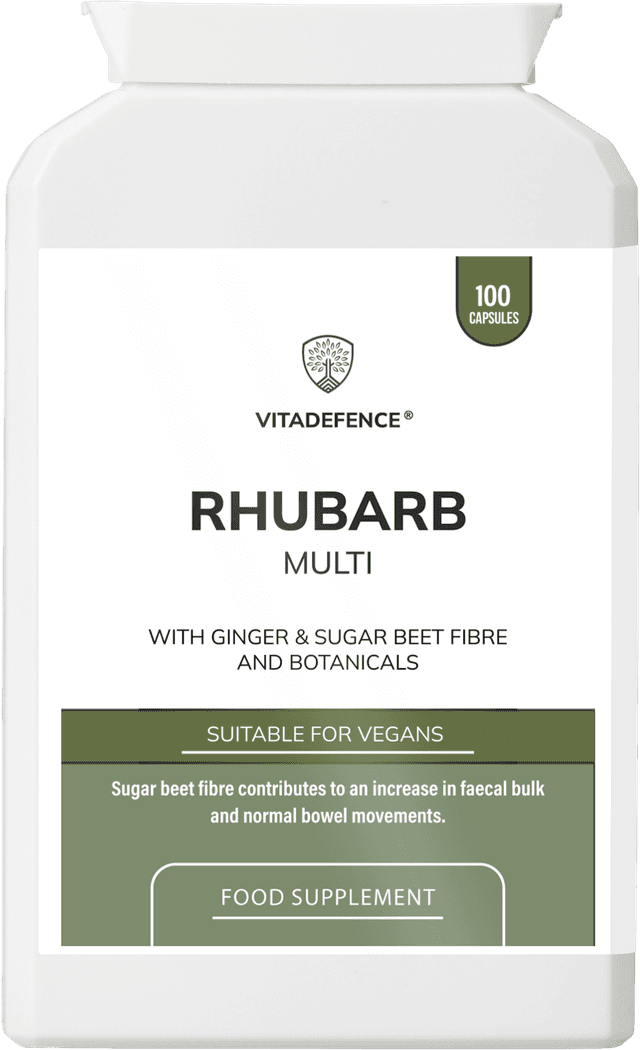
A kitchen-garden plant, ten warming companions, one daily capsule.
A note on what this is and isn't
If you've come here looking for a quick-fix laxative, this isn't quite that. Rhubarb root is one of the oldest items in the Chinese herbal medicine chest, and the formula in this pot has been built in the slow-bittering tradition rather than the strong-purgative one. We won't make any promises about transit time, schedule reliability, or a particular result. What we will do is tell you what each plant in the pot is, where it comes from, and why it earns its seat at the table. (See Honest caveats at the bottom — the rhubarb root we use, like all rhubarb-root products, is for short-course use, not daily-for-years.)
If your gut has been a little sluggish and your appetite a little flat
Maybe you've noticed it after a heavy week — too many late dinners, too many pints, too many supermarket sandwiches. The body feels a bit weighed-down. Appetite has gone soft. You're not ill; the food just isn't moving with the lightness it used to. Modern Western eating leaves the digestion under-stimulated; we've sanded the bitter and the warming notes off our food, and the gut, which evolved on a diet that tasted of bitter greens and warming roots, has fewer of the cues it used to rely on.
This little pot is one quiet attempt to put a few of those cues back, in a capsule that you can take during a busy stretch and stop when the body is back to itself. Rhubarb root sits at the head of the formula, with ten warming and bittering companions woven in — ginger, clove, burdock, cayenne, fennel, dandelion, liquorice, barberry, and two more. The dose is gentle. The tradition is old.
The pot, in your hand
A clean cream pot, the green band of our label running around it like a hedgerow line. One hundred vegan capsules inside — the shell is hydroxypropyl methylcellulose, plant-derived, no animal gelatine. The capsules carry a faintly warm, slightly bitter, faintly aromatic smell when you open the lid. That's the ginger, the clove, and the rhubarb root doing their bit.
Take one or two capsules, one to three times a day, with food. Most people use this product for a short course — two to four weeks during a heavy spell — rather than as a year-round daily.
The story of rhubarb
Rhubarb is a plant of two homes. The first most British readers will recognise: the leafy green plant with deep red-pink stalks growing in the kitchen garden, pulled in spring and stewed with sugar for crumbles. That plant — Rheum rhabarbarum — is the European table rhubarb.
The second home is older and very different. The high-altitude meadows of the western Chinese provinces of Sichuan, Gansu and Qinghai, where the medicinal rhubarbs Rheum palmatum and Rheum officinale have grown wild for millennia. The root of these high-meadow rhubarbs — not the stalk — appears in the Shennong Bencao Jing, the Divine Farmer's Materia Medica (c. 200 AD). It travelled west along the Silk Road, was traded by Persian and Arab apothecaries through the medieval centuries, and arrived in Renaissance Europe as the most expensive herb in the apothecary's drawer — by weight, more valuable than saffron.
What rhubarb root carries that earned it that traditional reputation is its anthraquinone glycosides — sennosides, rheinosides and emodins — together with a profile of bitter principles. The dose matters: small doses tend toward the bittering tonic end, larger doses toward the more dramatic end. The formula in this pot sits at the gentler tonic end, deliberately.
We use both rhubarb powder and rhubarb root extract, sourced from the medicinal Rheum palmatum. It is the headline ingredient.
Ginger root — the warming root from the wet tropics
Ginger (Zingiber officinale) is a tropical plant of South-East Asian origin, first domesticated around the islands of what is now Indonesia. It travelled to China by 200 BC, to Rome by the first century AD, and to medieval Europe via the Arab spice routes.
What ginger brings to a digestive formula is its gingerols and shogaols — the warm, slightly hot principles that have earned ginger its place across virtually every traditional medicine system on Earth. Chinese medicine, Ayurveda, European herbalism, Caribbean folk medicine: all of them have used ginger as a warming digestive herb.
Burdock root — the wild plant the Japanese eat as a vegetable
Burdock (Arctium lappa) is the broad-leaved wild plant of European and Asian roadsides — the burrs famously inspired Velcro after George de Mestral examined them under a microscope in 1941. The deep tap-root has been a staple food in Japan, where it is gobō, valued for its earthy flavour and its traditional reputation as a blood-cleaner in folk herbalism. In Western herbal practice, burdock is one of the bitter root family — used in slow tonic preparations alongside dandelion.
Clove bud, cayenne, fennel — the spice cabinet at work
Three culinary spices earn their seat in this formula.
Clove bud (Syzygium aromaticum) — the dried unopened flower bud of the evergreen tree native to the Indonesian Spice Islands. The active aromatic is eugenol, with a long history in dental folk medicine (the clove on the toothache tradition) and digestive-bitter formulas across European and Chinese practice.
Cayenne pepper (Capsicum annuum) — the warming chilli of the Americas, domesticated in Mexico and Peru more than six thousand years ago. Capsaicin is the principle behind cayenne's heat and its long reputation as a circulation-and-digestion warming spice.
Fennel seed (Foeniculum vulgare) — the aromatic seed served at the end of an Indian meal as mukhwas, the after-dinner mouth-freshener and digestive aid. An old, well-loved digestive seed across Mediterranean, European and South Asian kitchens.
Dandelion, liquorice, barberry — the bitter chorus
Three more roots and barks form the traditional bitter chorus.
Dandelion root (Taraxacum officinale) — the lobe-leaved kitchen-garden weed, roasted as a coffee substitute since the eighteenth century, used in European folk herbalism as a gentle bitter tonic.
Liquorice root (Glycyrrhiza glabra, in deglycerized form) — the sweet root of central and southwest Asian tradition, with thousands of years of recorded use in Chinese, Greek and Egyptian medicine. We use the deglycerized form (DGL) which has had most of the glycyrrhizin removed — a sensible precaution given glycyrrhizin's known interaction with blood pressure and potassium balance at large doses.
Barberry bark (Berberis vulgaris) — the inner bark of the European wild barberry shrub, source of berberine, an alkaloid with a long traditional reputation in Persian, Indian and Chinese medicine.
Sugar beet fibre and bamboo silica
Two more ingredients deserve a sentence each.
Sugar beet fibre (Beta vulgaris, 50mg per capsule) — the soluble-and-insoluble fibre fraction left after sugar extraction, a quietly excellent gut-microbiome food. Bamboo silica extract (Bambusa vulgaris) — silica is part of connective tissue, hair, nails and skin; bamboo is one of the richest plant sources.
The formula as a whole
Lay these eleven ingredients on a table — rhubarb, ginger, clove, cayenne, fennel, burdock, dandelion, liquorice, barberry, sugar beet fibre, bamboo — and what they share is the warming-bittering tradition. Most of them sit somewhere on the bitter or warm end of the flavour spectrum, the part of the meal that has largely vanished from supermarket food.
The thinking is the slow tonic. Not a one-day fix. Not a strong purge. A daily, gentle, bittering presence in your week that pairs well with a heavier-than-usual diet, a stretch of late dinners, or a season when the body wants a small reminder that it lives in a kitchen that used to taste like more than soft white bread and fizzy drinks.
How to use it
One or two capsules, one to three times a day, with food. Most people start with one capsule with breakfast and one with dinner. Use this product for a short course — two to four weeks — and stop. Long-term daily use of rhubarb-root products is not the traditional pattern.
Take with food, not on an empty stomach. The cayenne and the rhubarb can feel sharp on a hungry gut, and the formula is designed to walk alongside a meal rather than to dominate it.
Honest caveats
This is a food supplement — it complements a varied diet, doesn't replace one.
Do not take this product if:
- You are pregnant or breastfeeding
- You are under 18
- You have any GI obstruction history, IBD flare, undiagnosed abdominal pain, or recent abdominal surgery
- You have diarrhoea or any active digestive disturbance
- You take warfarin, apixaban or other anticoagulants without first discussing with your prescriber
- You take digoxin, diuretics, or potassium-affecting medication (the rhubarb and the residual liquorice content may interact)
- You have kidney stones or kidney disease (rhubarb is naturally high in oxalates)
Talk to your GP or pharmacist before starting if: you take any prescription medication, you have any chronic medical condition, or you simply aren't sure if a herbal-bittering product is appropriate for your circumstances.
Don't use long-term. Rhubarb-root preparations across all traditional medicine systems are short-course herbs — used for a few weeks during a heavy spell, then put away. Daily-for-years use is not the traditional pattern, and the modern medical literature suggests caution about anthraquinone-containing herbs taken indefinitely.
Keep the pot cool, dry, sealed, out of reach of children. Don't exceed six capsules a day.
If you've read this far, thank you. We tried to write the kind of page we'd want to read before spending money — no overblown laxative-promise language, no neon cleanse talk. Just an old kitchen-garden plant with a Silk Road past, ten warming-and-bittering companions, and a small daily ritual to keep on hand for the busier weeks.
— Vitadefence
— Vitadefence