Showcase
Rice Protein Multi — the quiet plant protein for the dairy-tired
Brown-rice protein with a soft chocolate finish, gentle on stomachs that have given up on whey. A daily 25g scoop, hypoallergenic, and an honest plant story.
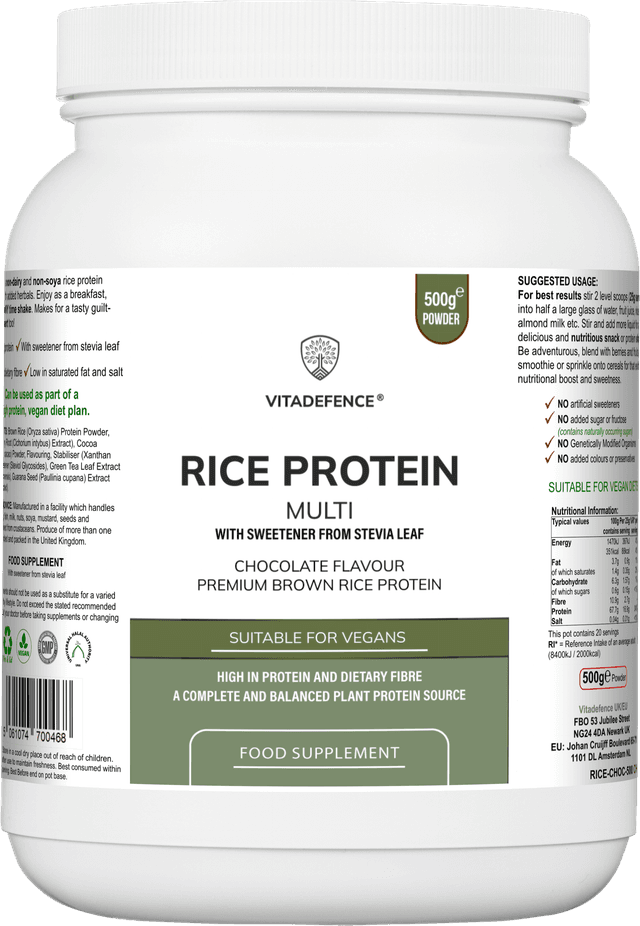
A quiet plant protein for the dairy-tired.
When whey starts to feel like a fight
You used to drink whey without thinking. Now your stomach turns thirty minutes after the shake. The bloat, the rumble, the urgent walk to the bathroom — most of us blame the workout, then the weather, then the supermarket milk, until one quiet day we admit it: the protein powder we've been buying for ten years isn't agreeing with us any more.
About one in three British adults has some level of lactose intolerance by their forties. Plenty more have grown an unspoken sensitivity to dairy proteins themselves. The body changes. Whey doesn't.
This pot is a soft answer. Brown rice protein. Cocoa. A little green tea. A little guarana. Twenty scoops, mixed with water or oat milk, gentle on the stomach the morning after, and quiet enough that you stop noticing the powder and start noticing the workout again.
The pot, in your hand
A 500g pot, brown-paper-coloured label, a single 25g scoop hidden under the lid. Mix two level scoops into half a glass of water, juice, oat or rice milk. Stir with a spoon (no shaker required — rice protein dissolves softer than whey). The colour is dark cocoa, the smell is faintly malted, the taste is closer to a thin hot-chocolate than to a sports drink.
Twenty servings to a pot. At one shake a day, that's about three weeks. Most people use it post-workout, some use it as a between-meal snack, a few stir it into morning porridge.
The story of brown rice protein
Rice has fed more humans than any other plant. Six thousand years of paddy fields across China, India, Persia, Japan, the Mediterranean — the grain that built civilisations. For most of that history rice was eaten whole, kernel and bran together, and nobody thought of it as a protein source. It was a starch. A staple.
The shift came in the late twentieth century. Food technologists working with brown-rice bran realised that a careful enzymatic separation could lift the protein fraction out of the grain — leaving behind the starch and the fibre, concentrating what had always been there but had always been diluted. Brown rice is roughly 8% protein by weight. Concentrated, dried, milled into a fine powder, that 8% becomes 80%.
The amino-acid profile of rice protein is, to be honest about it, incomplete on its own. It is naturally low in lysine and slightly low in threonine. This isn't a flaw — it's why traditional rice-eating cultures pair rice with beans, lentils, peas, fish, or tofu. The pairing wisdom is older than the protein chemistry.
The cleverness of a daily plant-protein habit is the same. If you drink rice protein in the morning and eat lentils, peas, chickpeas, tofu or fish at any other point in the day, your week's amino balance is already taken care of. We frame this not as a deficiency to fix but as a tradition to keep — the way humans have always eaten plant protein.
We use brown rice rather than white. The bran layer is where the bulk of the protein lives, alongside the trace minerals — magnesium, manganese, a little iron — that get stripped out when rice is polished for the supermarket aisle. The extraction is enzymatic rather than chemical, which means food-grade enzymes nudge the protein out of the grain at low temperatures rather than aggressive solvents pulling it out hot. The result is a powder that keeps more of its native amino structure intact — and that, in plain words, is why this pot dissolves softer than the cheaper rice powders from a decade ago, which had the chalky, sandy mouthfeel of badly-handled flour.
Cocoa and the bitter side of comfort
Cocoa is in this pot for two reasons. First, it makes plant protein actually palatable — rice protein on its own tastes faintly of damp paper, and most people will not drink that twice. Second, cocoa is a polyphenol-dense food in its own right. Theobroma cacao — food of the gods in the Greek-derived Latin — comes from the seed pods of a small tropical tree native to the Amazon basin and was a sacred drink in Maya and Aztec ceremony for two thousand years before it reached Europe.
The cocoa here is not the sweetened, milky version of childhood. It is the bitter, fermented seed dried into a brown powder. The chocolate in this pot is the cocoa itself, plus a small amount of stevia leaf for sweetness, with no maltodextrin and no skimmed-milk powder in this version.
Chicory root fibre
Most plant protein powders are dry on the palate. This one is softened by chicory root inulin — a soluble fibre extracted from the same plant whose roasted root has been a coffee substitute across France and the southern United States for three centuries. Inulin gives a slight sweetness and a creamy mouthfeel, and feeds the gut bacteria in the colon that benefit from soluble fibre.
It is here as a texture ingredient first, a fibre source second. Most British adults eat about half the daily fibre target. A small donation in a daily shake won't fix that, but it doesn't hurt either.
Green tea and guarana — a small lift
Two further plants ride along quietly: green tea leaf extract and guarana seed extract. Both contain caffeine. Together they give the shake a soft, lasting alertness — not a coffee jolt, not a pre-workout buzz, but a gentle hum across an hour.
Green tea — Camellia sinensis — is the same leaf that made Chinese tea ceremony, English afternoon tea, and Japanese matcha. It carries a unique amino acid called L-theanine that softens caffeine's edges, which is why a cup of green tea wakes you up without the jitter of espresso.
Guarana — Paullinia cupana — is a Brazilian climbing vine whose seeds were chewed by the Sateré-Mawé peoples of the Amazon for thousands of years before Europeans arrived. Each seed holds about four times the caffeine of a coffee bean, locked into tannins that release slowly.
Together they add a modest energy lift to the shake. If you are caffeine-sensitive, pregnant, or already drinking coffee in the morning, take this with that in mind — the total caffeine here is moderate but not negligible, and stacking it on top of two espressos is a poor idea.
The formula as a whole
What this pot is, simply: a vegan protein powder for people whose stomachs have started to argue with whey. Rice as the spine. Cocoa for taste. Chicory for body. Green tea and guarana for a soft daily lift. Stevia and xanthan gum to hold it together.
What it is not: a complete-protein hero replacing meat. Not a meal-replacement. Not a weight-loss shake.
How to use it
Two scoops (25g) in half a glass of water, juice, or plant milk, once a day. Most people drink it within an hour of training, or as a mid-morning between-meal snack. Stir with a spoon, or shake in a bottle, or blend with a banana and frozen berries for something closer to a smoothie.
If you want a more rounded protein day, eat lentils, beans, peas or tofu at lunch or dinner. The lysine they bring rounds out the amino profile of the rice. This is how plant-eating humans have always done it.
Twenty servings per pot. Three weeks at one a day.
Honest caveats
This is a food supplement and not a meal replacement. It complements a varied diet — it doesn't replace one.
The pot contains caffeine from green tea and guarana. If you are pregnant, breastfeeding, caffeine-sensitive, taking heart medication, on blood pressure treatment, or under eighteen, please leave this on the shelf or speak to your GP first. Don't stack it on top of strong coffee or pre-workout powders.
There are no declared dairy, soy, gluten, egg, fish or nut allergens — but the manufacturing facility is shared with other powders, so if you have a serious allergy, check the back-of-pot statement before opening.
Keep it dry, sealed, out of reach of children. Use within twelve weeks of opening.
If after a month nothing has changed in how you feel, stop. A protein powder that's not earning its place isn't worth the cupboard space.
— Vitadefence
— Vitadefence