Showcase
Siberian Ginseng — the taiga adaptogen, not the Panax
Eleutherococcus senticosus — a taiga shrub, no relation to Panax. Soviet field-research origin, a quiet daily adaptogen, single-ingredient simplicity.
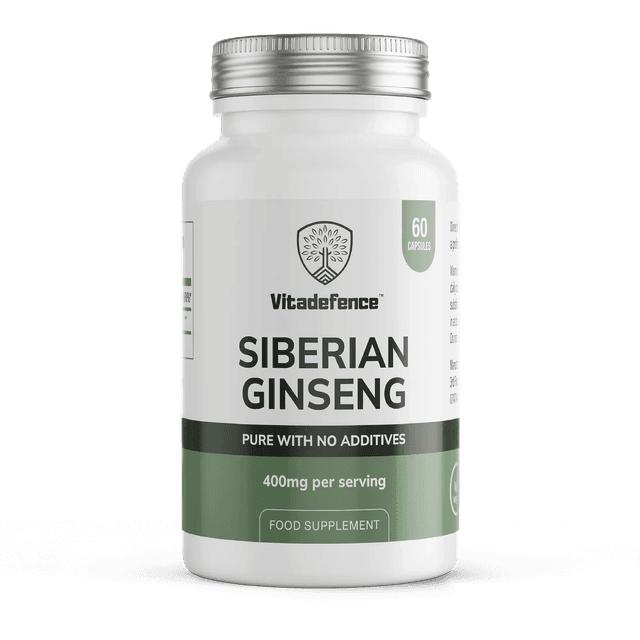
The taiga adaptogen, not the Panax.
Two plants, one nickname, two very different stories
If you've shopped for ginseng before, you've probably noticed something confusing: there are two of them. Panax ginseng — the Korean and Chinese root that's been used for five thousand years and tastes faintly of damp earth. And Siberian ginseng — sometimes spelled out as eleuthero, sometimes shortened to Eleutherococcus.
They share the word ginseng and almost nothing else. They are not the same plant. They are not even the same family. Panax is a slow ten-year root from a small understorey shrub in the Korean mountains. Siberian is the woody stem and root of a thorny taiga shrub that grows fast and hardy across the Russian Far East, parts of northern China, Korea, and Hokkaido.
The two have different chemistries, different traditional uses, different effects, and — frankly — different vibes. We sell both because they are not interchangeable.
This pot is the Siberian one. Sixty vegan capsules. Four hundred milligrams of pure root powder per capsule. No filler stack, no headline-bait actives. Just the plant, and a hydroxypropyl methylcellulose vegan capsule. That's the entire ingredient list.
The pot, in your hand
A small white pot, sixty 400mg capsules. The colour of the powder inside is a pale woody brown — closer to bark than to tea. The smell, if you open a capsule, is faintly resinous, with a hint of pepper. The taste, if you ever tasted the root in tea form, is bitter and slightly woody.
Take it with water, ideally with breakfast or lunch — not in the evening. Like most adaptogens with any caffeine-adjacent character, late-day dosing can interfere with sleep for some people.
Sixty capsules to a pot. At one a day, it lasts two months. The pot is small enough to live in a kitchen drawer; the capsule is small enough to swallow without water if you're caught short.
The story of Eleutherococcus senticosus
The plant grows wild across the Russian Far East — the Primorsky Krai, the Khabarovsk taiga, north into Sakhalin and Kamchatka. It is a thorny shrub two to three metres tall, the leaves five-fingered, the small black berries appearing in late summer. The Manchu and Nanai peoples of the region had used the root in folk medicine for generations before European botanists arrived to put a Latin name on it. Traditional Manchu hunters chewed the bitter root before long winter forays into the taiga; the Nanai brewed it as a daily winter tea. The Korean name, gasi-ohgapi, translates roughly as thorny five-bark — a description, not a metaphor; the bark of the root is genuinely the part that was prized.
The modern story starts in the 1960s. A Soviet pharmacologist called Israel Brekhman, working at the Institute of Biologically Active Substances in Vladivostok, was looking for a domestic Soviet alternative to the imported and expensive Panax ginseng of Asia. Panax didn't grow in the USSR. The Pacific coast forests of the Russian Far East were already known for an old folk-tonic shrub. Brekhman ran field studies through the 1960s and 1970s — on factory workers, on athletes, on military personnel, on long-distance shipping crews.
The conclusion he and his colleagues reached, in their published reports, was that this taiga shrub appeared to do something genuinely useful for people working under sustained physical and mental load. He coined the now-common word adaptogen to describe what he was seeing — a substance that seemed to help the body adapt to non-specific stress, broadly defined.
Whether you take Brekhman's framework on its full terms or with a pinch of contemporary scepticism, the historical record stands: this plant was studied seriously, by serious scientists, in serious volume, for two decades, on tens of thousands of working adults. The Russian, German, and Eastern European pharmacopoeias accepted it. The Western literature is patchier and the modern systematic reviews are honestly mixed.
We are not promising what Brekhman's team reported. We are saying this: the plant has a real history, the root has a real tradition, and a daily 400mg capsule is the modern, simple, capsule-form way of having that tradition in your cupboard.
What's actually in the root
The compounds modern chemists have most often pointed to are a family called eleutherosides — labelled A through M, lettered alphabetically as they were isolated. Different from ginsenosides (the Panax compounds), although both families belong loosely to the wider plant-saponin and lignan world.
We don't standardise this product to a specific eleutheroside percentage — our approach with single-ingredient roots is to keep the whole-root profile rather than to fractionate it into a marketed percentage. The capsule contains the root as it was harvested, dried, and milled. No fractionation, no concentration, no extraction.
There is a quiet philosophy here. A whole root has worked across centuries of traditional use. A 0.8%-eleutheroside-standardised extract is a twentieth-century marketing layer on top of that. We sell both kinds elsewhere in the Vitadefence range — Maca-Root-Multi has standardised companions, Panax-Ginseng-Multi has a ginsenoside spec — but for this particular adaptogen, the whole-root tradition is what we wanted to honour. That's why this pot is so simple.
The other quiet detail: this is the Russian Far East root, not a Korean cultivar nor a Chinese hill-grown variant. The plant grows in different soils across its range, and the chemistry of the root varies modestly with where it grew up. We source from the wild-harvest belt — the part of the species' range that has the longest documented tradition behind it — rather than from intensive farms.
Why it earns its place
This is a daily, gentle adaptogen pot. The kind of thing you take through a busy quarter at work, or across a winter that has been longer than the last, or during the eight-week run-up to a hard endurance event. It is not a pre-workout. It is not a sleeping aid. It is not a hormonal product. It does not contain caffeine in any meaningful pharmacological dose, although some sensitive people do report a subtle alertness from it.
Most users describe its effect — when they describe one — as quiet. A slightly steadier energy across the late afternoon. A slightly reduced sense of being wrung out by Friday. Slightly better adaptation to a heavy workload. Nothing dramatic, nothing sudden, no buzz, no crash.
Like most adaptogens, the published research is real but not unanimous. Some studies show effects, others don't. The traditional record is the steadier voice in the room, and it has been speaking for a long time.
How to use it
One capsule a day, with water, ideally before lunch. Some users take two capsules a day during particularly demanding weeks — an option, not a requirement.
Most adaptogens work best as a cycle rather than a perpetual habit. A common pattern with this plant in traditional and Soviet use is six to eight weeks on, two weeks off. Continuous dosing for years is not the way the root has been used historically.
Give it three to four weeks before judging it. Adaptogens are not stimulants — there is no Day-One signal. The shift is slower, quieter, and easier to miss if you are looking for the wrong sensation.
If after eight weeks nothing has changed in how you handle a busy week, stop. Like most things in this cupboard, it earns its place or it doesn't, and we'd rather have your trust for the next thing than your guilt over the wrong thing.
Honest caveats
This is a food supplement and complements a varied lifestyle. It is not a medicine and does not replace medical care.
Don't take this if you are pregnant or breastfeeding. Don't take it if you have uncontrolled high blood pressure, severe heart conditions, or are using digoxin or warfarin — Siberian ginseng has interacted with both in published case reports. If you are on any prescribed medication, especially for blood pressure, heart rhythm, blood thinning, or hormonal therapy, speak to your GP or pharmacist before adding this. If you have an autoimmune condition or are on immunosuppressive medication, take medical advice first.
Don't dose it in the evening — for some people it interferes with sleep.
Don't confuse this pot with our Panax Ginseng Multi. They are different plants with different chemistries, different traditional uses, and different daily windows. Stack them only on advice, not on instinct.
Keep it cool, dry, sealed, out of reach of children. Best before date is on the base.
— Vitadefence
— Vitadefence