Showcase
Soy Fibre Multi — soya protein, chicory fibre, fifteen vitamins and minerals
A chocolate-flavour soya protein powder layered with chicory root inulin and a full vitamin-mineral blend. Dairy-free, vegan, twelve servings to a pot.
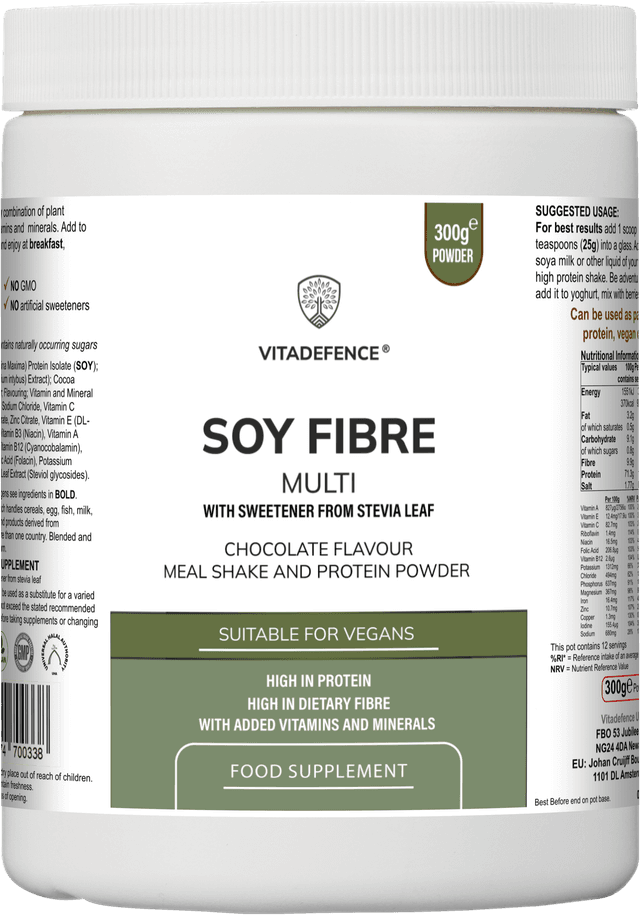
Soya, chicory, and fifteen quiet partners.
> Allergy note up front: This pot contains SOYA. If you are allergic to soya, this is not the supplement for you — please look at our hemp, rice, or pea protein options instead.
When you want a shake that does more than one job
Most protein powders are very good at one thing: protein. They are deliberately stripped down — high protein per scoop, low everything else, designed for people whose only goal is to hit a daily macro target.
This pot has a different brief. Yes, the spine is soya protein isolate — high in protein, complete in amino acids. But it is also a soluble-fibre delivery vehicle (chicory root inulin), a real cocoa drink, and a multivitamin in shake form. Twelve servings of 25g each, twelve days at one a day, or six days at two — depending on whether you treat it as a daily meal-on-the-go or an occasional protein boost.
It is, in short, the kind of shake you'd reach for if you'd missed breakfast and weren't going to get a proper meal until late, and you wanted something more than just protein in the meantime.
The pot, in your hand
A 300g pot, brown-and-green label, one scoop equals 25g. Add a scoop to half a glass of water, plant milk, juice or a smoothie. Stir or shake — the powder is fine and dissolves clean. Twelve scoops to a pot.
The flavour is dark chocolate with a slight earthy back-note from the soya. The colour is a milk-chocolate brown. It is not a heavily sweetened shake — the only sweetener is a small amount of stevia leaf, with no maltodextrin and no added cane sugar in this version.
The story of soya — older than you'd think
Soya — Glycine max — was domesticated in northeastern China around five thousand years ago, on the river plains of the Yellow River and Manchuria. It was already a staple of the Chinese diet by the Zhou dynasty (1100 BC), grown on small plots, fermented into miso and soy sauce, pressed into tofu by the Han dynasty around 200 BC, milked into soya milk by the same era.
Soya travelled to Japan, Korea, and Indonesia by the early centuries AD. Tempeh, natto, miso, doenjang, douchi, soy sauce — every soya-eating culture has its own ferment, its own tofu, its own daily quiet way of working the bean into the table. Europe didn't really notice the bean until the eighteenth century, and the United States didn't grow it commercially until the early twentieth.
The protein in soya is, biochemically, complete — meaning it contains all nine essential amino acids in proportions that meet human dietary requirements. That makes soya isolate one of the very few plant proteins that doesn't need a pairing partner the way rice or pea does. (We still recommend variety in your week — but you don't strictly need to pair this shake with anything to get a balanced amino profile.)
The protein isolate process strips out most of the carbohydrates and fats from the bean, concentrating the protein fraction to around 90% by weight. The result is a fine off-white powder that mixes cleanly into liquids and carries flavour well — which is why it has become the most common base for vegan protein shakes worldwide.
Chicory root inulin — the soft fibre
Chicory root — Cichorium intybus — is the second-billed ingredient. It is a roadside plant across Europe with bright blue flowers, the same plant whose roasted root has stood in for coffee across France and the southern United States for three centuries.
The fibre we extract from chicory is inulin — a soluble fibre that the small intestine doesn't digest, but the bacteria in the large intestine ferment readily. It is the same fibre family as the fructans in onions, garlic, leeks and asparagus. Inulin gives the shake a slightly sweet creamy mouthfeel, softens the otherwise dry texture of soya isolate, and contributes a small daily donation toward fibre intake.
Most British adults eat about half the recommended 30g of fibre a day. A scoop of this is not a fibre fix — it's a contribution.
The roasted chicory root has a quiet history of its own as a coffee substitute. During the Napoleonic wars, when British naval blockades cut French coffee imports, French households started roasting chicory root and brewing it as a coffee stand-in — a habit that survived long after the blockades lifted, and that lives on today in café au lait à la chicorée across the north of France. The same root, lightly extracted into a soluble fibre, is what's blended through this powder.
Cocoa — the chocolate that isn't a milkshake
The cocoa here is the bitter, fermented seed of Theobroma cacao — the same Mesoamerican plant from the Mayan and Aztec ceremonial drinks of two thousand years ago. Not sweetened, not mixed with milk powder. The chocolate flavour comes from the cocoa itself, lightly sweetened by stevia leaf extract.
Cocoa is also a food rich in polyphenols — flavanols and procyanidins, the dark-pigment compounds that mark out cocoa, dark berries, and red wine. It is here for taste first and polyphenol contribution second.
The vitamin and mineral spine
What makes this pot different from a plain protein-and-fibre shake is the third layer: a full multivitamin and mineral blend baked into the powder. Per 25g serving, the shake delivers a meaningful slice of:
- Vitamin A (acetate) — for vision and immune function
- Vitamin C (ascorbic acid) — for collagen synthesis and antioxidant defence
- Vitamin E — fat-soluble cell-membrane protector
- Vitamin B2 (riboflavin), B3 (niacin), B12 (cyanocobalamin), and folate — energy metabolism and red-blood-cell formation
- Iron (ferrous citrate) — non-haem plant-source iron
- Zinc, magnesium, copper, iodine, potassium, chloride, sodium, and phosphorus — the trace and macro mineral spine
Each contributes between 15% and 50% of the EU Nutrient Reference Value per serving — a meaningful daily slice, not a corrective megadose. The minerals are largely in citrate forms, which most people tolerate better than oxide forms in a daily shake.
This isn't a replacement for a multivitamin pot if you take one. It is a layered top-up — the kind that means a busy day with a quick shake doesn't leave a hole in your daily nutrition the way a plain protein scoop would.
How to use it
One scoop (25g) into half a large glass of water, soya milk, oat milk, almond milk, or fruit juice. Stir, shake, or blend with a banana and frozen berries. The shake works as:
- A breakfast skip-replacement when the morning runs away from you
- A mid-afternoon snack between lunch and a late dinner
- A post-workout shake for plant-based recovery
- A blended smoothie base with fruit and seeds
Twelve servings to a pot. At one a day, two weeks. At one every other day as an occasional shake, about a month.
Honest caveats
This is a food supplement and not a meal replacement. It complements a varied diet — it doesn't replace one.
This pot contains SOYA. If you are allergic to soya, do not take it. If you have a known soya sensitivity (different from a clinical allergy), take small amounts first and see how you tolerate it. Soya allergies are most common in childhood and can persist into adult life — if you are unsure, check with your GP.
If you have a thyroid condition or are on thyroid medication, soya can interfere with absorption — take soya-containing products at least four hours apart from levothyroxine. If you have a hormone-sensitive condition, the soya isoflavones in soya isolate are a different (and generally smaller) dose than in concentrated isoflavone supplements, but if you are on tamoxifen, aromatase inhibitors, or are managing an oestrogen-sensitive condition, speak to your specialist before adding daily soya protein.
Iron, vitamin A, and folate are all present in this shake. If you are also taking a multivitamin or a separate iron supplement, don't stack them — vitamin A in particular has an upper limit. One source per day is sensible.
If you are pregnant, breastfeeding, taking medication, or living with a medical condition, talk to your GP or pharmacist before making this a daily habit.
Keep it dry, sealed, out of reach of children. Use within twelve weeks of opening.
— Vitadefence
— Vitadefence