Showcase
Spirulina — the lake algae the Aztecs ate
A simple 500mg vegan capsule of pure Arthrospira platensis. The blue-green lake algae the Aztecs harvested off Lake Texcoco — one of the oldest dietary plants in human history.
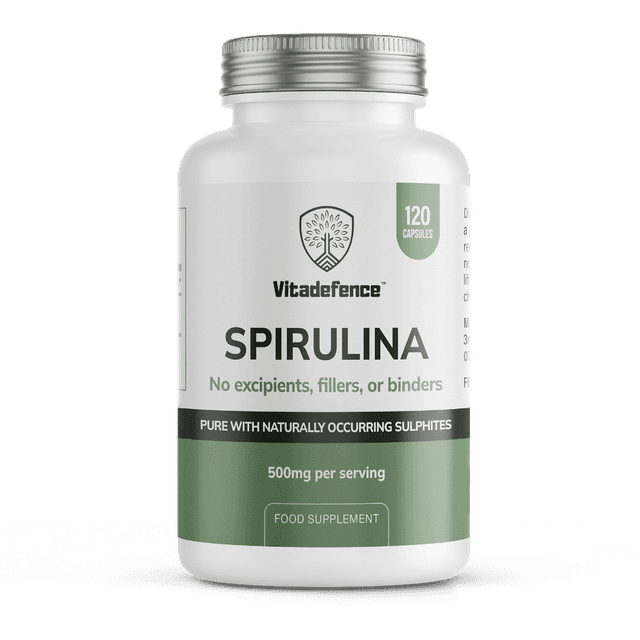
The lake algae the Aztecs ate.
When you want one quiet plant, not a stack
Most of the bottles in this cupboard are blends. Ten ingredients here, fifteen there, a small army of plants doing complementary jobs. This one is different. Just spirulina, pressed into a vegan capsule. Single ingredient. 500mg per cap. 120 caps to a pot. That's the entire formula.
You're probably here because you've read about spirulina before — as a smoothie powder, as a Whole Foods aisle staple, as a NASA-mentioned space-food curiosity, as the dark blue-green powder that turns smoothies the colour of pond water. You want the basic version, in a capsule, without the smoothie ritual or the seaweed-and-lemon aftertaste. That is what this is.
The pot, in your hand
A small white pot, 120 vegan capsules, the powder a deep navy-green when you crack one open. The smell is mild and faintly mineral — closer to fresh seaweed than to the heavy-fish smell most people expect. The dose is gentle: one capsule a day, with water, ideally with food.
At one a day, the pot lasts four months. Most people use it as a quiet daily background — like a plant-based version of taking a multivitamin, except it is one ingredient, not a synthetic stack.
The story of Arthrospira platensis
Spirulina is one of the oldest organisms on Earth that humans regularly eat. It is a cyanobacterium — a blue-green photosynthetic microbe — and the family it belongs to has been on the planet for around three and a half billion years. It is older than plants. Older than animals. Older than mushrooms. The oxygen we breathe was first put into the atmosphere by its ancient relatives.
The lakes spirulina prefers are alkaline, mineral-rich, and warm. Lake Texcoco in central Mexico — now mostly drained, once the lake on which Tenochtitlán (modern Mexico City) was built — was one of the great spirulina lakes of the ancient world. The Aztec name was tecuitlatl, roughly stone's excrement, the dense blue-green mat that the Aztecs collected from the lake's surface, sun-dried into thin cakes, and ate as a daily condiment. Spanish chronicler Bernal Díaz del Castillo described it in his 1568 True History of the Conquest of New Spain — small flat wafers sold in the Tlatelolco market, the colour and texture of soft cheese, the taste salty and somewhat fishy.
The other great traditional spirulina lake is Lake Chad in central Africa. The Kanembu people of the Lake Chad basin still harvest spirulina today using methods unchanged since at least the ninth century — clay-bowl skimming, sun-drying on hot sand, and pressing into thin green cakes called dihé that are crumbled into stews and sauces. In Kanembu households dihé is considered a daily condiment for women, especially after childbirth — the green cake stirred into millet porridge or fish stew. The European botanist Léonard wrote about it in 1940, the French nutritional researcher Brandily again in 1959. By the time NASA scientists were considering candidate foods for long-duration spaceflight in the 1970s, the Kanembu had been quietly eating spirulina for at least eleven hundred years.
Two ancient peoples, on two different continents, found the same blue-green organism on the surface of the same kind of lake — and made it part of daily food. That is not a coincidence. It is one of the most chemically interesting microbes in the natural world.
What's in the powder
Spirulina is, by dry weight, about 60–70% protein — among the most protein-dense organisms ever measured. The protein is complete in the strict biochemical sense (all nine essential amino acids in usable proportion), although the dose at one capsule a day is too small to be a meaningful dietary protein source — you would need to eat tens of capsules to match a single egg.
What it does deliver in a single 500mg capsule is a small but interesting profile of:
- Beta-carotene and other carotenoid pigments — the precursor of vitamin A and the orange/red layer underneath the blue-green
- Phycocyanin — the brilliant blue pigment unique to spirulina and a few related cyanobacteria, the compound responsible for the deep navy hue when wet, and increasingly used as a natural food colourant in confectionery and yoghurts
- Chlorophyll — the green pigment of all photosynthetic life
- A modest dose of iron, magnesium, manganese, and trace minerals absorbed from the alkaline lake water in which the algae is cultivated
The calorie load and the protein load at one capsule are both small. We are not selling this as a meal-replacement or a protein source. The plant earns its place in this cupboard for the small daily slice of pigments and trace minerals it brings — the deep colour, the tradition, the gentleness.
A note on B12
If you've read about spirulina online, you've probably seen claims that it is a vegan source of vitamin B12. We want to be honest about this: most modern analytical chemistry suggests that the form of B12 in spirulina is largely pseudo-cobalamin — a structurally similar molecule that does not function as vitamin B12 in human metabolism. We do not list this product as a B12 source, and if you are vegan or vegetarian, please get your B12 from a B12-specific supplement, fortified yeast, fortified plant milks, or a multivitamin — not from spirulina.
This is the kind of small honesty we'd rather be on the right side of than fudge.
Source and sustainability
Spirulina is one of the most environmentally efficient foods on Earth. It is grown in shallow alkaline ponds, fixes its own nitrogen from the atmosphere, requires no pesticides, and produces more protein per litre of water than any other cultivated organism. NASA studies in the 1980s identified it as a candidate food for long-duration space missions specifically because of this efficiency.
We source from cultivated alkaline-pond facilities with established food-grade quality control — not from wild-harvested sources, where heavy-metal and microcystin contamination can be a problem if the source water is in a polluted catchment. The sourcing detail is not a poetry point — it is a safety point. Wild spirulina from polluted water can carry liver-toxic compounds. Cultivated, tested, food-grade spirulina (which is what's in this pot) does not.
The pot label flags one further allergen note: contains naturally occurring sulphites. Sulphites occur naturally in many fermented and dried foods — wines, dried fruit, cured meats, some teas — and are not added here, but they are present in trace quantities. If you have a sulphite sensitivity, please be aware.
How to use it
One capsule a day, with water, preferably with food. Some users prefer to take it with breakfast, others with lunch. There is no strict timing window.
Don't exceed the recommended daily dose. Don't expect a same-week visible effect — like most pigment-and-mineral foods, the contribution is slow and quiet. Most people who notice anything at all describe it as a slightly steadier energy across the late afternoon, or a faint sense that their daily greens intake is a bit fuller. Most people don't notice anything dramatic, and that is normal.
If after eight weeks you feel no different, stop. A capsule that isn't earning its place isn't worth the cupboard space, and we'd rather have your trust for the next plant in this cupboard than your half-hearted continued purchase of one that didn't work for you. Our reading of spirulina is that it suits some people quietly and doesn't show up at all for others — both responses are normal.
Honest caveats
This is a food supplement and complements a varied diet. It is not a medicine and does not replace medical care.
If you are pregnant, breastfeeding, taking medication, or under medical supervision, please consult a healthcare professional before use.
If you have phenylketonuria (PKU), be aware that spirulina contains phenylalanine — at one capsule a day the dose is small, but at high-dose multi-capsule use it can be relevant.
If you are on blood-thinning medication (warfarin) or are planning surgery, the small amount of vitamin K in spirulina can shift your INR — speak to your GP.
If you have an autoimmune condition where immune over-activation is a concern (lupus, multiple sclerosis, rheumatoid arthritis), some practitioners advise caution with immune-modulating algae products. Take medical advice first.
The pot contains naturally occurring sulphites.
Keep it cool, dry, sealed, out of direct sunlight, out of reach of children.
— Vitadefence
Related articles
— Vitadefence