Showcase
Turmeric Max — the bright yellow root, dialled to its strongest
A high-strength turmeric capsule built around 150mg of curcumin, with black pepper, ginger, and the trace minerals that make a label honest.
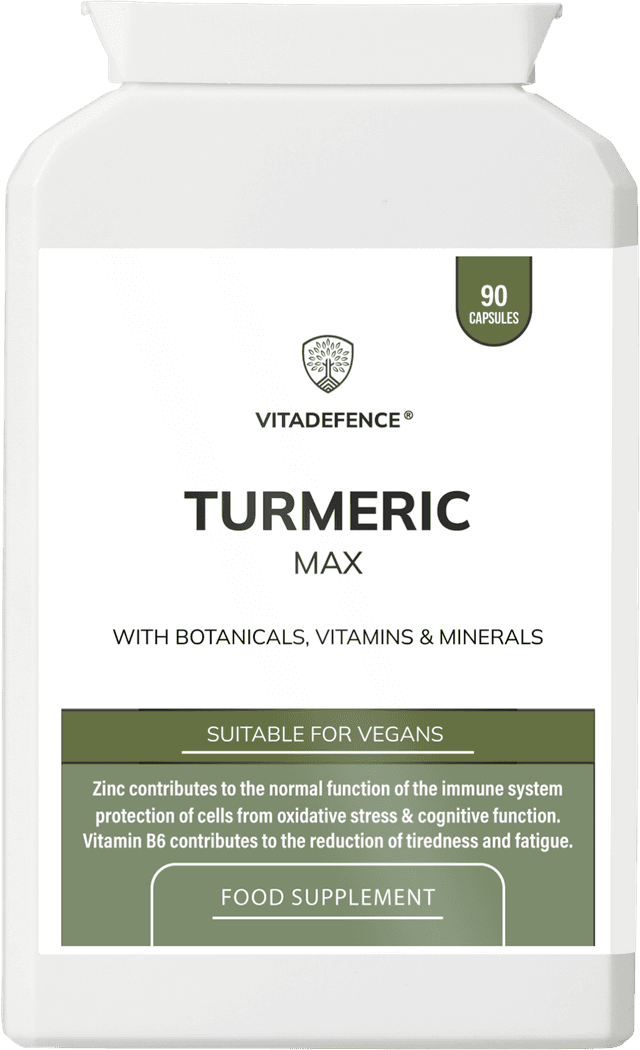
When you've heard about turmeric for years and want the strong version
Most people meet turmeric in a kitchen — in a bowl of dahl, a chicken curry, a turmeric latte that stained a favourite mug yellow. You've probably had it a hundred times. Then somebody — a yoga teacher, a sister-in-law, a piece in the weekend paper — mentions that the active compound in turmeric is called curcumin, and that the dose you'd get from food is small compared to what's been studied. So you start looking at capsules.
The capsule aisle is confusing. One bottle says 500mg of turmeric. Another says 1000mg of turmeric extract. Another says 95% curcumin. The numbers don't compare. Most people give up and pick whichever bottle the pharmacist seems most confident about.
This is the strong version of the story. One capsule — small, vegan, easy to swallow — built around 150mg of curcumin, with the partner ingredients that turmeric has been paired with for centuries. We made it for the person who's already tried the gentle approach and wants to dial it up.
The bottle, in your hand
A clean cream pot, the green band of our label running around it like a forest line. Ninety vegan capsules inside. Take one to three a day, with food, with water. The dose is flexible because turmeric is one of those plants that asks to be tuned to the person — some people feel the room change at one capsule, others want three across the day to keep a steady level in the system.
That's how a turmeric protocol tends to work. Not in a single dramatic dose. In daily, patient, kitchen-rhythm rituals.
The story of turmeric
Turmeric — Curcuma longa — is a rhizome, not a root, technically. A swollen underground stem belonging to the ginger family. The plant grows shoulder-high in the wet, warm parts of South Asia and Southeast Asia. The rhizome is harvested, boiled, dried, and ground into the brilliant yellow powder that has coloured Indian kitchens for at least four thousand years.
The earliest written record we have is from the Sushruta Samhita, a Sanskrit medical text from around 600 BC, where turmeric is recommended as part of a formula for poisoned arrow wounds. By the time Marco Polo travelled through southern China in the 1280s he was writing home about a vegetable that had "all the properties of saffron" but was nothing like it. He meant turmeric. Saffron, the costly stigma of a crocus, and turmeric, the cheap rhizome of a tropical plant, share nothing botanically — but both stained whatever they touched a deep, joyful yellow, and to the European eye that was the same magic.
In Ayurveda turmeric is haridra, one of the most-used herbs in the entire system. In traditional Chinese medicine it is jiang huang, prescribed to move stagnant qi and warm cold places in the body. In Indonesian and Malay traditional cooking, fresh turmeric goes into rendang, into nasi kuning at weddings, into the paste rubbed into the skin of brides before the ceremony.
The compound modern science has been most interested in is curcumin — the molecule that makes turmeric yellow. Curcumin is what's called a polyphenol, in the same broad family as the colour compounds in red wine, dark chocolate, and green tea. Researchers have spent the last forty years quietly piling up papers on curcumin's behaviour in the lab. We won't list them here — what matters is that the molecule is real, the dose matters, and the kitchen-rhythm of taking it daily is older than any of the science.
Our extract is concentrated to deliver 150mg of curcumin per capsule, sitting on a base of 7895mg-equivalent turmeric root. We then add a smaller dose of organic turmeric root powder — 200mg — because the whole rhizome contains other turmerones and oils that, in traditional preparation, were always taken together with the pigment, never apart from it.
Black pepper — the kitchen partner
Anyone who has cooked an Indian dish from a grandmother's recipe knows: turmeric is almost never used alone. It comes with black pepper. Always. The pairing predates the chemistry by thousands of years, and the chemistry, when modern researchers got there in the 1990s, turned out to back the cook up.
The pepper you grind onto food contains a compound called piperine. Piperine appears to slow the speed at which the body removes certain other compounds — including curcumin — from circulation. The effect, in laboratory studies, has been described in dramatic numbers. We won't promise a specific multiplier in your bloodstream because human absorption varies. But we will say: every sensible turmeric formula in the world includes black pepper, and ours includes 5mg of fresh ground black pepper per capsule for exactly the reason your grandmother would have given you, if you'd asked her.
Ginger — turmeric's blood relative
Ginger and turmeric are family — both Zingiberaceae. Open both rhizomes side by side and the resemblance is unmistakable. Sliced ginger is pale yellow and turmeric is fluorescent yellow, and they share a faint warming, slightly bitter aromatic profile that makes them work in the same dishes.
In traditional Asian medicine ginger is the warming herb — the one you reach for when something feels cold and slow in the digestion or in the joints. We use 200mg of ginger root extract per capsule. Not as a hero. As turmeric's familiar travelling companion. The two have been blended together in tonics, teas, and curries for as long as anyone has been writing recipes down.
Cayenne — the gentle heat
Cayenne pepper — Capsicum frutescens — joins the formula in a small dose, 40mg per capsule. The active molecule, capsaicin, is what makes a chilli hot. In a turmeric formula it serves the same role it serves in a stew: a small amount of heat that lifts everything else and signals the digestive system that something is coming.
Some people are sensitive to capsaicin. Forty milligrams is gentle — well below the level that would make a capsule unpleasant — but if your stomach is on the delicate side, take this one with food, not on an empty stomach. Most people don't notice the cayenne at all. A few notice a small warming feeling in the chest about half an hour after the capsule. That's working as intended.
Bamboo — silica with a long quiet history
Bamboo extract gives 7.5mg of silica per capsule. Silica is a trace mineral that is part of the body's connective tissue — bone, skin, hair, nails. Why is it in a turmeric formula? Because turmeric in the Ayurvedic tradition was often used in protocols that included a structural-tissue support layer, and bamboo silica is the modern version of that. A small, supporting member of the band. Not the headline.
Zinc and Vitamin B6 — the label-honest spine
Two of the ingredients in this bottle can be spoken about with the precision of nutrition science, because they are essential nutrients with European Food Safety Authority authorised wording.
Zinc (1.5mg, 15% NRV) — contributes to normal immune function and to the protection of cells from oxidative stress.
Vitamin B6 (0.21mg, 15% NRV) — contributes to normal energy-yielding metabolism and to the reduction of tiredness and fatigue.
These two are not the headline. They are the spine — a backbone of label-accurate nutrition behind the turmeric story.
How to use it
One capsule, one to three times a day, with food. Most people start at one capsule a day with their main meal for two weeks, then move to two a day if they want a stronger daily presence. Three a day is the upper end and is the dose people on a defined twelve-week protocol sometimes use.
Take it with food, always. Curcumin is fat-soluble — it absorbs better when there's a little fat in the meal. A teaspoon of olive oil, a piece of cheese, a handful of nuts: all fine. On an empty stomach with a glass of water it still works, but with food it works better.
A note: turmeric will, very occasionally, stain a fingertip yellow if you split a capsule. Don't split capsules. The pigment that does this is the same pigment doing the work — there's nothing wrong, but cooks already know that turmeric stains everything, and capsules don't change that fact.
Honest caveats
This is a food supplement — it complements a varied diet, doesn't replace one. Don't exceed three capsules a day.
If you are pregnant or breastfeeding, talk to your GP or pharmacist before adding a high-strength turmeric formula. If you are on blood-thinning medication (warfarin, apixaban, rivaroxaban) or anti-platelet medication (clopidogrel, aspirin at therapeutic doses), check with your doctor first — turmeric in concentrated form has a small effect on platelet behaviour that is worth noting before surgery or alongside anticoagulants. If you have gallstones or a known biliary obstruction, avoid this formula — turmeric stimulates bile flow and that's the wrong moment for it.
If you've read this far, thank you. We tried to write the kind of page we'd want to read before spending money — no neon promises, no overblown language. Just a four-thousand-year-old golden rhizome from a South Asian kitchen, dialled to its strong setting, with the partners it has always been taken alongside.
— Vitadefence
— Vitadefence