Showcase
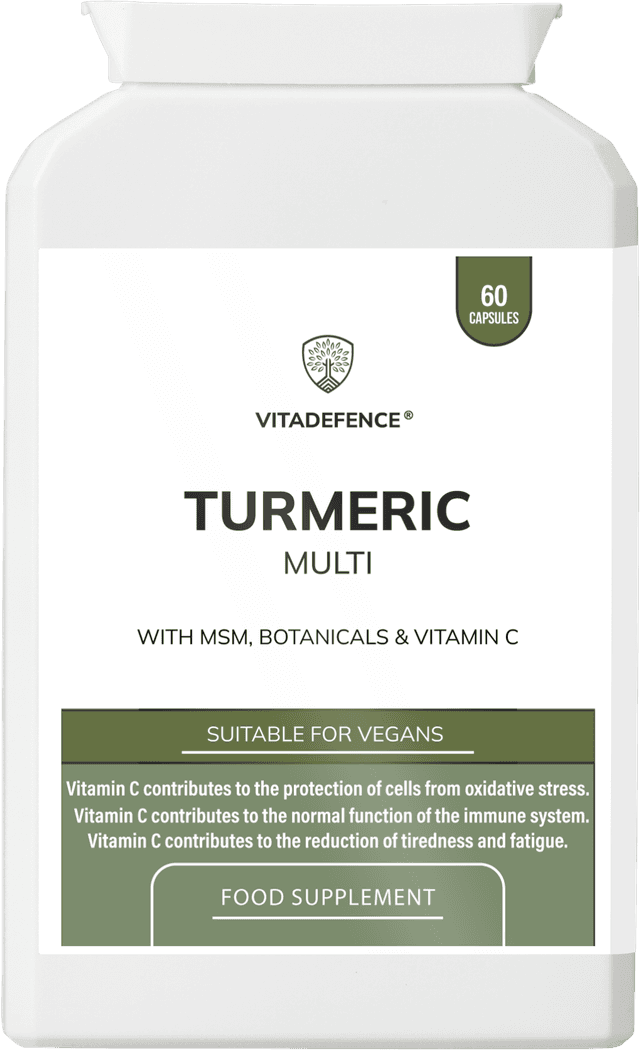
Turmeric Multi — the golden rhizome with thirteen quiet companions
A combined-formula turmeric capsule built around joints and movement: turmeric, glucosamine, MSM, ginseng, nettle, rosehip, horsetail, and a slow-cooked plant chorus.
When the morning hour matters more than it used to
You used to swing your legs out of bed and stand up. Now there's a small ceremony — a moment where the knees decide whether they're cooperating today, a hand reaching for the bedside table. It isn't dramatic. You're not ill. It's just that the body has started asking for ten quiet minutes in the morning before the joints feel like joints again.
Most people meet turmeric for the headlines: the bright golden curry powder, the polyphenol that fills the wellness press. But turmeric in the Ayurvedic tradition was very rarely used by itself. It went into formulas. The cook added ginger, the herbalist added rosehip, the village kitchen added whatever the season had given. Turmeric was the leader of a small chorus, not a soloist.
This bottle is the small chorus. Thirteen partners, one capsule, a formula built around the morning hour and the way the body moves through the day.
The bottle, in your hand
Sixty vegan capsules, in our cream pot with the green band. Take one capsule, two to three times a day, with food. At three a day the bottle lasts about three weeks — these are working-dose formulas, not gentle once-a-week vitamins. The full daily dose carries a meaningful amount of every ingredient on the back, which is why we'd rather give you sixty real capsules than two hundred dilute ones.
This is what we mean by a multi. Not a multivitamin in the supermarket sense. A blend — the way a stew is a blend, the way a household herbal jar is a blend.
The story of turmeric, briefly
Turmeric — Curcuma longa — has been in South Asian kitchens for at least four thousand years. The compound that gives it its yellow colour is curcumin, a polyphenol in the same broad family as the colour compounds in red wine and dark chocolate. We've written the long version of the turmeric story on our Turmeric Max page; on this page, turmeric is one voice in a band, not the lead singer. Our extract delivers 50mg of curcuminoids per capsule on a 2631mg-equivalent rhizome base. Lower than Turmeric Max — by design, because here it shares the bottle with twelve other plants and minerals.
Glucosamine — the long-quiet structural-support compound
Glucosamine is a small sugar-like molecule that the body uses as a building block for connective tissue. It's been on supplement shelves since the 1990s, when European clinical interest moved it from veterinary medicine — where it had been used in horses for years — into human use. We use 300mg of vegan glucosamine hydrochloride per capsule. Vegan matters here: most glucosamine on the market is made from shellfish shells, which makes the supplement unsuitable for shellfish-allergic people and for vegetarians. Ours is fermented from corn — same molecule, different source.
We won't claim glucosamine repairs cartilage. The clinical literature is honestly mixed. What we will say is: it has a thirty-year track record, it is well-tolerated, and it earns its place in a movement-and-morning-hour formula by long use.
MSM — the sulphur compound from the rain
Methylsulphonylmethane — MSM — sounds industrial. The molecule itself is not. It's a sulphur compound that occurs naturally in fresh foods, in milk, in the rainwater that falls onto green plants. Sulphur is one of the lesser-known minerals — the body uses it to make connective tissue and to maintain the joint's water content.
We use 200mg of MSM per capsule. It pairs with glucosamine in clinical literature and in commercial formulas the world over. Together they are the structural-tissue layer of this bottle — the unglamorous spine the rest of the chorus stands on.
Bamboo — silica, the connective-tissue trace mineral
Bamboo extract delivers 22.5mg of silica per capsule — a higher dose than Turmeric Max, because here we're leaning into the structural-support story. Silica gives connective tissue its tensile springiness. It earns its place quietly, without claims.
Korean Panax Ginseng — the warm tonic from the eastern hills
Korean Panax Ginseng — Panax ginseng — is the slow-grown root called the man-root for two thousand years because mature roots fork like a human figure. A note of clarity: there are two unrelated plants both called ginseng. Korean Panax (true ginseng) is the slow-grown forest understory root in this formula. Siberian ginseng — Eleutherococcus senticosus — is a different plant entirely; we sell it separately and the two are not interchangeable. We use 100mg of Panax extract here as a guide herb — a small dose of something warm and grounding that helps the rest of the formula settle.
Nettle leaf and rosehip — the green and the orange
Stinging nettle — Urtica dioica — has been a European spring tonic for as long as cookbooks have existed. The young leaves, before the plant flowers, are mineral-rich. Country traditions of spring tonic — nettle tea, nettle soup — appear across Britain, Scandinavia, and the Slavic-speaking world. We use 100mg per capsule.
Rosehip — Rosa canina — is the bright orange fruit of the dog rose, ripening on the hedgerow into October. Country tradition was rosehip syrup, fed to children through the war years when oranges were rare. We use 100mg per capsule and pair it with the 12mg of vitamin C on the label spine.
Horsetail — the silica plant from the prehistoric record
Horsetail — Equisetum arvense — is one of the oldest plant lineages on earth. Fossils show its ancestors growing in the carboniferous swamps three hundred million years ago. The plant is unusual for its high silica content; medieval Europeans used it to scour pewter pots, and it has been used in folk medicine across the Northern Hemisphere as a structural-tissue tonic. Fifty milligrams per capsule. A small dose of a very old plant.
Ginger root — the warming kitchen partner
Ginger — Zingiber officinale — is turmeric's family. We've explained the rhizome cousinship on the Turmeric Max page. Here we use 40mg of ginger extract — a smaller dose than in Turmeric Max because in this multi-formula ginger is one of the supporting voices, not the harmonic partner.
The smaller voices — Montmorency, ACV, bromelain, kelp, papain
The bottom of the formula list contains a group of ingredients at 5–20mg apiece. Together they are what blenders call the band's bench — small, supporting parts that nudge the formula's flavour without dominating. Montmorency cherry (20mg) for its anthocyanins; apple cider vinegar powder (5mg) as a digestive nod from European folk tradition; bromelain (5mg) and papain (5mg) — pineapple- and papaya-derived enzymes that have a quiet history in traditional formulas; kelp (5mg) for trace iodine and the salty mineral profile of seaweed. None of these is the reason you would buy this bottle. Each is in here because, in a slow-built movement formula, the small voices change the colour of the whole.
Vitamin C — the label-honest spine
The one ingredient on this bottle that can be spoken about with the precision of nutrition science is Vitamin C (12mg, 15% NRV). EFSA-authorised wording: contributes to normal collagen formation for the normal function of cartilage and skin. That single sentence is the most label-honest thing in the whole formula and it sits where it should — quietly, on the spine of the label.
How to use it
One capsule, two to three times a day, with food. Most people land on two a day after the first week — one with breakfast, one with the evening meal. Three a day is the upper end and is the dose people on a defined twelve-week joint-and-movement protocol sometimes use.
Take it with food, always. Several ingredients in this formula — particularly the curcumin and the cayenne-free formula's bromelain enzymes — sit better in the stomach with a little fat or protein around them. Most people don't notice anything dramatic for the first three weeks. Plant-and-mineral formulas of this kind work in the background. By week six or eight a daily user usually has a quiet sense that the morning hour is a touch shorter than it was.
Honest caveats
This is a food supplement — it complements a varied diet, doesn't replace one. Don't exceed three capsules a day.
If you are pregnant or breastfeeding, talk to your GP first. If you are on blood-thinning medication, on diabetes medication, or on lithium, check with your doctor before starting — Panax ginseng and turmeric both have small interactions worth flagging in advance. If you have a known shellfish allergy: this formula uses vegan glucosamine (corn-fermented), so it is shellfish-free, but always read the back of the bottle. If you have gallstones, avoid this formula because of the turmeric content.
If you've read this far, thank you. We tried to write the kind of page we'd want to read before spending money. Just a golden rhizome from a four-thousand-year-old kitchen, with twelve quiet companions, and a small daily ritual for the morning hour.
— Vitadefence
— Vitadefence