Showcase
Vitamin C Multi — the daily citrus dose, with seventeen quiet partners
A high-strength Vitamin C capsule built around 512mg of ascorbic acid, with baobab fruit, black aged garlic, acerola, olive leaf, and a botanical chorus.
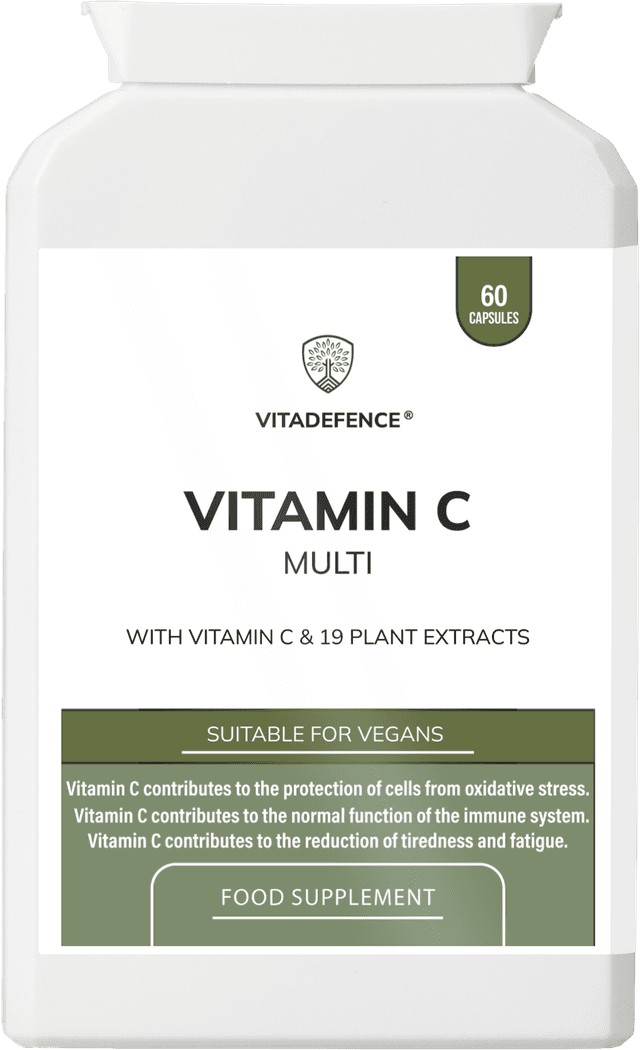
When you've decided Vitamin C is part of your week
Vitamin C is one of the few supplements almost everyone has an opinion about. A grandmother's lemon-and-honey at the first sniffle. A father's effervescent orange tablet. The tall green-and-orange tubs at the back of every gym. Whether you grew up with it as a kitchen ritual or a sports-shop habit, you've met it.
What's harder to find is a Vitamin C bottle that doesn't oversell itself. Most of the noise around this nutrient comes from a 1970 book by Linus Pauling, the two-time Nobel laureate, who proposed that very large doses might do extraordinary things. The clinical work that followed has been honestly mixed. We won't relitigate that here. We will say what the European Food Safety Authority has authorised — Vitamin C contributes to the normal function of the immune system, to normal collagen formation, to the reduction of tiredness and fatigue — and leave the dramatic claims to other people.
This bottle is the considered version of the story. 512mg of Vitamin C per capsule — six and a half times the NRV — sitting on top of seventeen quiet partners. Built for the person who wants a meaningful daily Vitamin C dose without surrendering to a wall of citrus-flavoured marketing.
The bottle, in your hand
Sixty vegan capsules, in our cream pot with the green band. Take one capsule, one to three times a day, with food, with water. At one a day the bottle lasts two months. At three a day, twenty days — these are working-dose formulas, not gentle once-a-week vitamins.
Vitamin C is water-soluble, which means the body uses what it needs and politely sends the rest down the plumbing. There's no point in heroic single doses; the body has a saturation point. What works is a steady daily presence, taken with the meals and the rituals you already have.
Vitamin C — the headline
Vitamin C — ascorbic acid — is one of only thirteen molecules the human body cannot make for itself. Most mammals synthesise it from glucose. Humans, the great apes, guinea pigs, and most bats lost the gene about forty million years ago, and we have eaten our Vitamin C from food ever since.
The discovery story is good. In 1747, James Lind, a Royal Navy surgeon on HMS Salisbury, ran what is generally counted as the first controlled clinical trial in medical history. Twelve sailors with scurvy, divided into pairs, each pair given a different proposed cure: cider, vinegar, sea water, garlic-and-mustard, oil of vitriol, and oranges and lemons. The two sailors on oranges and lemons recovered within a week. Lind's A Treatise of the Scurvy (1753) is one of the great quiet documents in medicine. The molecule itself wasn't isolated until 1932, when the Hungarian biochemist Albert Szent-Györgyi extracted it from paprika — Hungarian red pepper. He won the Nobel Prize for it five years later.
Our capsule delivers 512mg of Vitamin C per capsule — 640% of the European NRV. That's a working dose, well above what you'd get from a kitchen-rhythm orange, and it is the headline this whole formula is built around.
Baobab fruit pulp — the African upside-down tree
The baobab — Adansonia digitata — is one of the strangest trees on earth. The trunk swells and stores water like an enormous wooden barrel; the bare branches at the top look so much like roots that the tree's nickname across the African continent is the upside-down tree. Mature baobabs live for over a thousand years.
The fruit is a hard, woody, gourd-shaped pod. Inside, the seeds sit in a dry, creamy, tangy pulp that is naturally rich in Vitamin C — gram for gram, more than the equivalent weight of fresh orange. We use 100mg per capsule for the whole-food matrix — the surrounding fibre and minerals that the bare ascorbic acid molecule travels with in nature.
Acerola, black aged garlic, olive leaf, reishi — the supporting chorus
Acerola — Malpighia glabra — is a small tropical cherry from the Caribbean. The fresh fruit is one of the most concentrated natural sources of Vitamin C in the plant kingdom — roughly thirty times the density of a fresh orange. We use 48mg per capsule.
Black aged garlic is regular Allium sativum held under controlled warm humidity for several weeks. The cloves turn glossy black, the texture becomes jelly-like, and the sharp pungency is replaced by a sweet, balsamic flavour. The technique is Korean and Japanese in origin; aged black garlic has been a kitchen ingredient there for centuries. We use 50mg per capsule.
Olive leaf — Olea europaea — has been a Mediterranean folk medicine for thousands of years. The compound that has earned it its modern reputation is oleuropein, the polyphenol that gives the leaves their distinctive bitterness. We use 40mg per capsule.
Reishi — Ganoderma lucidum — is the lacquer-glossy red bracket fungus that grows on East Asian hardwood logs. In the Han pharmacopoeia Shennong Bencao Jing (around 200 AD) it is listed in the highest superior class of herbs. We use 20mg of fruiting body extract per capsule — a long-quiet tradition nodded to at small dose.
Citrus bioflavonoids and rosehip — the colour-and-pigment partners
The bioflavonoids — hesperidin, naringenin, eriocitrin, others — are the orange-and-yellow pigments that give citrus fruits their colour. They sit in the white pith and the inner segment walls — the parts of the orange most people throw away. In nature, ascorbic acid almost always travels alongside these pigments; the bare molecule on its own is a laboratory creation. We add 25mg of citrus bioflavonoid complex per capsule for that reason.
Rosehip — Rosa canina — adds another 25mg. Rosehip syrup, fed to British children through the war years when oranges were scarce, was the country's home-front Vitamin C. The dog-rose fruit is naturally rich in ascorbic acid plus a wider mix of carotenoids and flavonoids — another whole-food matrix contribution.
The smaller voices — turmeric, cayenne, elderberry, ginger, grapefruit seed, Bioperine
The middle of the formula is a chorus of plants that each contribute 10–36mg per capsule. Turmeric (36mg) for its curcumin pigment; cayenne (20mg) for capsaicin warming; black elderberry (15mg) — the country-hedge berry of Northern Europe; grapefruit seed (15mg); ginger (10mg); Bioperine (2.6mg) — the standardised black pepper extract with piperine, here to support the rest of the formula's absorption.
None of these is the headline. Each is in here because, in a slow-built daily Vitamin C formula, the plant chorus changes the colour of the whole.
The trace mineral and live-culture spine
The bottom of the label is the spine — the place where the EFSA-authorised wording lives.
Vitamin E (5mg α-TE, 41% NRV) — contributes to the protection of cells from oxidative stress. Zinc (5mg, 50% NRV) — contributes to normal immune function and to the protection of cells from oxidative stress. Vitamin B6 (1.5mg, 107% NRV) — contributes to the reduction of tiredness and fatigue. Selenium (10μg, 18% NRV) — contributes to normal immune function. Vitamin D (2.5μg, 50% NRV) — contributes to normal immune function.
Plus a small dose of Lactobacillus acidophilus — 125 million CFU. A live-culture nod. Not a probiotic in the high-strength sense — for that, look at our Live Cultures range — but a small daily presence here.
How to use it
One capsule, one to three times a day, with food. Most people land on one or two a day. Three is the upper end and is the dose people use during a defined two-week period — for instance, around a stressful week, a long flight, a season change.
A practical note: take this in the morning or with the midday meal. Vitamin C is mildly stimulating in the way coffee is mildly stimulating, and a 512mg capsule taken at 9pm has, in some sensitive people, a small effect on getting to sleep. Most don't notice. A few do.
Honest caveats
This is a food supplement — it complements a varied diet, doesn't replace one. Don't exceed three capsules a day.
If you are pregnant or breastfeeding, talk to your GP first. If you are on iron-overload monitoring (haemochromatosis), bear in mind that high-dose Vitamin C increases iron absorption — useful for some people, the wrong direction for others. If you have a history of kidney stones, particularly oxalate stones, talk to your doctor before sustained high-dose Vitamin C use. If you take warfarin or other blood-thinners, check with your doctor — the small dose of garlic in this formula is well below culinary use, but worth flagging.
If you've read this far, thank you. We tried to write the kind of page we'd want to read before spending money. Just a Royal Navy surgeon's lemon ration, a Hungarian paprika molecule, an upside-down African tree, and a small daily ritual.
— Vitadefence
— Vitadefence