Showcase
Vitamins Multi — the daily A–Z, with the gaps the modern diet usually leaves
A comprehensive vegan multivitamin built around 17 essentials, plus alfalfa, psyllium, sugar beet fibre, seagreens, and a small live-culture blend.
When the daily diet doesn't quite cover it
Most people don't take a multivitamin because they're sick. They take one because the modern shopping basket has more processed food and less colour than the basket their grandparents carried home. Because work weeks run long and lunch is sometimes a sandwich. Because last Tuesday's dinner was a takeaway and last Wednesday's was leftovers and the spinach in the fridge has gone slightly slimy.
A multivitamin is not a replacement for food. It is a quiet floor — the small daily insurance that the gaps in this week's diet aren't gaps that matter. The way a homeowner thinks about a smoke alarm: not the main event, but a sensible thing to have running in the background.
This bottle is the comprehensive version of that idea. Seventeen essential vitamins and minerals on the label spine, four whole-food botanicals, a small live-culture blend, and a small green note from seaweed. One capsule, one to three times a day, with food. Vegan, halal-certified, no fillers, no nonsense.
The bottle, in your hand
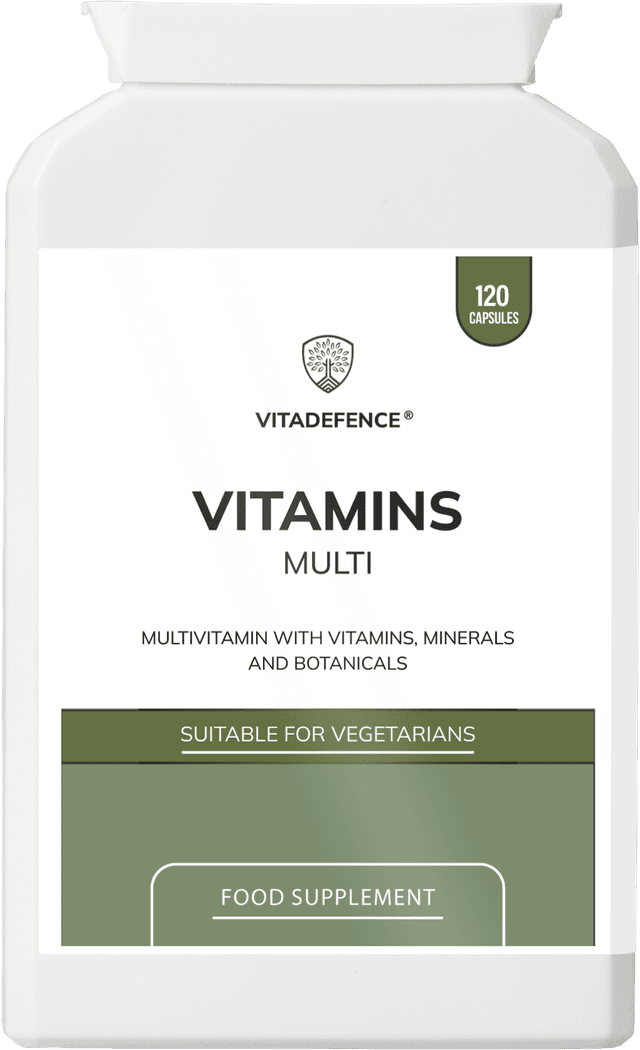
A clean cream pot, the green band of our label running around it like a forest line. One hundred and twenty vegan capsules inside — a four-month bottle at one a day, six weeks at three a day. Take one capsule, one to three times a day, with a meal.
The reason we built it as 1–3 capsules rather than as a single megadose tablet is that vitamins and minerals work best when the body absorbs them gradually across the day, alongside food. A single big dose at breakfast saturates absorption pathways and the rest gets sent down the plumbing. Three smaller doses across breakfast, lunch and dinner is closer to how a varied diet would deliver the same nutrients in real life.
The eight B-vitamins — the daily energy work
The B-vitamins are a family of eight water-soluble compounds the body uses for almost every act of daily metabolism. They came to be called the B group because nutritionists in the 1920s and 30s kept finding them in the same parts of the same foods — yeast, whole grains, leafy greens. Being water-soluble, they aren't stored in any meaningful reserve. We need a steady daily presence.
Each of the eight at 50%–100% of the European NRV per capsule:
Vitamin B1 (Thiamin, 1.1mg, 100%) — energy-yielding metabolism. The vitamin whose absence causes beriberi.
Vitamin B2 (Riboflavin, 1.4mg, 100%) — energy metabolism. The bright yellow vitamin that gives B-complex urine its neon colour. Harmless.
Niacin (B3, 16mg NE, 100%) — energy metabolism and reduction of tiredness.
Pantothenic Acid (B5, 6mg, 100%) — normal mental performance.
Vitamin B6 (1.4mg, 100%) — red blood cell formation and reduction of tiredness.
Folic Acid (B9, 200μg, 100%) — normal blood formation.
Vitamin B12 (Cyanocobalamin, 2.5μg, 100%) — the vitamin almost only found in animal products. The single most important reason a vegan or near-vegan diet needs supplementation.
Biotin (B7, 25μg, 50%) — normal hair, skin and mucous membranes.
Vitamin C — the daily citrus dose
Vitamin C (40mg, 50% NRV) — contributes to normal immune function, normal collagen formation, and to the reduction of tiredness and fatigue. A modest dose by design — if you want a working Vitamin C presence, look at our Vitamin C Multi or Vitamin C Capsules. Here, the 40mg sits as part of a balanced multivitamin, not as the headline.
The fat-soluble four — D3, E, K2
Vitamin D3 (2.5μg, 50% NRV) — contributes to the maintenance of normal bones and to normal immune function. The British winter vitamin: the latitude of the United Kingdom is far enough north that, between October and March, sunlight is too weak for skin to make meaningful Vitamin D. Most British adults are at least mildly deficient through winter. We use vegan D3, derived from algae rather than sheep's wool.
Vitamin E (14.8mg α-TE, 100% NRV) — contributes to the protection of cells from oxidative stress.
Vitamin K2 (37.5μg, 50% NRV) — contributes to the maintenance of normal bones. We use the menaquinone-7 form, the long-tail K2 isomer that has the longest half-life in the body and works in tandem with D3 in the calcium-routing pathway.
The mineral spine — Iron, Zinc, Manganese, Selenium, Iodine
Iron (7mg, 50% NRV) — contributes to normal red blood cell formation, to normal cognitive function, and to the reduction of tiredness and fatigue. We use ferrous glycinate, the gentlest of the iron forms on the stomach. Iron is a particular concern for menstruating women and for anyone on a vegetarian or vegan diet, where dietary iron is harder to absorb.
Zinc (5mg, 50% NRV) — contributes to normal immune function and to the maintenance of normal hair, nails, skin, and the protection of cells from oxidative stress. The mineral whose deficiency tends to show up first in the hair and nails.
Manganese (2mg, 100% NRV) — contributes to normal connective tissue formation and to the protection of cells from oxidative stress.
Selenium (27.5μg, 50% NRV) — contributes to normal immune function and to the protection of cells from oxidative stress. A trace mineral the body needs in microgram quantities, easy to fall short on if your diet is low in nuts, fish, and whole grains.
Iodine (37.5μg, 25% NRV) — contributes to normal thyroid function. The mineral most commonly missing from a low-salt or sea-salt-only diet, since iodised table salt is the default European source.
Alfalfa, psyllium, sugar beet fibre, seagreens — the four whole-food botanicals
Alfalfa — Medicago sativa — is one of the oldest cultivated forage plants on earth. The Persians grew it for their cavalry horses two and a half thousand years ago, and the Romans took it across Europe. What makes alfalfa interesting nutritionally is its tap root, which sends down fifteen or thirty feet, drawing minerals from soil layers most plants never reach. Forty milligrams per capsule.
Psyllium husk — Plantago ovata — is a small flowering herb whose seed husks expand on contact with water into a slippery gel. Native to India and Iran. Forty milligrams per capsule is a small daily fibre contribution; for a working fibre dose, see our dedicated Psyllium Husk Multi.
Sugar beet fibre is the dietary-fibre fraction left after the sugar has been pressed out of European Beta vulgaris. Forty milligrams per capsule, providing 38mg of oligofructans (FOS) — small fibre molecules that the live-culture bacteria in the gut metabolise. A prebiotic: it doesn't do anything itself, it feeds the bacteria that do.
Seagreens is the brand-neutral name for bladderwrack — Fucus vesiculosus — a brown seaweed harvested from the cold waters of the Hebrides. A long-standing Scottish kitchen and folk-medicine ingredient. Forty milligrams per capsule contributes trace minerals including natural iodine, magnesium, and a wide spectrum of sea-derived microminerals.
The live-culture blend — a small daily presence
Lactobacillus acidophilus and Bifidobacterium lactis, providing 1 Billion CFU per capsule. This is a small live-culture dose by probiotic standards — for a working probiotic presence look at our Live Cultures range. Here, 1 Billion CFU is the small daily floor — the equivalent of a teaspoon of yogurt with breakfast, without the dairy.
How to use it
One capsule, one to three times a day, with a meal. Most people land on one or two. Three is the upper end and is the dose people use when they know their diet is poor for a stretch — moving house, exam season, a long work tour.
Take it with food, always. Several of the fat-soluble vitamins (D, E, K) absorb meaningfully better when there's a little fat in the meal — a teaspoon of olive oil, a piece of cheese, a handful of nuts.
A note: don't be alarmed if your urine turns bright neon yellow about an hour after the capsule. That's riboflavin (B2). It's harmless and it means the capsule is working through.
Honest caveats
This is a food supplement — it complements a varied diet, doesn't replace one. Don't exceed three capsules a day.
If you are pregnant or breastfeeding, this formula contains 200μg of folic acid per capsule which is good — but the recommended pregnancy dose is 400μg, so you'd need two capsules a day during pregnancy. Talk to your GP. If you are on warfarin or other anticoagulants, the Vitamin K2 in this formula is at a low dose (37.5μg) but worth flagging to your doctor — patients on warfarin generally aim for steady weekly K intake rather than fluctuating doses. If you have thyroid disease, the iodine and seagreens content is at modest dose but is worth mentioning to your endocrinologist. If you have a known iron-overload condition (haemochromatosis), the 7mg of iron in this formula may not be appropriate.
If you've read this far, thank you. We tried to write the kind of page we'd want to read before spending money. Just a comprehensive daily floor, with seventeen essentials and a small handful of plants, for the days the kitchen doesn't quite cover.
— Vitadefence
— Vitadefence