Showcase
Whey Protein Multi — the cheesemaker's byproduct, dialled to its modern form
A 600g chocolate-flavour whey protein powder built on whey concentrate and isolate, with cocoa, stevia, and the cheesemaking heritage that gave us whey in the first place.
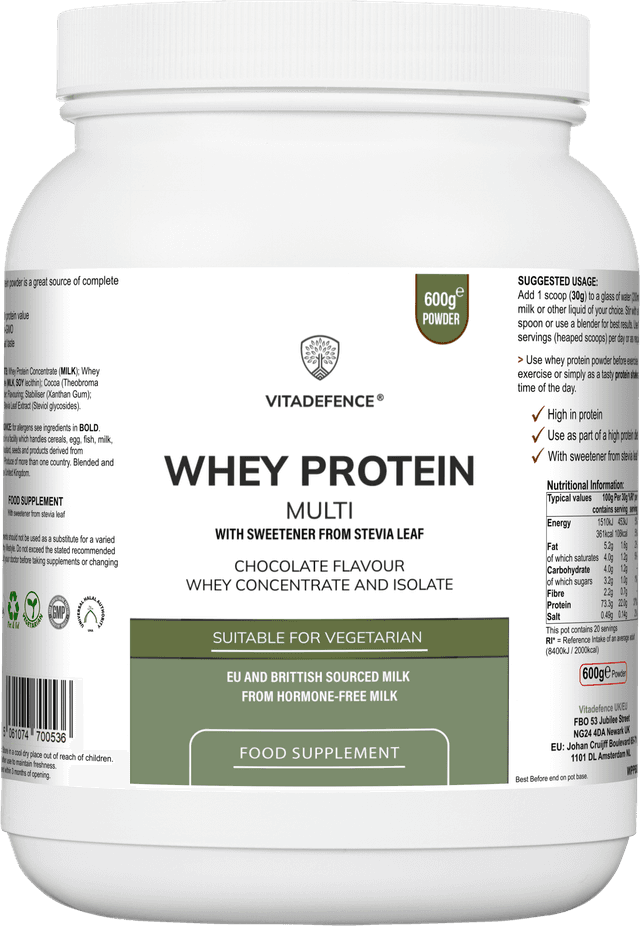
> ⚠️ Allergy notice — read before buying. This powder contains MILK and SOY (lecithin). It is not suitable for anyone with a milk or soy allergy, lactose intolerance, or a cow's-milk-protein sensitivity. For lactose-intolerant readers, see our Pea Protein Multi or Rice Protein Multi. For vegan readers, see our Hemp Protein Multi.
When the protein number on the back of the packet starts to matter
Most people meet protein powder in a gym. The mid-afternoon shaker on the desk. The post-training scoop in a plastic bottle by the squat rack. For some readers it'll be a familiar habit; for others, a slightly intimidating world of branded tubs and capital-letter advertising.
What's worth saying first is that whey protein, despite the modern packaging, is one of the oldest food products in Europe. It is the byproduct of cheesemaking. When milk is curdled — by rennet, by acid, by the slow work of bacterial cultures — the milk separates into two fractions. The white, soft solid is the curd; this is what becomes cheese. The pale, thin, slightly sweet liquid that drains away is the whey. For most of European agricultural history, whey was fed to pigs, fed to children when food was scarce, used to make ricotta (literally re-cooked — Italian dairies cook the whey a second time to extract the last protein), or simply poured back into the river.
It is only in the last sixty years that food technology has learned to dry the whey, separate its components, and turn it into the protein powder you see on the gym-shop shelf. The molecule is the same one a Tuscan grandmother would feed her grandchildren in 1850. The packet is new. The food is not.
The bottle, in your hand
A 600g pot, twenty servings, in our cream pot with the green band. Take one scoop (30g) in 200ml of water, milk, juice, or your liquid of choice. Stir with a fork or shake in a sealed bottle. One to three servings a day, depending on training load and diet. The chocolate flavour is the cocoa-and-stevia version; we also do a vanilla.
Twenty servings is enough for about a month at one scoop a day, or about ten days at the higher end of the dosing range. Store it in a cool, dry cupboard with the lid sealed. Don't keep the open pot in the bathroom or the kitchen near the kettle — heat and humidity are the enemies of any protein powder.
The story of whey, and the long story of cheese
The earliest archaeological evidence of cheesemaking comes from Polish pottery sieves dated to about 5500 BC, with milk-fat residues still detectable on the clay. Cheesemaking is older than writing.
Whey is what runs out of the cheesecloth. In the European peasant kitchen, fresh whey was a daily drink. In Switzerland it was Molke, a tonic taken at nineteenth-century altitude resorts — whey cures were a recognised regime in the Swiss Alps for convalescence and recovery. In Sicily, ricotta — literally re-cooked — is the second cheese, made from whey heated a second time until the remaining proteins coagulate into the soft white cheese that fills cannoli.
What was lost on no one was that whey was protein-dense. The casein — the slow-digesting protein — went into cheese. The whey took the fast-absorbing whey proteins (alpha-lactalbumin, beta-lactoglobulin, immunoglobulins), the lactose sugars, and the minerals.
Modern food technology, starting in the 1960s, learned to dry liquid whey gently into a powder, then concentrate the protein fraction by membrane filtration. The result is whey protein concentrate — typically 70–80% protein by weight. Filter it further and you get whey protein isolate — typically 90%+. We use both. The concentrate carries the natural creaminess and the wider mineral profile; the isolate brings the protein percentage up and reduces the lactose content for people mildly lactose-sensitive.
A practical note: this is not a zero-lactose product. The blend of concentrate and isolate keeps the lactose content low but not negligible. Severely intolerant readers should choose pea, rice, or hemp protein.
Cocoa — the chocolate flavour, and the heritage behind it
The chocolate flavour comes from cocoa powder — the dried, defatted, ground seed of the Theobroma cacao tree, the small understorey tree of the Mesoamerican rainforest. The Latin name itself is poetic — theobroma means food of the gods — and was coined by Linnaeus in 1753, three hundred years after the Spanish brought the cacao bean back from Mexico.
Cocoa was a sacred drink for the Maya and the Aztec. The Aztec court drank xocolātl — bitter, frothed cold water with toasted ground cacao seeds, ground maize, vanilla, and chilli. There was no sugar in the original recipe. Sugar came later, in the European version, when Spanish nuns started adding cane sugar in the 1500s.
We use cocoa powder in this formula at the level required for flavour rather than as a superfood claim — though cocoa is, on its own merits, one of the most polyphenol-dense foods in the kitchen. The drink you stir in the morning carries a real, modest dose of the cocoa polyphenol family on top of the protein number on the back of the packet.
Stevia — the sweet leaf from Paraguay
The sweetener in this formula is stevia leaf extract — steviol glycosides — the sweet compounds isolated from the leaves of Stevia rebaudiana, a small plant native to the highland regions of Paraguay and southern Brazil. The Guaraní people of the Paraguay River basin used the dried leaves to sweeten yerba mate tea for at least a thousand years before European contact.
Stevia is roughly 200–300 times sweeter than sucrose, with no calories and no glycaemic effect. We use it instead of sucrose because it gives a clean, plant-based sweetness without spiking blood sugar — which matters for anyone using protein powder as part of a managed diet. Some people taste a faint mineral or liquorice-like aftertaste from stevia; if you've tried stevia in coffee or in soft drinks before and didn't like it, you may not love this powder. Most people find that the cocoa carries the flavour and the stevia is invisible.
Xanthan gum — the small structural touch
The other ingredient on the label is xanthan gum, a thickener at low dose that keeps the powder from settling into a gritty layer at the bottom of your shaker. Xanthan is a fibre produced by a friendly bacterium (Xanthomonas campestris) fed on sugars; food technologists discovered it in the 1960s. It's been on supermarket shelves in salad dressings, gluten-free baking flours, and yoghurts ever since. A tiny amount in this powder gives the drink a smoother, less watery mouthfeel.
The protein numbers, and what we won't claim
A 30g scoop of this powder delivers a working daily dose of high-quality protein with a complete amino acid profile — whey is one of the most digestible protein sources in the human kitchen, alongside egg.
We won't claim this powder makes you stronger. Strength comes from progressive overload in the gym, sleep, recovery, and time. Protein powder helps you hit a daily protein number that, for most active adults, is hard to reach from food alone — particularly for people who don't enjoy eating large amounts of meat. EFSA-authorised wording: protein contributes to the maintenance and the growth of muscle mass, and to the maintenance of normal bones.
That sentence — quiet, plain, label-accurate — is the entire health claim of this product. The rest is taste, texture, and the long story of cheese.
How to use it
One to three servings (heaped scoops, 30g each) per day. Stir 30g into 200ml of water, milk, plant milk, juice, or whatever liquid you prefer. Most people use one scoop a day post-training; some use two if they're on a higher-protein diet plan; three is the upper end for active individuals on extended training cycles.
Mixing tip: if you're stirring with a spoon, add the powder to the liquid (not the other way round) and stir from the bottom of the glass. A shaker bottle with a wire whisk ball gives the smoothest result. A blender with a banana, oats, and milk gives the best smoothie. Cold milk or oat milk is the most forgiving liquid; hot tea will not dissolve a protein powder properly and we don't recommend it.
Honest caveats
This is a food supplement — it complements a varied diet, doesn't replace it. Allergy advice: contains MILK and SOY (lecithin). Not suitable for anyone with a milk or soy allergy. Severely lactose-intolerant readers should choose plant protein.
If you are pregnant or breastfeeding, talk to your GP first. If you have kidney disease, talk to your doctor before adding any high-protein supplement to your daily intake — the kidneys process the nitrogen load from protein, and a compromised kidney handles it differently. If you are vegan, this is not your product — see our Hemp, Pea, Rice, or Soy Fibre protein powders. If you are vegetarian and dairy-friendly, this works.
If you've read this far, thank you. We tried to write the kind of page we'd want to read before spending money. Just a Tuscan grandmother's whey, a Mexican forest seed, a Paraguayan sweet leaf, and a small daily ritual at the gym door.
— Vitadefence
— Vitadefence