Creatine vs L-Arginine: Different Pre-Workout Roles
Creatine and L-arginine work differently in the body. Learn how each supports exercise performance and which might suit your goals.
By Vitadefence Team
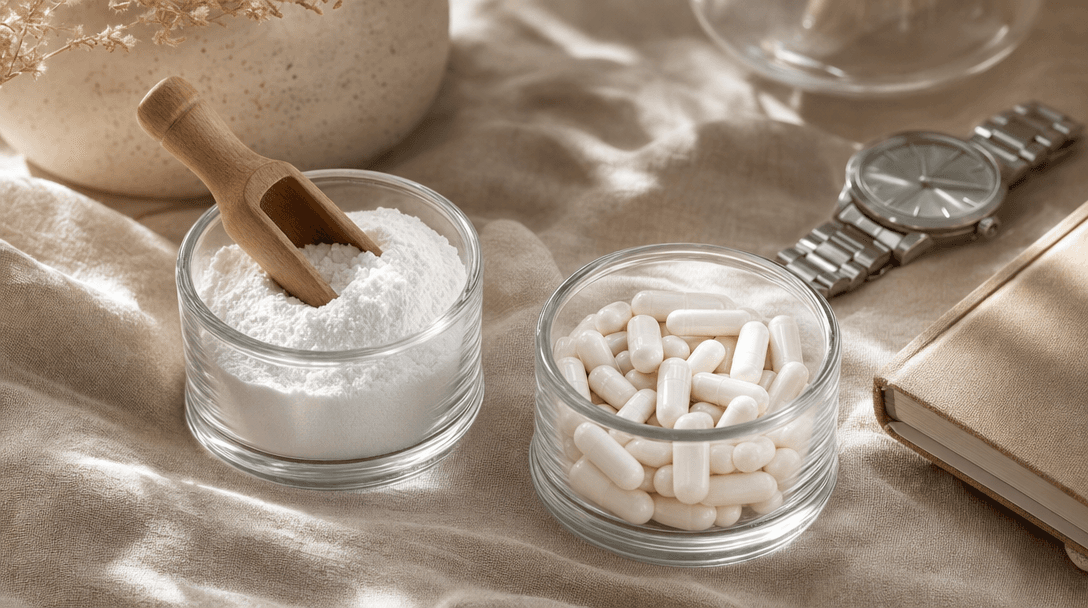
If you’ve ever looked at a pre-workout label, you’ve likely seen both creatine monohydrate and L-arginine listed. While they often share the same tub, these two molecules serve very different purposes. Understanding how each works can help you choose the right supplement for your training goals.
What is Creatine Monohydrate?
Creatine is a naturally occurring compound made from three amino acids: arginine, glycine, and methionine. About 95% of your body’s creatine is stored in skeletal muscle as phosphocreatine. During high-intensity exercise, phosphocreatine donates a phosphate group to ADP to rapidly regenerate ATP — your body’s primary energy currency. This process supports short bursts of power, like sprinting or heavy lifting.
Supplementing with creatine monohydrate increases muscle creatine stores, which can enhance performance in repeated bouts of high-intensity exercise. A meta-analysis by Kreider et al. (2017) concluded that creatine supplementation improves strength, power, and lean mass when combined with resistance training.
What is L-Arginine?
L-arginine is a conditionally essential amino acid that serves as a precursor to nitric oxide (NO). Nitric oxide is a vasodilator, meaning it relaxes the inner muscles of your blood vessels, causing them to widen. This increases blood flow to working muscles during exercise, which can improve oxygen and nutrient delivery and help remove waste products like lactate.
While L-arginine is often marketed for its NO-boosting effects, oral supplementation has limited bioavailability due to extensive metabolism in the gut and liver. A study by Böger (2014) highlights that high doses (6–10 g) may be needed to see a modest increase in NO production, but this can cause gastrointestinal distress.
Key Differences in Mechanism
The primary difference lies in their roles: creatine directly supports ATP regeneration, while L-arginine aims to improve blood flow via NO. Creatine’s effects are immediate during high-intensity efforts, whereas L-arginine’s potential benefits are more about sustained performance and recovery through enhanced circulation.
Creatine works intracellularly, increasing the availability of phosphocreatine within muscle cells. L-arginine works extracellularly, influencing endothelial function and blood vessel diameter. This means they target different aspects of exercise performance.
What Does the Research Say?
Creatine Monohydrate
Hundreds of studies support creatine’s efficacy. A comprehensive review by Kreider et al. (2017) found that creatine supplementation increases muscle strength, power, and lean body mass. It also appears to enhance recovery and reduce muscle damage. The standard dose is 3–5 g per day, with a loading phase of 20 g/day for 5–7 days optional.
L-Arginine
Evidence for L-arginine is mixed. Some studies show improved exercise performance, while others find no benefit. A meta-analysis by Viribay et al. (2017) reported that L-arginine supplementation can increase time to exhaustion and reduce lactate accumulation, but effects are modest and dose-dependent. Many athletes prefer citrulline malate, which boosts arginine levels more effectively.
Which Should You Choose?
Your choice depends on your training goals. If you focus on strength, power, or high-intensity interval training, creatine monohydrate is the more evidence-based option. It’s also more affordable and has a well-established safety profile.
If your goal is endurance or you want to improve blood flow and “the pump,” L-arginine might be worth trying — but consider citrulline malate as a more effective alternative. Some athletes combine both for a synergistic effect, but research on stacking is limited.
Note that creatine can cause water retention and mild bloating, while L-arginine may cause digestive issues at high doses. Neither is a magic bullet; consistent training and nutrition are far more important.
Bottom line
Creatine monohydrate and L-arginine are not interchangeable. Creatine is a proven ergogenic aid for high-intensity performance, while L-arginine’s role in vasodilation offers potential but less consistent benefits. For most people, starting with creatine monohydrate is a sensible first step. If you want to experiment with L-arginine, start with a lower dose and monitor your response. Always consult a healthcare professional before adding new supplements to your routine.
More from the journal
Spirulina: The Original Superfood — Protein, B12, and Phycocyanin Antioxidant Power
9 min · Ingredients
Siberian Ginseng Benefits: Why This Adaptogen Is Different From Panax Ginseng
7 min · Ingredients