FREE Royal Mail · 2–3 daysGMP quality standardsMade in the UKVAT included
Turmeric & ginger · 100% Plant-based · Vegan · With Turmeric, Apple Cider Vinegar & Enzyme Blend · 90 Capsules
| Turmeric Root* (providing 20mg Curcuminoids) | 421mg |
| Betaine Hydrochloride (providing 110.58mg of Betaine) | 145mg |
| Alfalfa | 50mg |
| Amylase (providing 2250SKB of Amylase) | 45mg |
| Apple Cider Vinegar | 30mg |
| Caraway Seed | 20mg |
| Chamomile Flower | 20mg |
| Fennel Seed | 20mg |
| Ginger Root* | 20mg |
| Peppermint Leaf | 20mg |
| Protease 4.5 (providing 540HUT) | 10.8mg |
| Lipase (providing 330 Units) | 6.6mg |
| Protease (providing 23.9HUT) | 4.78mg |
| Bromelain (providing 6GDU) | 3mg |
| Papain (providing 0.3USP Units) | 0.15mg |
| Protease 3 (providing 48HUT) | 0.03mg |
Betaine Hydrochloride Powder, Capsule Shell: Hydroxypropyl Methylcellulose (HPMC), Stoneground Brown Rice Flour (Oryza Sativa), Alfalfa Herb Powder (Medicago Sativa), Amylase, Apple Cider Vinegar Powder (Malus Sylvestris), Turmeric Root Extract (Curcuma Longa), Peppermint Leaf Powder (Mentha x Piperita), Chamomile Flower Powder (Matricaria Chamomilla), Fennel Seed Powder (Foeniculum Vulgare), Caraway Seed Powder (Carum Carvi), Protease 4.5 50,000HUT/g, Lipase 50,000 U/g, Protease 5000HUT/g (from vegetable), Bromelain 2000GDU/g, Ginger Root Extract (Zingiber Officinale), Papain 2000 USP-U/mg, Protease 3 1.6 M HUT/g.
Take 1 or 2 capsules with each main meal or as advised by a health professional. If taken alone (i.e. rather than in combination with other digestive supplements), start off on a higher intake of 2 - 3 capsules before breakfast, lunch and the evening meal for 3 - 4 weeks. Thereafter, reduce to 1 - 2 capsules, 2 - 3 times per day or as required. Warning: Do not take if peptic ulcers are present.
Store in a cool, dry place, out of reach of children. Do not use if the seal is damaged. Best before date printed on the base.
Suitable for vegetarians and vegans · Halal approved
Looking for digestive enzymes tablets? Ours are capsules, not tablets: Digestive Enzyme Multi (With Turmeric, Apple Cider Vinegar & Enzyme Blend, 90 Capsules), made in the UK.
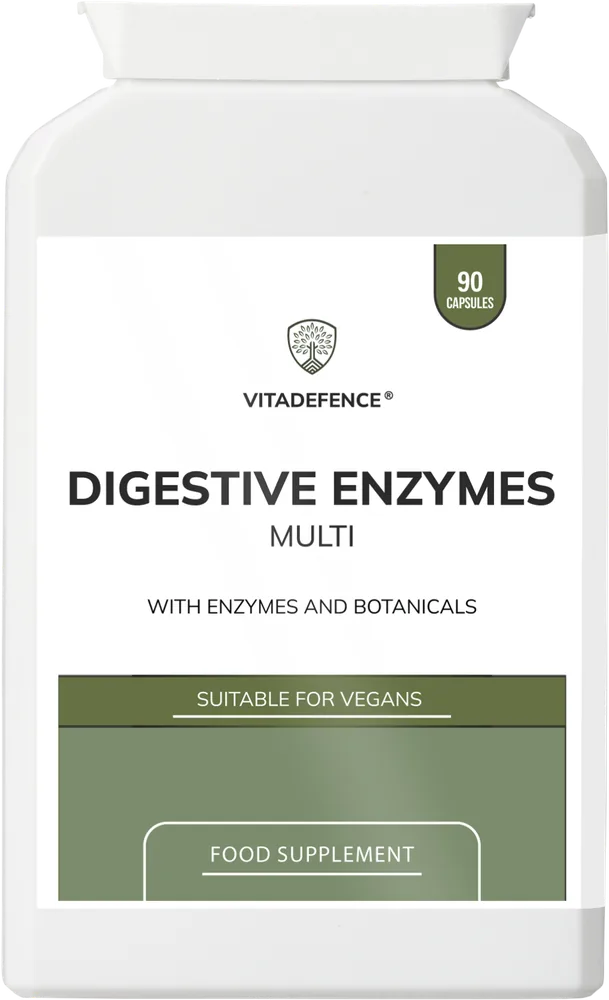
A clean cream pot, the green band of our label running around it like a forest line. Ninety vegan capsules inside. The dose is flexible — one or two with each main meal, or a higher loading dose if you've been struggling for a few weeks and want to reset. Best before date on the base. Halal-approved. Vegan-friendly.
Plants like these don't shout. They get to work in the background.
The root itself looks like a small ginger — knobbly, fibrous, brilliant orange when you cut it.
What makes turmeric quietly extraordinary is its curcuminoid content. Standardising means every capsule carries 20mg of curcuminoids.
Apple cider vinegar is one of those ingredients that has been quietly reinvented in every century. The Romans called it posca and gave it to their soldiers diluted with water as a daily field drink. Hippocrates wrote about it. Mediaeval monks brewed it in cellars beneath their orchards. Every culture that grew apples eventually fermented some of them into vinegar, and every culture that fermented vinegar eventually used it for the gut.
We use 30mg of apple cider vinegar powder per capsule — a small inclusion, deliberately so. Apple cider vinegar powder, 30mg per capsule.
Betaine hydrochloride, 145mg per capsule (110mg betaine).
(One honest note: this is also why we say don't take this product if you have an active peptic ulcer. If your stomach is already inflamed, the last thing it wants is more acid in the room. Talk to your GP first.)
Open any traditional European herbal — French, Italian, German, English — and you'll find the same four plants showing up again and again in the chapter on digestion after eating. Fennel seed. Peppermint leaf. Chamomile flower. Caraway seed.
Fennel (Foeniculum vulgare) is the seed you're handed in a small dish at the end of a meal in every Indian restaurant. The Roman cookbook Apicius lists it. Charlemagne ordered it grown in every monastery garden in his empire.
Peppermint, chamomile, fennel and caraway are traditional after-dinner herbs.
Caraway (Carum carvi) is the seed in good rye bread, in Hungarian goulash, in Tunisian harissa — and, separately, in every European herbalist's drawer for centuries.
We've put all four into this formula at 20mg of each per capsule. None of them are doing the heavy lifting. All four together are doing the after-dinner-tea job in capsule form.
Ginger root extract sits at 20mg per capsule — small, but worth its place. Ginger root extract, 20mg per capsule.
50mg of alfalfa leaf rounds out the herbal side. Alfalfa (Medicago sativa) is one of the world's oldest cultivated plants — the Persians grew it as horse fodder, the Greeks brought it to Europe, and herbalists have used the leaf for centuries as a gentle, mineral-rich green note in digestive blends. It earns its place because every formula like this benefits from a small amount of plain green leaf — chlorophyll, trace minerals, the whole-food signature.
Now we leave the herbal garden and enter the laboratory. Seven of the ingredients in this bottle are digestive enzymes — small proteins that break down specific kinds of food into smaller pieces your body can absorb.
Amylase (45mg, providing 2,250 SKB) — breaks starches into sugars. The enzyme that handles bread, pasta, rice, potato.
Protease 4.5 (10.8mg, providing 540 HUT) and Protease (4.78mg) and Protease 3 (0.03mg) — the three proteases break proteins into smaller peptides. The enzymes that handle meat, fish, eggs, beans.
Lipase (6.6mg, providing 330 Units) — breaks fats. The enzyme for the rich, buttery, oily parts of a meal.
Bromelain (3mg, providing 6 GDU) — a protease originally extracted from pineapple. Latin Americans have known for centuries that pineapple eaten after meat tenderises it. Bromelain is the reason.
Papain (0.15mg, providing 0.3 USP units) — the same idea, this time from papaya. South Asian cooks have wrapped tough meat in papaya leaf for the same effect since long before anyone had a word for the molecule responsible.
We chose this seven-enzyme spectrum deliberately. A starch-only enzyme would only help the bread side of dinner. A protein-only enzyme would only help the meat side. A real meal contains all three — starches, proteins, fats — and a real digestive blend should cover all three.
For most people, one or two capsules with each main meal is the right starting place — taken just before you eat, or with the first bite. Drink water alongside.
If taken on its own, the label suggests 2 to 3 capsules before each main meal for 3 to 4 weeks, then the normal dose.
If you take any other digestive supplement (a separate enzyme product, a separate betaine HCl, a stand-alone probiotic) — don't stack them on top of this one without spacing. More is rarely more in the gut. One thoughtful blend is usually plenty.
This is a food supplement — it complements a varied diet, doesn't replace one, and it doesn't replace the advice of a healthcare professional. Don't take this product if you have an active peptic ulcer — the formula is designed to gently support stomach acid, and an inflamed stomach lining doesn't need that. If you are pregnant, breastfeeding, on medication, or living with a medical condition, talk to your GP or pharmacist first.
Keep it cool, dry, sealed, out of reach of children. Best before date is on the base.
If you've read this far, thank you. Plants and enzymes don't replace cooking well, eating slowly, or getting to bed at a reasonable hour. They do help, on the nights when the meal sat a little heavier than it should — which, for most of us in this century, is more nights than we'd like to admit.
— Vitadefence


