Showcase
Aloe Vera Capsules — a desert leaf, ten kitchen botanicals, and a quieter inside
On the dry hills of the Arabian peninsula, a thick green leaf has soothed human stomachs for five thousand years. Around it we built a quiet kitchen-cabinet of ten old plants — the rhubarb, the ginger, the fennel, the dandelion — that grandmothers across Europe and Asia have reached for after a heavy meal.
Key facts
- When dinner sits heavier than it used to
- The bottle, in your hand
- The story of aloe vera
- Rhubarb — the first ingredient on the label
- Burdock root — the wild thistle of country lanes
When dinner sits heavier than it used to
The body changes, slowly, in your thirties and forties. The same plate of pasta you ate at twenty-two now feels different at forty-two. You finish your evening meal and there's a small tight feeling that sits with you until bedtime. You drink mint tea and that helps. Your trousers feel snug after a week of restaurant work lunches. You wake up at three in the morning with that vague, restless heaviness in the middle of you.
None of this is a medical problem. It's life. The digestive tract — easily our hardest-working internal organ — needs a bit more attention as the years pass. Smaller meals. Slower meals. Warmer meals. And, in almost every culture in the world, an after-dinner ritual involving a small set of bitter, aromatic, kitchen-garden plants that have been quietly used for the same job for thousands of years.
This little bottle is one daily concentrated form of that old after-dinner ritual.
The bottle, in your hand
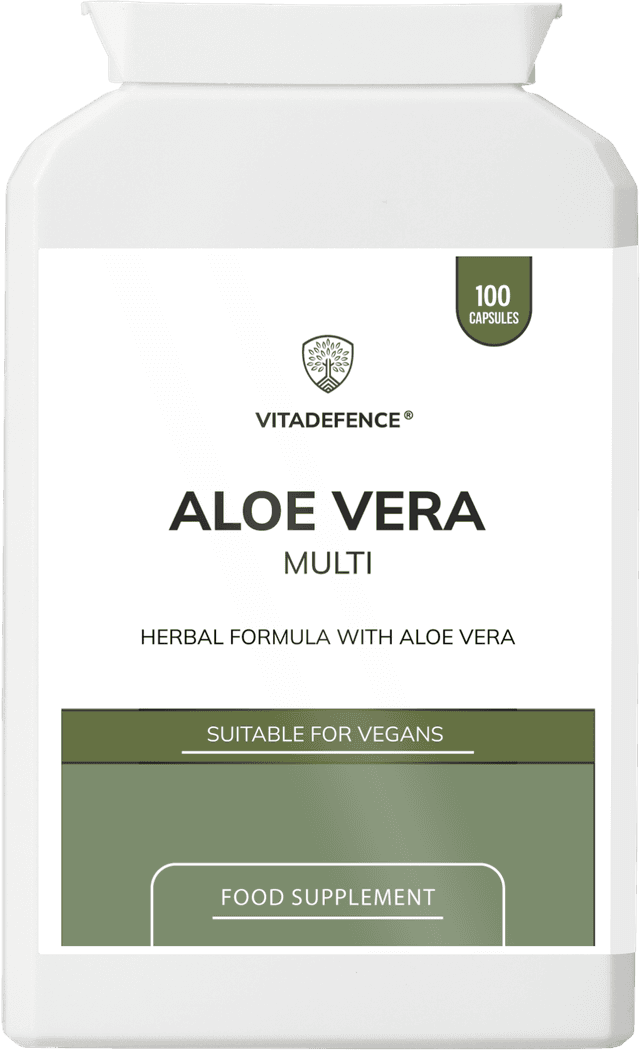
A clean cream pot, the green band of our label running around it, one hundred vegan capsules inside. The dose is gentle — one or two capsules, one to three times a day, with water. Most people take one with a glass of water before dinner and find that's plenty.
A bottle of one hundred lasts you between a month and three months depending on how you take it. The kind of thing that lives quietly on the shelf next to the salt and pepper.
The story of aloe vera
Long before aloe vera was a houseplant, it was a temple plant. The Sumerians wrote of it on clay tablets four thousand years ago. The Ebers Papyrus — the Egyptian medical text from around 1550 BC — lists aloe in over a dozen recipes. Dioscorides, the 1st-century Greek physician whose herbal was the standard medical reference for fifteen hundred years, gave it an entire chapter. The Chinese have used it since the Tang dynasty. That's an unusual amount of pedigree for a plant.
Aloe vera — in Latin, the true aloe — is a stocky succulent native to the Arabian peninsula. The thick fleshy leaves are filled with a clear gel the plant uses as its own water store in dry country. Inside that gel is a class of compounds called acemannans, alongside a complex mucilage of polysaccharides — the same kind of long-chain plant sugars that give okra its slip, oats their porridge, and psyllium its gel. Modern research is still mapping out exactly how aloe interacts with the gut wall, but the folk record is unanimous: across continents, the inner-leaf aloe is reached for when something inside isn't quite settled.
We use a concentrated aloe vera leaf extract from properly cultivated Aloe barbadensis miller, alongside ten other kitchen-and-hedgerow plants — each with its own place at this table.
Rhubarb — the first ingredient on the label
Most British people meet rhubarb in a crumble. Pink stalks, sugar, pastry, custard. What few realise is that rhubarb root — the part underneath, never seen in a kitchen — is one of the oldest medicinal plants in the world. The Chinese physician Shen Nong listed it in his herbal compendium around 2700 BC. Marco Polo wrote home about it. For most of the medieval period, rhubarb root was more valuable per pound than tea, and Russian merchants made fortunes carrying it from Persia and Tibet to the apothecaries of London.
The reason was simple. Rhubarb root, used carefully, is a quiet bitter for the lower gut. It is the leading ingredient in this formula by weight, and the foundation of the digestive logic of the whole bottle.
Burdock root — the wild thistle of country lanes
Anyone who walked a British footpath in autumn as a child has had a burdock burr stuck to their jumper. Arctium lappa. The plant inspired the inventor of Velcro. The roots, less photographed than the burrs, were a staple of the European apothecary garden — slightly sweet, faintly earthy, traditionally drunk as a tea for the clearing class of country remedies. In Japan it is gobo, served as a side vegetable.
Cayenne pepper — the heat that wakes the stomach
The Aztecs and Mayans were domesticating chillies six thousand years ago. By the time the Spanish brought them to Europe, Capsicum had reached every continent except Antarctica. What cayenne does in a digestive blend isn't really about heat — it's about capsaicin, the small molecule that gently signals the digestive tract to wake up and do its job. We use a trace amount, an old apothecary trick.
Fennel seed — the after-dinner ritual
Walk into any Indian restaurant in Britain and at the end of the meal there's a small bowl by the door. Saunf. Sugar-coated fennel seeds. You take a pinch, chew it slowly, and walk out into the evening. That's not theatre. It's a five-thousand-year-old after-meal ritual that exists in essentially every Mediterranean and South Asian culture.
Fennel — Foeniculum vulgare — is one of the original kitchen herbs of the ancient world. The Romans cultivated it. The Anglo-Saxons used it. Its sweet aniseed flavour comes from a compound called anethole, which is the chemistry behind its quiet reputation in folk medicine for soothing a heavy meal.
Ginger root — the warming root
Ginger has been on the human menu for at least three thousand years. Confucius wrote about not eating without it. The Romans imported it at heroic prices. It is the warming root of half the world's kitchens, from Indonesian rendang to the British ginger biscuit. The reason it has earned its place in nearly every digestive folk tradition on earth is the gingerol compound family that gives it its warmth on the tongue. We use a concentrated ginger root extract.
Glucomannan — the fibre with a long résumé
Konjac is a root vegetable from East Asia. The Japanese have eaten it for over a thousand years as a wobbly translucent jelly called konnyaku. Its glucomannan is a soluble fibre that swells with water in the stomach — the same physical principle behind the satiety of porridge or psyllium. A small dose adds quiet bulk and slowness to the formula.
Liquorice root — the sweet root
Liquorice — Glycyrrhiza glabra — was chewed by Egyptian pharaohs (root samples were found in Tutankhamun's tomb), prescribed by Greek physicians, and traded along the Silk Road. We use the deglycyrrhized form — meaning the strong glycyrrhizin compound has been mostly removed, leaving the soothing mucilaginous fraction without the blood-pressure consideration of unprocessed root.
Barberry bark — the yellow-bitter of European folk practice
Barberry — Berberis vulgaris — is a thorny European hedgerow shrub whose bright yellow inner bark contains a compound called berberine. Apothecaries valued it as one of the bitter tonics. Iranian kitchens dry the small red berries — zereshk — and scatter them through saffron rice.
Dandelion root — the lawn weed that is a herbal hero
Of all the plants in your back garden, the most underestimated is the dandelion. Children pick the seedheads to make wishes. Adults curse them in the lawn. Apothecaries valued every part — leaf as a salad green, root as a coffee substitute, flower as a wine. The roasted root was a Victorian bitter for the kitchen-cabinet clearing class of formulas. In a digestive blend it is the gentlest of all the bitters — soft, slightly nutty, very old.
Bamboo silica — the trace mineral
Bamboo extract delivers silica, a trace mineral that is a quiet structural component of connective tissue. No EFSA-authorised claim sits behind silica, so we won't make one. It's here on the strength of its long traditional use, and as a small mineral grace note in a plant-heavy formula.
The formula as a whole
Eleven plants. Each one earns its place by traditional use. Aloe vera carries the headline. Rhubarb is the first ingredient by weight, the spine of the formula. Burdock and dandelion add the European bitter tradition. Cayenne, ginger, fennel and barberry add the warming-aromatic line that runs through nearly every world cuisine. Liquorice softens. Glucomannan adds bulk. Bamboo adds the mineral grace note.
What unites them is that they are old. None of these are press-release plants. They are the plants on your great-grandmother's spice rack, the plants in your favourite restaurant's after-dinner bowl, and the plants in the apothecary cabinets of a dozen civilisations. We just put them in a capsule, in sensible doses, so you don't have to brew a tea every evening.
How to use it
One or two capsules, one to three times a day, with a full glass of water. Most people take one before dinner and find that's plenty. Two with a heavier meal is reasonable.
Don't take it on top of strong laxative teas — the rhubarb is doing real work and stacking is unnecessary. Do take it with water, not just a sip. The glucomannan needs water to do its job; the same goes for the aloe.
Plants of this kind work in the background. Most people who notice anything notice a slightly lighter, slightly more comfortable feeling after meals — not a dramatic shift, more a quiet one — somewhere in the second or third week.
If after sixty days nothing has changed, stop. A supplement that isn't doing anything for you isn't worth your money.
Honest caveats
This is a food supplement — it complements a varied diet, doesn't replace one. If you are pregnant, breastfeeding, taking medication, or living with a medical condition, talk to your GP or pharmacist first. Avoid if you have an active gut inflammation diagnosis without a doctor's nod. Keep it cool, dry, sealed, out of reach of children. Don't exceed six capsules a day.
Several of the plants in this bottle don't grow in the UK. We source each one from its traditional region — aloe from Mexico and the Caribbean, rhubarb root from China and the Himalayas, ginger from South-East Asia, cayenne and barberry where they have always grown. The blend is then milled and encapsulated to UK GMP standards.
If you've read this far, thank you. We tried to write the kind of page we'd want to read before spending money — no neon promises, no overblown language. Just eleven old plants, a single daily capsule, and a quieter inside.
— Vitadefence
Related articles
— Vitadefence