Showcase
Amino Acid Multi — the three building blocks of muscle, dissolved in a glass of lemon and lime
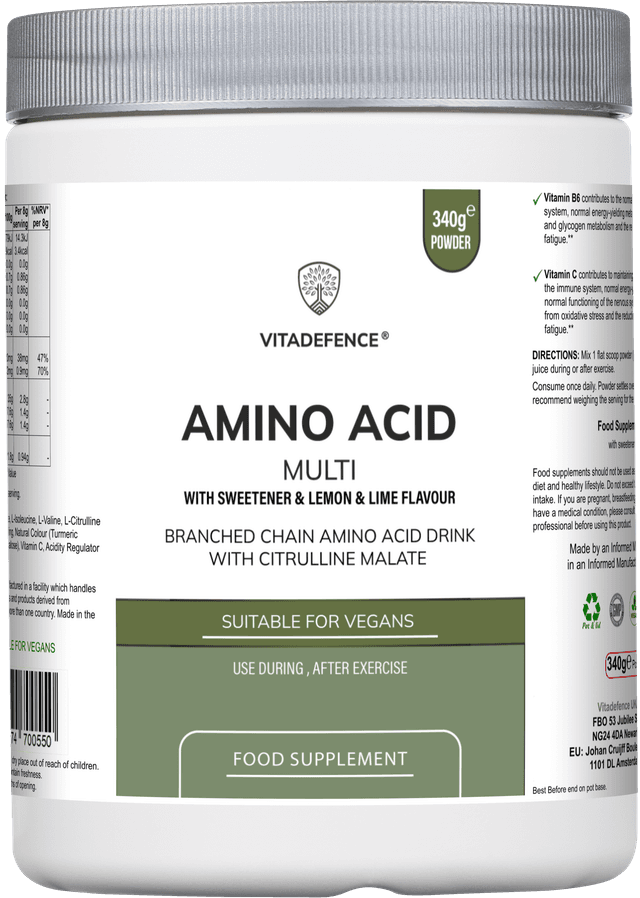
Inside every muscle in your body sits the same trio of amino acids: leucine, isoleucine, valine. Together they're called BCAAs. We blended a meaningful dose of all three with citrulline malate, vitamin C, and vitamin B6 — and made it taste like a cold lemonade on a summer afternoon.
Key facts
- When you've started training again and your body has noticed
- The pot, in your hand
- The three letters everyone in the gym knows
- Leucine — the most important of the three
- Isoleucine and valine — the supporting pair
When you've started training again and your body has noticed
Maybe it's a new gym membership in January. Maybe it's a doctor's nudge about your blood pressure. Maybe it's the ache that started appearing under your shoulder blade when you sit at the desk too long, and you decided to do something about it. Most adult journeys back to exercise begin not in glory but in inconvenience. Knees stiffer than you remember. The handful of muscle soreness that lasts three days instead of one. The honest realisation that the body you trained at twenty-two is not the body you live in now.
You don't need a complicated supplement stack to come back to fitness. You need water, sleep, food, and patience. But there is one specific tool that has earned its place in the pre-, intra-, and post-workout window for the last forty years of sports nutrition: a glass of dissolved amino acids. Not a meal replacement. Not a mass-gainer. Just the three small molecules your muscle uses most heavily, in a form your body can pull straight off the shelf.
This is that glass.
The pot, in your hand
A clean cream tub, the green band of our label running around it, three hundred grams of fine pale-yellow powder inside. The flavour is lemon and lime — sweet, sharp, summery. The dose is one flat scoop, eight grams, mixed into 250ml of water or juice during or after training. Forty-two servings per pot. The kind of thing that lives in a gym bag.
The three letters everyone in the gym knows
BCAA stands for branched-chain amino acid. The branching is a small structural quirk of the molecule — three of the twenty amino acids that make up every protein in your body share it: leucine, isoleucine, valine. These three are the most abundant amino acids in skeletal muscle by a significant margin, and they are essential, meaning your body cannot synthesise them — they must come from food.
In ordinary life, food covers the job. Eggs, chicken, fish, dairy, beans and legumes all carry meaningful BCAA loads. But around exercise — particularly resistance training, long runs, or hot training in a fasted state — the body uses BCAAs faster than a normal meal can deliver them. Sports nutrition figured out, in the 1980s and 1990s, that giving the body a free pool of BCAAs during the training window did something useful: it kept the working muscle fed with the exact molecules it was burning.
That's the entire logic of a BCAA drink. Not a magic bullet. Not a substitute for protein. A targeted top-up, taken in a window when targeting matters.
Leucine — the most important of the three
Of the three BCAAs, leucine is the headline. It is the single amino acid that most strongly signals the body to build muscle protein, through a pathway called mTOR. The food chemists figured this out in the early 2000s — that a single threshold dose of leucine, around two and a half to three grams, is what flips the switch on muscle protein synthesis.
You can hit that threshold with a chicken breast, three eggs, a whey shake, or a serving of this powder. We use 35 grams of leucine per 100g of powder — the highest by weight of the three — which means a single 8g serving carries roughly 2.8 grams of leucine. That's a meaningful dose, in the language modern sports nutrition speaks.
Isoleucine and valine — the supporting pair
Leucine without its two siblings is a half-formula. Isoleucine and valine each play their own quiet role: isoleucine in glucose uptake into the muscle cell, valine in the energy supply during long efforts. The traditional ratio in sports drinks has been 2:1:1 — leucine high, isoleucine and valine equal and lower. This bottle uses approximately that ratio: 35g leucine, 17.6g isoleucine, 17.6g valine per 100g.
Why the ratio matters: too much leucine alone, in a body short of the other two, can pull the others down. Keeping the trio together is how the muscle has met them in food for the entire history of the species.
Citrulline malate — the pump ingredient
Citrulline is an amino acid your body makes itself, but in modest amounts. It rose to prominence in sports nutrition through a route nobody planned: a French pharmaceutical product called Stimol, originally sold in the 1970s as a quiet daily tonic for fatigue, was found by gym-goers in the 1990s to produce a noticeable working-muscle pump. The active ingredient was citrulline malate.
The mechanism is reasonably understood: citrulline is converted by the kidneys into arginine, which is one step away from nitric oxide — a small molecule that helps blood vessels relax and widen. That widening is what people in the gym mean when they say pump. Bodybuilders chase it for cosmetic reasons. Endurance athletes use the same effect to deliver oxygen and nutrients to working muscle a little more efficiently.
We use 11.8 grams of citrulline malate per 100g — meaningful at the standard 8g serving, more meaningful if you double-scoop on a hard training day. The malate part — malic acid — is the same molecule that gives sour green apples their sharpness, and it's the source of much of the lemon-lime brightness in this powder.
Vitamin C — collagen, iron, and the connective tissue around the muscle
Most BCAA powders ignore vitamin C. We didn't. Around heavy training, the connective tissue holding your muscles together — tendons, ligaments, fascia — is doing as much work as the muscle itself. Vitamin C is essential for collagen formation, the protein that builds that connective tissue. Vitamin C also assists in iron absorption, which matters more for endurance athletes than they often realise.
We use 470mg of vitamin C per 100g of powder — meaning each 8g scoop carries roughly 38mg. Not a megadose. A training-window dose, layered alongside the amino acids in the same drink so the body meets them together.
Vitamin B6 — the metabolic workhorse
Vitamin B6 — pyridoxine — sits at the centre of amino-acid metabolism. The chemistry textbook is clear: most of the enzymes that handle amino acids in the body need B6 as a cofactor. If you're loading the body with amino acids, you may as well include the small B-vitamin that helps it process them.
We use 12mg of vitamin B6 per 100g of powder — meaning each scoop carries about 1mg, or roughly 70% of the European reference intake. Vitamin B6 contributes to normal protein and glycogen metabolism, and to the reduction of tiredness and fatigue. That's the language the food authority has agreed it earns.
A note on sweetener and flavour
We sweeten this powder with sucralose, a non-caloric sweetener that has been on the European-approved list for over twenty years. The natural colour comes from turmeric extract — the same yellow that brightens curry, here giving the drink its sunny lemon-lime appearance. The acidity is citric acid, the same molecule that makes a fresh lemon a lemon. The flavour itself is plant-derived, blended to taste of cold lemonade with a sour-lime finish.
We don't use artificial colours. The yellow you see in the glass is real turmeric.
The formula as a whole
A clean training drink, in five parts: leucine to flip the muscle-protein-synthesis switch, isoleucine and valine to keep the trio in proper ratio, citrulline malate for the pump-and-circulation effect that has made it the most widely used pre-workout amino since the 1990s, vitamin C for the connective tissue around the muscle, vitamin B6 for the chemistry that handles all of it. Forty-two servings per pot. Eight grams per serving.
We didn't put creatine in this. We didn't put caffeine in this. We didn't put four warming spices and a stim-blend in this. If you want those, we have them in other bottles. This one stays in its lane: the amino-acid-and-citrulline lane, as classical sports nutrition built it.
How to use it
Mix one flat scoop — eight grams — into 250ml of water or juice. Drink during or after training. Once a day on training days. Powder settles in the pot over time, so we recommend weighing the serving rather than scooping if you want the most accurate dose.
For longer or harder sessions — a long run, a heavy leg day, hot weather — two scoops in 500ml is reasonable. Don't take it on top of a separate citrulline supplement; you'll get enough here.
If you train fasted in the morning, drink it before you start. If you train in the evening, drink it during the session. Either is fine. The window is generous — an hour either side of training is the active zone.
Honest caveats
This is a food supplement — it complements a varied diet, doesn't replace one. It is not a meal-replacement and should not be used as one. If you are pregnant, breastfeeding, taking medication, or living with a medical condition, talk to your GP or pharmacist first. Keep it cool, dry, sealed, out of reach of children.
The pot is made for serious training. If you're walking the dog and stretching twice a week, you don't need it. A balanced meal and a glass of water are doing the job. This is for the days you're training hard enough that the body has noticed.
If you've read this far, thank you. We tried to write the kind of page we'd want to read before spending money — no neon promises, no overblown language. Just three amino acids, one classical pump ingredient, two vitamins, and a glass of cold lemon-lime water on a hard training day.
— Vitadefence
— Vitadefence