Showcase
Creatine Monohydrate — the most studied molecule in the gym, on its own
Creatine is the white powder you'll find in the kit bag of nearly every serious lifter, sprinter and rugby pro on earth. It's also one of the most studied compounds in human nutrition, with several hundred trials behind it. We sell it the way it actually wins — pure, unflavoured monohydrate, 5g a serving, 100 servings to a tub. No fillers. No flavour. No fuss.
Key facts
- When you've decided to be honest about getting stronger
- The pot, in your hand
- The story of creatine
- The form: monohydrate
- The dose
When you've decided to be honest about getting stronger
You've watched the videos, read the threads, talked to the friend who actually trains. The conclusion is always the same. Of every supplement on the shelf — every shaker tub and powder and gummy and pill — only one has the kind of evidence that ends arguments. It's the cheapest of them, by a long way. It's the one nobody bothers to flavour. It works for almost everyone, by a small but real margin, and it works on the lift you're already doing.
Creatine monohydrate is a slightly boring answer to a glamorous question. We sell it the way the people who actually use it buy it — pure, unflavoured, in a 500g tub at the bottom of the kit bag, dosed by the gram, mixed in water.
The pot, in your hand
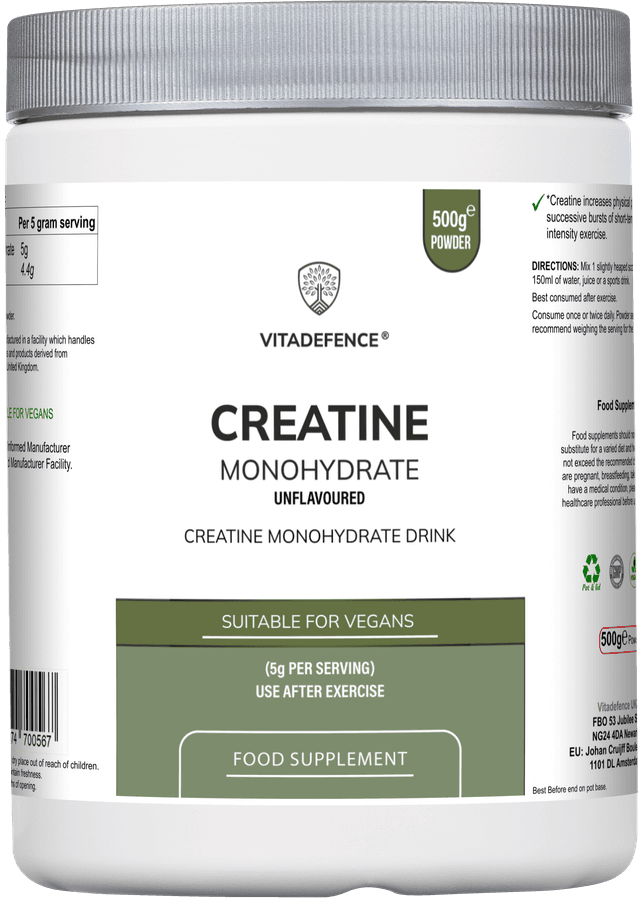
A cream pot, the green band running around it. Five hundred grams of fine white powder inside. One hundred servings, at 5g each. A small scoop tucked under the lid; a pair of kitchen scales is more accurate, because powder settles. The taste is essentially nothing — a faint mineral note in cold water, gone in two sips with juice.
That's it. One ingredient, one job.
The story of creatine
Creatine is an amino-acid derivative your body makes itself, every day, in the liver and kidneys, from glycine, arginine and methionine. About 95% of the creatine in you sits in skeletal muscle, where it's stored in a phosphorylated form — phosphocreatine — and used as a tiny rapid-deploy battery. When a muscle fibre needs to fire hard for a few seconds, it doesn't have time to wait for slow aerobic metabolism. It pulls phosphate off phosphocreatine and re-charges its ADP back into ATP. Five seconds of all-out effort comes out of that battery.
The compound was first isolated in 1832 by a French chemist, Eugène Chevreul, who pulled it from beef broth and named it after the Greek kreas — flesh. It was a curiosity for a hundred and fifty years. Then in the early 1990s a small group of researchers — a sports scientist in Sweden, a pharmacist in the UK — started giving it to athletes in measurable doses, and the floor of weight-room performance moved.
What they found, and what hundreds of trials since have confirmed, is that supplementing creatine raises the intramuscular phosphocreatine pool by roughly 15–20% in most people. The effect on output is small — typically a 5–15% improvement in maximal short-duration efforts — but it is reliable, dose-dependent, and shows up across age groups, training levels, and a long list of sports.
You can get creatine from food: red meat, herring, salmon. A 250g steak contains about 1g. To match a 5g supplemental serving from food alone you'd be eating around 1.25kg of beef a day, which is a different conversation entirely.
The form: monohydrate
There are at least eight forms of creatine on the market — ethyl ester, hydrochloride, buffered, magnesium-chelated, liquid, and so on. Each has been marketed as superior in some way: faster absorption, less bloat, no loading phase, lower dose required.
The literature is unequivocal: monohydrate is at least as good as every other form, costs a fraction, and has the longest safety record. Every meta-analysis and every position stand from the International Society of Sports Nutrition lands in the same place. Buy monohydrate. Save your money.
We sell monohydrate. The grade is "Informed" — manufactured in a facility certified to test against the WADA banned substances list, which matters if you compete in a tested sport. That's the only "premium" claim we make about the powder. It's high-purity, single-ingredient, no flow agents, no flavour.
The dose
The standard daily dose is 5 grams. That's one slightly heaped scoop with the included spoon, or — more accurately — 5g weighed on kitchen scales.
You can "load" — 20g a day in four 5g doses for the first 5–7 days — to fill the muscle creatine pool faster, then drop to 5g/day to maintain. Or you can simply take 5g a day from the start, which fills the same pool over three to four weeks. Both end up at the same place. Loading is a choice about how quickly you want the effect, not whether you want it.
Best taken after training, in water or juice or a sports drink — the small carbohydrate spike from juice slightly improves uptake into muscle. Most people take it once daily; some take it twice on training days. None of these decisions are load-bearing. The total weekly grams is what counts.
What it actually does
We're not in the business of overpromising. Three things, well-supported across the literature, in plain words:
More reps before failure on heavy short sets. A 5x5 squat at 85% becomes a 5x5 at 87.5% within a few weeks for many people. Small numbers; real numbers.
Slightly more lean mass. Creatine pulls water into the muscle cell. The first few weeks of supplementation typically add 1–2kg of body weight, mostly intracellular water. Over months, the additional training stimulus permitted by the slightly higher output tends to translate into a small extra gain in actual lean tissue.
Faster recovery between hard sets. Phosphocreatine is the battery. A bigger battery refills the next rep more completely.
What it doesn't do: turn anyone into someone they're not. Creatine is a margin, not a transformation. The transformation is the training.
Beyond the gym
There's a second story here, and it deserves a paragraph because it's not just about lifters. Brain tissue uses phosphocreatine the same way muscle does — as a rapid energy buffer. A growing body of work suggests creatine supplementation may support cognitive performance under conditions of metabolic stress: sleep deprivation, mental fatigue, the high cognitive load of an exam week. The effect sizes are small and the trials are smaller, but the mechanism is biologically sensible. Some older adults take it for the same reason — the brain is a creatine-hungry organ.
We don't lead on this because the evidence is younger than the muscle evidence. But it's there, and it's worth a sentence.
The formula as a whole
There isn't one. That's the point. Creatine monohydrate is a single-ingredient powder. No stimulants, no proprietary blends, no "matrix", no "complex". One white powder, weighed and stirred into water, taken every day, for as long as you train.
If you want creatine in a stack with whey, BCAAs, electrolytes and a vitamin premix, we make that too — Creatine Multi. This pot is for the people who'd rather build their own stack and want one ingredient at a time.
How to use it
5g per day. Mix one scoop or 5g weighed into 150–200ml of water, juice or a sports drink. Stir; it dissolves over a couple of minutes. Drink it. Do this every day, training day or not.
Take it post-training on training days. Take it whenever you remember on rest days. Skipping a day is fine — the muscle pool empties slowly, over weeks. The habit of drinking 5g of plain powder in water is the only adherence challenge with creatine, and it's a small one.
If after three months of consistent training and consistent dosing you genuinely cannot tell the difference on the bar, stop. We'd rather have your trust for the next thing than your money for the wrong thing.
Honest caveats
This is a food supplement — it complements a varied diet, doesn't replace one. Creatine has one of the longest safety records in sports nutrition; the historical concerns about kidney function in healthy adults have not held up in the literature. If you have existing kidney disease, talk to your GP before supplementing. If you are pregnant or breastfeeding, the same. Drink water — creatine pulls fluid into muscle, and dehydration is the only avoidable side effect. Keep the pot cool, dry and sealed. Manufactured to UK GMP standards in an Informed-Manufacturer facility.
If you've read this far, thank you. We tried to write the kind of page we'd want to read before buying a 500g tub of plain white powder — no neon promises, no marketing matrix. Just the most studied molecule in the gym, the cheapest one on the shelf, the one that actually does what the videos say it does.
— Vitadefence
— Vitadefence