Showcase
Digestive Enzyme Multi
A turmeric-led digestive blend with apple cider vinegar, fennel, peppermint, ginger and a six-enzyme spectrum — built for the meal that sits a little heavier than it should.
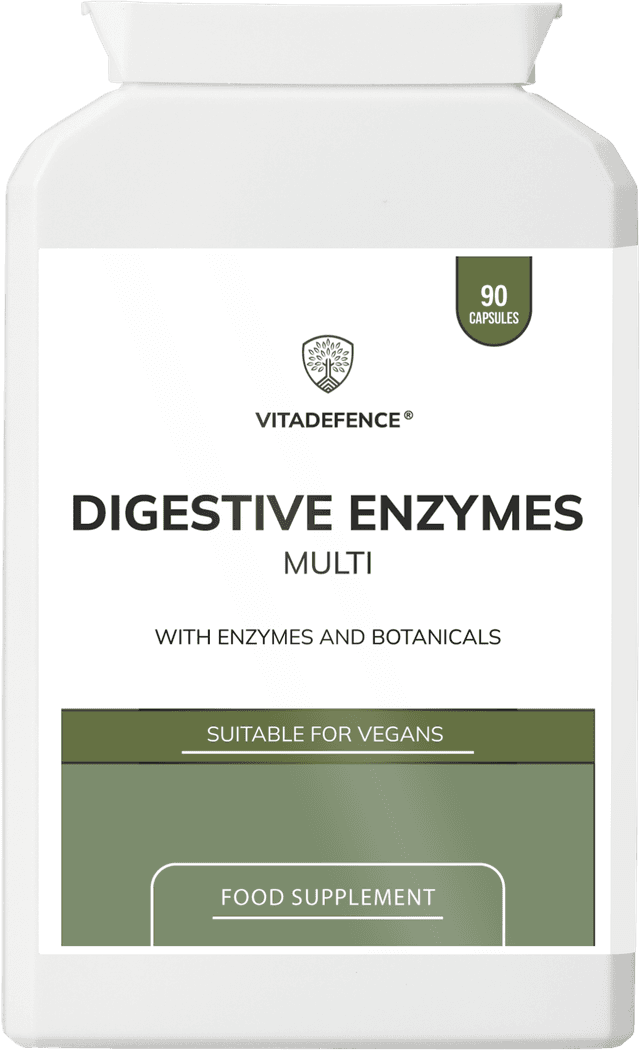
The meal that sits a little heavier than it should — and what a careful blend of plants and enzymes can do about it.
You know the feeling. The plate was good. Maybe a little richer than usual, maybe a little later in the evening, maybe just a little more than your stomach was ready for. An hour later you're on the sofa, slightly bloated, slightly sluggish, slightly regretting the second helping. Not unwell. Just heavy.
For most of human history this was a problem you'd have solved with a small bitter tea after dinner — a little fennel, a little peppermint, a sliver of fresh ginger root in hot water. The cup was tradition before it was science. Across the Mediterranean it was an amaro. Across India it was a pinch of fennel seed chewed straight after a meal. Across Europe it was the chamomile tisane your grandmother put in front of you when you were small.
This bottle is, in plain terms, that tradition concentrated into a capsule — with the addition of a six-enzyme blend that does some of the work your own pancreas does, on the days when your pancreas would rather not.
The bottle, in your hand
A clean cream pot, the green band of our label running around it like a forest line. Ninety vegan capsules inside. The dose is flexible — one or two with each main meal, or a higher loading dose if you've been struggling for a few weeks and want to reset. Best before date on the base. Halal-approved. Vegan-friendly. UK-blended to GMP standards.
Plants like these don't shout. They get to work in the background. Most people who notice a difference notice it within the first few meals — the heaviness fades a little earlier, the bloating that used to last until bedtime tapers off by the time the kettle goes on.
Turmeric — the golden root that started in a curry pot
We start with turmeric because turmeric is the spine of this formula — 421mg of root extract per capsule, standardised to deliver 20mg of curcuminoids, the deep yellow pigments that give the spice its colour and its character.
Turmeric (Curcuma longa) has been a kitchen ingredient and a medicinal one for at least four thousand years across South Asia. In Sanskrit Ayurvedic texts it appears as haridra — the yellow one — used in everything from skin pastes to digestive tonics. In a Tamil household it goes into the tadka of nearly every dal. In a Punjabi kitchen it goes into the milk you give to a child with a sore throat. The root itself looks like a small ginger — knobbly, fibrous, brilliant orange when you cut it.
What makes turmeric quietly extraordinary is its curcuminoid content. These are polyphenols — plant compounds that have been studied for decades for the way they interact with the body's own balancing systems. We use a standardised extract because raw turmeric powder, while wonderful in a curry, varies wildly in active content. Standardising means every capsule does what the last one did.
Apple cider vinegar — the kitchen acid the Romans drank
Apple cider vinegar is one of those ingredients that has been quietly reinvented in every century. The Romans called it posca and gave it to their soldiers diluted with water as a daily field drink. Hippocrates wrote about it. Mediaeval monks brewed it in cellars beneath their orchards. Every culture that grew apples eventually fermented some of them into vinegar, and every culture that fermented vinegar eventually used it for the gut.
We use 30mg of apple cider vinegar powder per capsule — a small inclusion, deliberately so. The acid helps create the gentle stomach environment that food was meant to be met by. Most modern stomachs, particularly past forty, are a little less acidic than they used to be. A small dose of vinegar with a meal is the oldest digestive nudge in the book.
Betaine hydrochloride — the same idea, sharpened
Right next to the apple cider vinegar sits betaine hydrochloride at 145mg per capsule — providing 110mg of betaine. This is the modern, more direct version of the vinegar idea: it gently supports the stomach's own acid-producing machinery during the meal. The two work together — vinegar as the warm-up, betaine HCl as the main act.
(One honest note: this is also why we say don't take this product if you have an active peptic ulcer. If your stomach is already inflamed, the last thing it wants is more acid in the room. Talk to your GP first.)
Fennel, peppermint, chamomile, caraway — the after-dinner garden
Open any traditional European herbal — French, Italian, German, English — and you'll find the same four plants showing up again and again in the chapter on digestion after eating. Fennel seed. Peppermint leaf. Chamomile flower. Caraway seed.
Fennel (Foeniculum vulgare) is the seed you're handed in a small dish at the end of a meal in every Indian restaurant. The Roman cookbook Apicius lists it. Charlemagne ordered it grown in every monastery garden in his empire.
Peppermint (Mentha × piperita) is the leaf the British make tea from when something feels wrong with the stomach — the menthol gives that small cooling sensation that loosens the chest and the gut alike.
Chamomile (Matricaria chamomilla) is the flower of bedtime — the small white-and-yellow daisy of every European kitchen garden, brewed for centuries against unsettled stomachs and the kind of tightness that keeps you awake.
Caraway (Carum carvi) is the seed in good rye bread, in Hungarian goulash, in Tunisian harissa — and, separately, in every European herbalist's drawer for centuries.
We've put all four into this formula at 20mg of each per capsule. None of them are doing the heavy lifting. All four together are doing the after-dinner-tea job in capsule form.
Ginger — the root that travels well
Ginger root extract sits at 20mg per capsule — small, but worth its place. Zingiber officinale is the rhizome that travelled out of Southeast Asia along the spice routes and quietly anchored itself in every traditional medicine cabinet on the planet. It is the cup of ginger tea you make when you feel a little queasy. It is the slice of pickled ginger between bites of sashimi. It is the syrup our grandmothers gave us before a long car journey.
Modern research has paid particular attention to ginger and the way it sits with an unsettled stomach. We use it here as the quiet partner to peppermint — both of them anchoring the settle end of the formula.
Alfalfa — the green note
50mg of alfalfa leaf rounds out the herbal side. Alfalfa (Medicago sativa) is one of the world's oldest cultivated plants — the Persians grew it as horse fodder, the Greeks brought it to Europe, and herbalists have used the leaf for centuries as a gentle, mineral-rich green note in digestive blends. It earns its place because every formula like this benefits from a small amount of plain green leaf — chlorophyll, trace minerals, the whole-food signature.
The six-enzyme blend — the modern half of the formula
Now we leave the herbal garden and enter the laboratory. Five of the ingredients in this bottle are digestive enzymes — small proteins that break down specific kinds of food into smaller pieces your body can absorb. They are exactly the same kinds of enzymes your pancreas makes itself; the formulation simply gives your meal a little extra help.
Amylase (45mg, providing 2,250 SKB) — breaks starches into sugars. The enzyme that handles bread, pasta, rice, potato.
Protease 4.5 (10.8mg, providing 540 HUT) and Protease (4.78mg) and Protease 3 (0.03mg) — the three proteases break proteins into smaller peptides. The enzymes that handle meat, fish, eggs, beans.
Lipase (6.6mg, providing 330 Units) — breaks fats. The enzyme for the rich, buttery, oily parts of a meal.
Bromelain (3mg, providing 6 GDU) — a protease originally extracted from pineapple. Latin Americans have known for centuries that pineapple eaten after meat tenderises it. Bromelain is the reason.
Papain (0.15mg, providing 0.3 USP units) — the same idea, this time from papaya. South Asian cooks have wrapped tough meat in papaya leaf for the same effect since long before anyone had a word for the molecule responsible.
We chose this six-enzyme spectrum deliberately. A starch-only enzyme would only help the bread side of dinner. A protein-only enzyme would only help the meat side. A real meal contains all three — starches, proteins, fats — and a real digestive blend should cover all three.
How to use it
For most people, one or two capsules with each main meal is the right starting place — taken just before you eat, or with the first bite. Drink water alongside.
If you're going through a stretch where everything feels heavy — perhaps after a long course of antibiotics, or a stressful month, or a stretch of restaurant meals you'd rather not have eaten — a higher loading dose can help: two or three capsules before breakfast, lunch and dinner for three to four weeks, then drop back to the maintenance dose.
If you take any other digestive supplement (a separate enzyme product, a separate betaine HCl, a stand-alone probiotic) — don't stack them on top of this one without spacing. More is rarely more in the gut. One thoughtful blend is usually plenty.
Honest caveats
This is a food supplement — it complements a varied diet, doesn't replace one, and it doesn't replace the advice of a healthcare professional. Don't take this product if you have an active peptic ulcer — the formula is designed to gently support stomach acid, and an inflamed stomach lining doesn't need that. If you are pregnant, breastfeeding, on medication, or living with a medical condition, talk to your GP or pharmacist first.
Keep it cool, dry, sealed, out of reach of children. Best before date is on the base.
If you've read this far, thank you. Plants and enzymes don't replace cooking well, eating slowly, or getting to bed at a reasonable hour. They do help, on the nights when the meal sat a little heavier than it should — which, for most of us in this century, is more nights than we'd like to admit.
— Vitadefence
— Vitadefence