Showcase
Live Cultures Max
Twenty billion live organisms per capsule, eight strains, one month at intensive strength. The bottle for the gut reset, the antibiotic recovery, the long-haul travel rebuild. The big sister to our daily Live Cultures Multi.
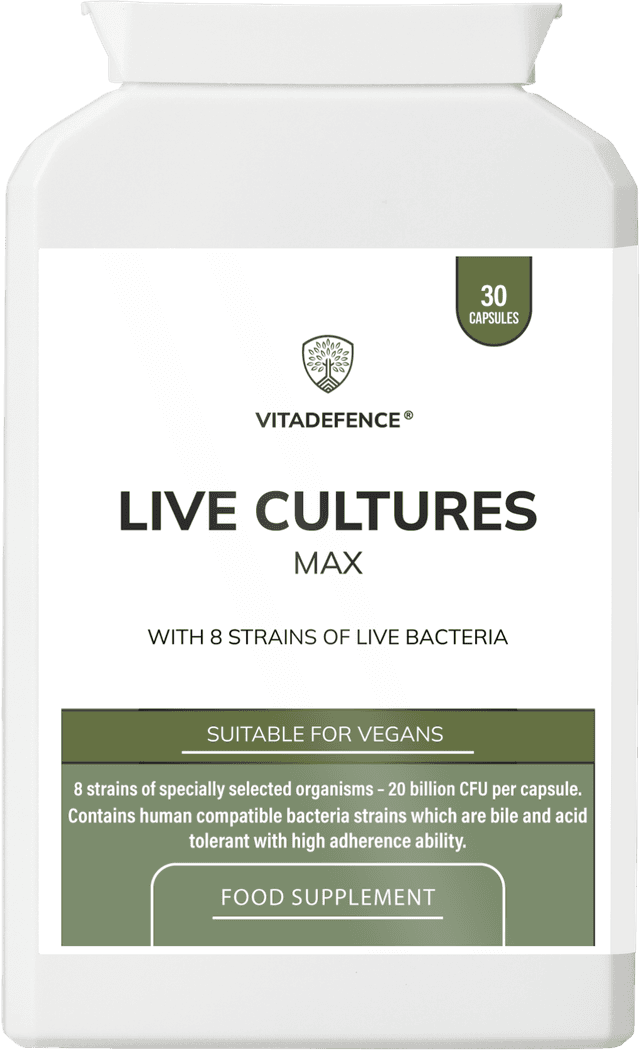
The intensive month. Twenty billion organisms, eight strains, one capsule a day.
When the gut needs more than maintenance
Most of the time, your gut runs itself. The thirty-eight trillion bacteria, archaea, fungi, and viruses that share the inside of your digestive tract — collectively, the microbiome — have been there since you were born and will be there when you go. They digest fibre your own enzymes can't break down. They train your immune system. They make a small but real contribution to vitamins K and several Bs. They keep the gut lining in good repair. Most days, the system holds itself in balance without you ever thinking about it.
Then come the days that knock it sideways. A course of antibiotics, taken for a chest infection or a dental abscess, that wipes out billions of friendly bacteria along with the target. A long-haul flight followed by a week of foreign water and unfamiliar food. A bout of gastroenteritis. A stretch of travel through Asia or Latin America. A dietary blowout — Christmas, a wedding fortnight, a holiday all-inclusive. A period of extreme stress that diverts blood away from digestion. A round of chemotherapy or steroid treatment. A surgery and the days of antibiotic prophylaxis around it.
Any one of these can leave the microbial population thinned, lopsided, and slow to come back. The gut feels it: looser stools, gassier afternoons, brain fog, food that used to sit easily now sitting awkwardly, an immune system that picks up the next bug going round.
This bottle is for those times. Twenty billion live organisms per capsule, eight strains, taken daily for a month — a deliberate, intensive recolonisation, not a daily maintenance dose. Our daily-maintenance bottle is the four-billion CFU Live Cultures Multi, sitting alongside this one in our range. They are siblings. This is the bigger one.
The bottle, in your hand
A clean cream pot, the green band of our label running around it. Thirty plant-fibre capsules inside — a one-month course at one capsule a day, or a two-week intensive at two capsules a day if a clinician has set you a higher dose. The capsules are HPMC — hydroxypropyl methylcellulose, a plant-derived shell — so the bottle is suitable for vegans, vegetarians, and any kosher or halal kitchen.
Inside each capsule, twenty billion freeze-dried, viable organisms held in brown rice flour. The rice flour is not filler — it is a humble, dry medium that keeps the bacteria stable on the shelf, away from moisture, in suspended animation until the capsule meets stomach acid and water. The first sip of water you take after the capsule is what wakes them up.
No refrigeration needed. The freeze-drying and the moisture-control sachet inside the bottle keep the organisms viable at room temperature.
What "twenty billion CFU" actually means
CFU stands for colony-forming unit — the standard way of counting living, reproducing bacteria in a probiotic. It isn't a marketing number. The figure on this bottle is what arrives in the capsule at the time of manufacture, with a margin built in to allow for the natural decline that happens between bottling and best-before date.
Twenty billion is a meaningful dose. For context, a tablespoon of fresh live yoghurt typically contains a few hundred million live organisms — perhaps half a billion on a generous day. A serving of kefir runs a little higher. A daily-maintenance probiotic capsule of the kind we sell as Live Cultures Multi delivers four billion CFU, which is sufficient for healthy gut maintenance and the kind of dose backed by the broadest body of research.
Twenty billion is what the literature on antibiotic recovery, traveller's gut, and post-illness recolonisation tends to use. It is the dose for the month when your microbiome has had a knock and you want to give it real reinforcements rather than a holding gift.
When the course is finished — typically thirty days at one a day — most people step down to the daily-maintenance bottle. We do not recommend taking twenty billion CFU every day for the rest of your life. The gut likes a base level of variety and a steady supply, not a constant flood. This is the intensive bottle for the intensive months.
The eight strains, briefly
Eight strains across two genera — Lactobacillus and Bifidobacterium — chosen because they are, between them, among the most extensively studied probiotic strains in the world.
Lactobacillus rhamnosus. A small-intestine specialist and the single most-studied probiotic strain in human research. Tolerates travel and antibiotic disruption better than most.
Lactobacillus casei. A versatile fermenter found in cultured dairy. Helps establish the foothold for less tough strains alongside it.
Lactobacillus acidophilus. The original household-name probiotic, in yoghurt cultures since the 1920s. A producer of lactic acid that helps lower the local pH against less friendly organisms.
Bifidobacterium infantis. A colon resident, valued for its work on the gut barrier and on short-chain fatty acid production in the lower bowel.
Streptococcus thermophilus. The yoghurt-making partner of Lactobacillus bulgaricus. A transient — passes through rather than settling — but useful in helping break down lactose for those who tolerate dairy poorly.
Bifidobacterium breve and Bifidobacterium longum. Two colon-dwelling Bifidobacteria, both abundant in the healthy adult lower gut. Workhorses of fibre fermentation.
Lactobacillus bulgaricus. Named after Bulgaria, where Stamen Grigorov first isolated it from local yoghurt in 1905. Pairs with S. thermophilus in classical yoghurt fermentation.
You don't need to remember the names. What matters is that this is a wide profile rather than a single hero strain — a small ecosystem in capsule form, designed to give the gut multiple kinds of reinforcement at once.
A short history of probiotic thinking
The idea that bacteria in food might be good for you is older than the word probiotic. The Russian biologist Élie Metchnikoff, working at the Pasteur Institute in the early 1900s, noticed that the long-lived peasant communities of the Caucasus and the Bulgarian highlands were heavy consumers of fermented dairy. He hypothesised that the lactic-acid bacteria in their daily yoghurt were displacing less helpful organisms in the gut. He won the 1908 Nobel Prize in Medicine, partly for that gut hypothesis.
It was only in the 2000s, when DNA sequencing made it possible to read the entire microbial population of a stool sample, that the modern field of microbiome research really took off. What that field has shown — across many independent studies — is that the gut is a living ecosystem, that disturbances to it (antibiotics, infections, dietary shocks, chronic stress) leave measurable footprints, and that targeted reintroduction of friendly strains can help the system find its feet again. The strains we use are the ones with the longest paper trail behind them — workhorses, not novel boutique strains.
How to use it
One capsule a day, before a meal, with a glass of water — the empty stomach lets the capsule pass through to the small intestine quickly without lingering in stomach acid. Most people take theirs in the morning before breakfast.
If you are recovering from a course of antibiotics, start the day after the antibiotic course finishes — taking probiotics during the antibiotic itself reduces the dose that survives the blast. If you are using this bottle for travel, start it three days before the flight, continue throughout the trip, and finish the bottle at home.
For an intensive reset — particularly after a serious gut upset, a hospitalisation, or a long stretch of poor eating — some people take two capsules a day, split morning and evening, for the first two weeks, then drop to one a day for the second two weeks. The bottle holds thirty capsules; that pattern uses it in just under three weeks. Don't exceed three capsules a day.
When the course is done, step down to a daily-maintenance probiotic — our Live Cultures Multi at four billion CFU is the natural successor — or go back to a fibre-rich, fermented-food diet and trust the gut to hold itself there.
How to look after the bottle
Keep it in a cool, dry place, out of direct sunlight. The kitchen cupboard is fine. The bathroom is not — too much humidity. The car glove box on a hot summer day is the worst spot in the house.
The small sachet inside the bottle is a moisture absorber. Leave it in until the bottle is empty. Don't eat it.
Honest caveats
This is a food supplement, not a medicine. If you are immunocompromised, on chemotherapy, or in a critical-care setting, talk to your specialist before taking any live bacterial supplement — there are situations in which probiotics are not appropriate, and a clinician needs to make the call. If you are pregnant, breastfeeding, or living with a chronic gut condition like inflammatory bowel disease, talk to your GP first.
If you have not taken probiotics before, the first three or four days can sometimes bring slightly more wind or a single looser stool as the new organisms find their place — this is short-lived and normal, but if it persists past a week, stop and reassess.
If you read this far, thank you. We tried to write the kind of page we'd want to read — no neon promises. Just a bigger sister to our daily probiotic, an intensive month, and a small living crew of well-studied organisms ready to work.
— Vitadefence
Related articles

— Vitadefence