Showcase
Saccharomyces Multi — the friendly yeast, not a bacterium
A single-strain probiotic yeast — Saccharomyces boulardii — paired with olive leaf, vitamin D3, biotin and bamboo silica. The quieter member of the probiotic family.
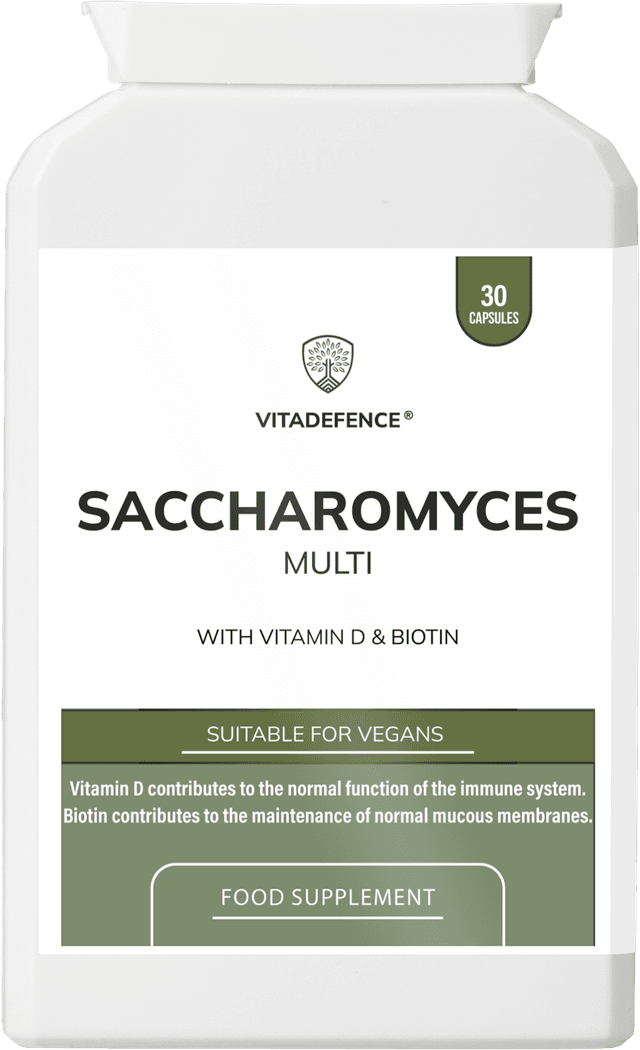
The friendly yeast, not a bacterium.
When the usual probiotic advice doesn't quite fit
Most of what you read about probiotics is about bacteria. Lactobacillus this, Bifidobacterium that, multi-strain blends in cold-chain pots. But there is another quiet citizen in the gut-health story — a friendly yeast — and it sits at a slightly different table.
You might be reading this because you've just finished a course of antibiotics and your stomach is cross with you. Maybe you're packing for a trip somewhere where the water doesn't always agree with everyone. Maybe a doctor or a pharmacist mentioned S. boulardii and you went home and looked it up and ended up here.
This little 30-capsule pot is built around a single yeast strain — Saccharomyces boulardii — paired with olive leaf, a bit of vitamin D3, biotin, and bamboo silica. It is not a replacement for the bacterial probiotic you might already be taking. It sits alongside it.
The pot, in your hand
A small white pot, thirty vegan capsules inside, the seal closed snugly with a tiny food-grade desiccant sachet to keep moisture out. The dose is gentle — one capsule, one to three times a day, before meals — taken with water. The whole pot lasts ten days at the higher dose, a month at the gentlest.
It does not need refrigeration. S. boulardii is unusually stable at room temperature compared with the bacterial probiotics in your fridge — one of the quiet practical advantages of the strain. You can take this pot in your suitcase to a hot country without it losing potency.
The story of Saccharomyces boulardii
In 1923, a French microbiologist called Henri Boulard was working in Indochina during a cholera outbreak. He noticed that local people who chewed the skins of lychee and mangosteen fruit seemed to weather their bouts of acute diarrhoea more comfortably than those who didn't. He cultured what was on the skins and isolated a single yeast — a relative of brewer's yeast and baker's yeast, but distinct, with a temperature preference of 37°C (body temperature) rather than 30°C (kitchen temperature).
He named it after himself.
For most of the twentieth century, S. boulardii sat in a small French pharmaceutical niche, prescribed for traveller's tummy and post-antibiotic upset across the Mediterranean. By the 1990s the rest of the world had caught up: Germany, Spain, Italy, Latin America, parts of Asia all carry it on pharmacy shelves under one trade name or another.
What makes this yeast different from a bacterial probiotic is that it is not bacteria. Antibiotics — which are designed to kill bacteria — don't kill it. That single biological fact is why people take it during and after a course of antibiotics: the bacterial probiotic in the fridge is being knocked out at the same time as the infection, but the yeast capsule is sailing through unaffected, holding a temporary corner of the gut while the bacterial cultures re-establish themselves.
It also doesn't take up permanent residence. S. boulardii is a transient — it passes through over the course of a few days after you stop taking it, leaving the gut to its own bacterial communities. That transient quality is, again, a feature rather than a bug. It is a guest, not a resident.
We use 5 billion CFU (colony-forming units) per capsule. That sits in the middle of the dosing range used in published research — high enough to be meaningful, low enough that one to three capsules a day fits a sensible daily window.
Olive leaf — a Mediterranean co-traveller
If the headline of this pot is the yeast, the closest companion is the olive. Olive leaf has been used in Mediterranean folk medicine since at least the time of the Pharaohs — the ancient Egyptians wrapped mummies in olive leaves, and the leaf shows up in Crete, Cyprus, and across the Levantine coast as a fevers-and-stomach plant for two thousand years.
The active fraction modern chemistry has paid most attention to is a bitter compound called oleuropein — the same compound that gives olive oil its peppery back-of-throat finish. We use 200mg of olive leaf extract standardised to 2.00mg of oleuropein per capsule.
Olive leaf earned its place here for the same reason it earned its place in Mediterranean kitchens: it is a quietly sturdy plant whose tradition runs alongside the modern story rather than competing with it.
The pairing of yeast and olive leaf is not random. The Mediterranean coast where S. boulardii was first refined into pharmacy form is the same coast where olive leaf tea has been brewed for stomach upsets for centuries. We are not claiming a clinical synergy. We are noting a geographical one — two ingredients that grew up in the same kitchen, kept the same company for a long time, and earn a daily seat together for that reason alone.
Vitamin D3 — the small dose that joins the conversation
Vitamin D3 is in this pot at a modest 2.50µg (100 IU, 50% NRV) per capsule. It is not the headline. It is here because vitamin D is one of the very few nutrients with EFSA-authorised wording for normal function of the immune system, and because British adults — particularly those of us who don't see much sun between October and March — tend to run lower than is comfortable.
If you are already taking a higher-strength D3 supplement, this small dose simply adds to it. If you are not, it is a soft daily contribution rather than a corrective one. Take with a meal that contains some fat — D3 is fat-soluble, so a piece of toast with butter, a meal with olive oil, or a fatty breakfast all help absorption.
Biotin and bamboo silica — the trace partners
Biotin (vitamin B7) sits at 8µg per capsule (16% NRV). It contributes to the maintenance of normal hair, skin, and mucous membranes — including the mucous membrane that lines the digestive tract from the mouth to the colon. Its presence here is small but thematically appropriate.
Bamboo silica, at 10mg per capsule, is a plant-derived source of silicon, a trace mineral that is part of connective tissue. It is here as a quiet seat-of-table ingredient — a tradition more than a strong claim — and rounds out the formula without overcrowding it.
How to use it
One capsule, one to three times a day, before meals, with water. Take with the first meal of the day if you are using it as a daily one-capsule habit. Take with each main meal if you are working through a more intensive ten-day course (for example, alongside antibiotics or while travelling).
If you are taking antibiotics, S. boulardii can be taken at the same time as the antibiotic — it is unaffected by the drug. You don't need to space it apart the way you would with a bacterial probiotic. Continue for a week or two after the antibiotic course finishes to bridge the gap while bacterial cultures re-establish.
If you are travelling, start two or three days before departure and continue throughout the trip and a few days after. The pot fits in hand luggage and tolerates the cabin temperature without complaint.
If after a fortnight nothing in your gut has changed, stop. Like most things in this cupboard, S. boulardii either earns its place quickly or doesn't earn it at all.
Honest caveats
This is a food supplement and not a medicine. It complements a varied diet, it doesn't replace one, and it does not replace medical care. If your stomach trouble is severe, persistent, bloody, or accompanied by fever or weight loss, that is a GP visit, not a capsule.
If you are immunocompromised — chemotherapy, organ transplant, HIV, severe immune deficiency — speak to your specialist before taking any live yeast supplement. Cases of S. boulardii fungaemia have been reported, very rarely, in patients with central venous catheters or severely weakened immunity. The risk in healthy adults is essentially zero, but for the small group above it is not, and that group should take medical advice first.
If you have a known yeast allergy, this is not the supplement for you — try a bacterial probiotic instead.
This pot is not a treatment. We don't claim it does. We are saying, as plainly as we can: this is a quiet daily addition that thousands of people across Europe have used since the 1950s for the kinds of mild, common gut situations that come with travel, antibiotics, or a temporarily out-of-sync digestion. It complements a balanced lifestyle.
Keep it cool, dry, sealed, out of reach of children.
— Vitadefence
Related articles
— Vitadefence