Showcase
Live Cultures Multi
Four billion live organisms per capsule, eight strains, one capsule a day. The everyday probiotic — for the steady kitchen, the ordinary diet, the long quiet maintenance of a healthy gut.
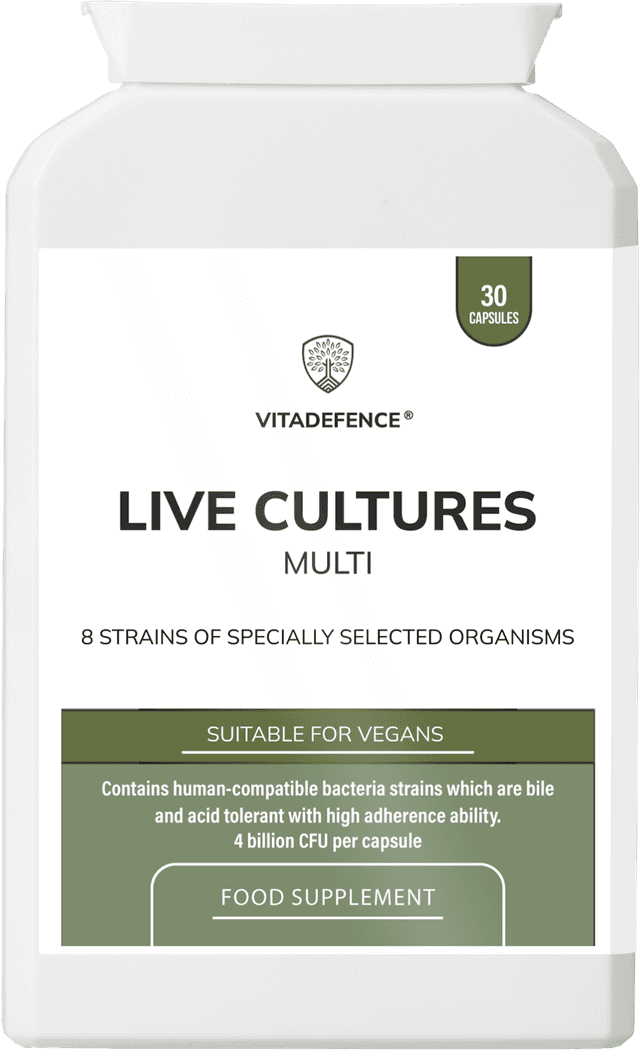
The everyday probiotic. Four billion organisms, eight strains, one capsule a day.
The slow daily work of a healthy gut
Most of what your gut does, it does quietly. Thirty-eight trillion microorganisms — bacteria, archaea, fungi, the occasional virus — share the inside of your digestive tract, and on most ordinary days they hold themselves in a steady balance you don't have to think about. They digest the fibre your own enzymes can't break down. They make small amounts of vitamins K and several Bs. They train your immune system in the lymph tissue of the gut wall, the largest concentration of immune cells anywhere in the body. They keep the lining of the bowel in good repair.
This balance is not robust. It tilts under daily pressures most of us recognise. A stretch of poor sleep. A week of takeaway dinners and not enough fibre. The five-day stress of a deadline. A period of lower exercise. A fortnight of too much alcohol. A repeating diet that has narrowed to the same six vegetables on rotation. None of these is dramatic. None is an antibiotic course or a stomach bug. But all of them, accumulated over months, can leave the microbial population a little thinner, a little less diverse, and a little less able to do its quiet daily work.
The gut feels it. Not in a way that a doctor would write down. Just in a slight bloating after meals that didn't used to bloat you, a little less regularity than there was at twenty-five, a touch more weather around the way food sits.
This little bottle is for that ordinary daily life. Not the intensive month after antibiotics — that's our Live Cultures Max bottle, sitting alongside this one in our range. This is the everyday version. Four billion live organisms per capsule, eight strains, one capsule a day, taken on quiet repeat for as long as the kitchen cupboard holds it.
The bottle, in your hand
A clean cream pot, the green band of our label running around it. Thirty plant-fibre capsules inside — a one-month supply at one capsule a day. The capsules are HPMC — hydroxypropyl methylcellulose, a plant-derived shell — so the bottle is suitable for vegans, vegetarians, and any kosher or halal kitchen.
Inside each capsule, four billion freeze-dried, viable organisms held in brown rice flour. The rice flour is not filler — it is a humble, dry carrier that keeps the bacteria stable on the shelf, in suspended animation, until the capsule meets the warm wet environment of the small intestine. The first sip of water you take after the capsule is what wakes them up.
No refrigeration needed. The freeze-drying and the moisture-control sachet inside the bottle keep the organisms viable at room temperature.
Why four billion, not twenty
The strength of a probiotic is not a contest. More CFU is not automatically better — there is a point above which the gut simply doesn't have room for new arrivals to settle, and the surplus passes through.
Four billion CFU is the dose the broadest body of consumer-research evidence sits around for daily-maintenance probiotics — enough to make a real contribution to a healthy adult microbiome on a daily basis, not so much that it overwhelms the existing ecosystem. The kind of number that makes sense as a steady drip, week after week, the way you might top up a garden bird-feeder.
Twenty billion is for the intensive month — antibiotic recovery, post-illness reset, foreign-water travel rebuild. Four billion is for the rest of the year. If you have just finished a course of our high-strength bottle, this is the natural step-down. If you are starting probiotics for the first time without any particular crisis to address, this is the right starting dose.
The eight strains, briefly
Eight strains across two genera — Lactobacillus and Bifidobacterium — chosen because they are, between them, among the most extensively studied probiotic strains in the world.
Lactobacillus rhamnosus. A small-intestine specialist. The single most-studied probiotic strain in human research.
Lactobacillus casei. A versatile fermenter found in cultured dairy. Helps establish the foothold for less tough strains alongside it.
Lactobacillus acidophilus. The original household-name probiotic, in yoghurt cultures since the 1920s. A producer of lactic acid that helps lower local pH.
Bifidobacterium infantis. A colon resident, valued for its work on the gut barrier and on short-chain fatty acid production.
Streptococcus thermophilus. The yoghurt-making partner of Lactobacillus bulgaricus. A transient, useful in helping break down lactose for those who tolerate dairy poorly.
Bifidobacterium breve and Bifidobacterium longum. Two colon-dwelling Bifidobacteria, both abundant in the healthy adult lower gut, both workhorses of fibre fermentation.
Lactobacillus bulgaricus. Named after Bulgaria, where Stamen Grigorov first isolated it from local yoghurt in 1905. Pairs with S. thermophilus in classical yoghurt fermentation.
You don't need to remember the names. What matters is that this is a wide profile rather than a single specialist — a small ecosystem in capsule form, designed to give the gut multiple kinds of gentle reinforcement at once.
What probiotics earn their place doing
The ordinary, unromantic role of a daily probiotic is to keep the microbial population a little wider than it would otherwise be, a little better fed, a little more resilient when one of those small daily pressures lands.
The friendly bacteria here do four broad kinds of useful work. They produce lactic acid and short-chain fatty acids — gentle fuel for the bowel lining and a contributor to local pH that keeps less helpful organisms in check. They occupy real estate on the gut wall. They engage with the gut-associated lymphoid tissue — the dense layer of immune cells lining the intestine — in a daily quiet conversation about friend and foe. And they help with certain fibre digestions and food-compound metabolism, particularly lactose for adults whose tolerance has slipped.
A short history
The idea that bacteria in food might be good for you predates the word probiotic by a century. The Russian biologist Élie Metchnikoff, working at the Pasteur Institute in the early 1900s, noticed that the long-lived peasant communities of the Caucasus and the Bulgarian highlands were heavy consumers of fermented dairy. He hypothesised that the lactic-acid bacteria in their daily yoghurt were displacing less helpful organisms in the gut.
It was only in the 2000s, when DNA sequencing made it possible to read the entire microbial population of a stool sample, that the modern field of microbiome research really took off. The strains we use are the workhorses with the longest paper trail — not novel boutique strains, not single-species hero shots, but the small ecosystem that keeps showing up in human research.
How to use it
One capsule a day, before a meal, with a glass of water. The empty stomach lets the capsule pass through to the small intestine quickly without lingering in stomach acid. Most people take theirs in the morning before breakfast — a habit that pairs naturally with whatever else is already part of the morning routine.
If you have been recommended a higher intake — perhaps you've just finished a course of antibiotics, or your GP has suggested a fortnight of higher-dose probiotic — you can take three or four capsules a day, split through the day with food, for two to four weeks. After that, drop to one or two a day for ongoing maintenance.
This bottle is designed for the long quiet repeat — month after month, year after year, the way you might take a multivitamin. The gut likes a steady drip more than it likes a sudden flood.
If you have been on a different probiotic, you can swap straight across — there is no taper needed.
How to look after the bottle
Keep it in a cool, dry place, out of direct sunlight. The kitchen cupboard is fine. The bathroom is not — too much humidity. The car glove box on a hot summer day is the worst spot in the house.
The small sachet inside the bottle is a moisture absorber. Leave it in until the bottle is empty. Don't eat it.
Honest caveats
This is a food supplement, not a medicine. If you are immunocompromised, on chemotherapy, or in a critical-care setting, talk to your specialist before taking any live bacterial supplement. If you are pregnant, breastfeeding, or living with a chronic gut condition like inflammatory bowel disease, talk to your GP first.
If you have not taken probiotics before, the first three or four days can sometimes bring slightly more wind or a single looser stool as the new organisms find their place. This is short-lived and normal, but if it persists past a week, stop and reassess.
Probiotics are not a substitute for a varied, fibre-rich diet. The gut feeds on plant fibre. The friendliest thing you can do for the bacteria in this capsule, after swallowing it, is to eat something they want for breakfast — oats, beans, lentils, fruit, fermented foods, vegetables of more than one colour. The capsule is the introduction. The diet is the ongoing relationship.
If you read this far, thank you. We tried to write the kind of page we'd want to read — no neon promises. Just a steady daily probiotic, eight well-studied strains, a clean cream bottle in the kitchen cupboard, and the quiet long-form work of looking after a microbiome over years rather than weeks.
— Vitadefence
— Vitadefence